A goldsmith of Mainz and the European integrator of printing (c. 1400–1468), who printed the 42-line Bible (c. 1455) with a metal-type system. He financed the work by borrowing from the merchant Johann Fust; losing a 1455 debt suit, his workshop and equipment passed to Fust, who continued the business with Peter Schöffer. Gutenberg himself ended in obscurity.
This highly worthy art was first invented at Mainz… and it was begun in the year of our Lord 1440.
—— The Cologne Chronicle (1499), among the earliest sources on Gutenberg
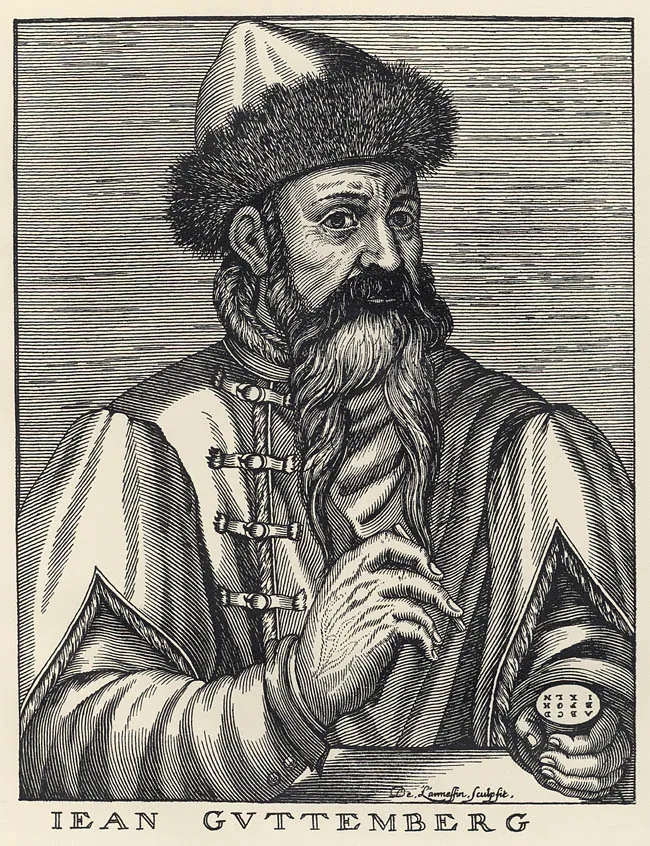
History
Firm sources on Gutenberg himself are surprisingly scarce. He was born around 1400 to a Mainz burgher family, lived for a time in Strasbourg working in metal and mirrors, and there seems already to have experimented with printing. Around 1450, back in Mainz, he borrowed heavily from the merchant Johann Fust, set up a workshop, and printed the 42-line Bible and other works. But in 1455 Fust sued him over the debt (recorded in the Helmasperger notarial instrument); Gutenberg lost, and his workshop, equipment, and unsold Bibles passed to Fust—who, with his able son-in-law Peter Schöffer, carried on the business, taking most of the fame and profit. Gutenberg ended his days poor, granted a nominal sinecure by the Archbishop of Mainz in 1465 to live on, and died in 1468; his renown was affirmed only decades later, by sources such as the Cologne Chronicle.
Connections
Consequences1
- The Gutenberg PresscontributedGutenberg integrated the metal-type system
Sources
- John Man, The Gutenberg Revolution
- Helmasperger Instrument (1455)
- Johannes Gutenberg
Open questionspartly uncertain
- His birth around 1400 is uncertain, but his death in 1468 is firmly established.
- The record of his lawsuit with Fust (the Helmasperger notarial instrument of 1455) is a primary source.
- Which technical details Gutenberg himself originated is disputed, because the sources are scarce.
Why it matters
Gutenberg's story has a sharp twist: the "inventor" of European printing scarcely profited from the world-changing technology. He lost first the lawsuit, then the credit (the earliest printed books mostly do not bear his name). This teaches two things. First, "who invented printing" is far more tangled than textbooks say: metal casting, ink, and the press each had their own origins, and Gutenberg's achievement was integration, not creation from nothing. Second, the history of a technology is never the biography of its inventor: what made printing "revolutionary" was the social conditions it met, not one man's genius.