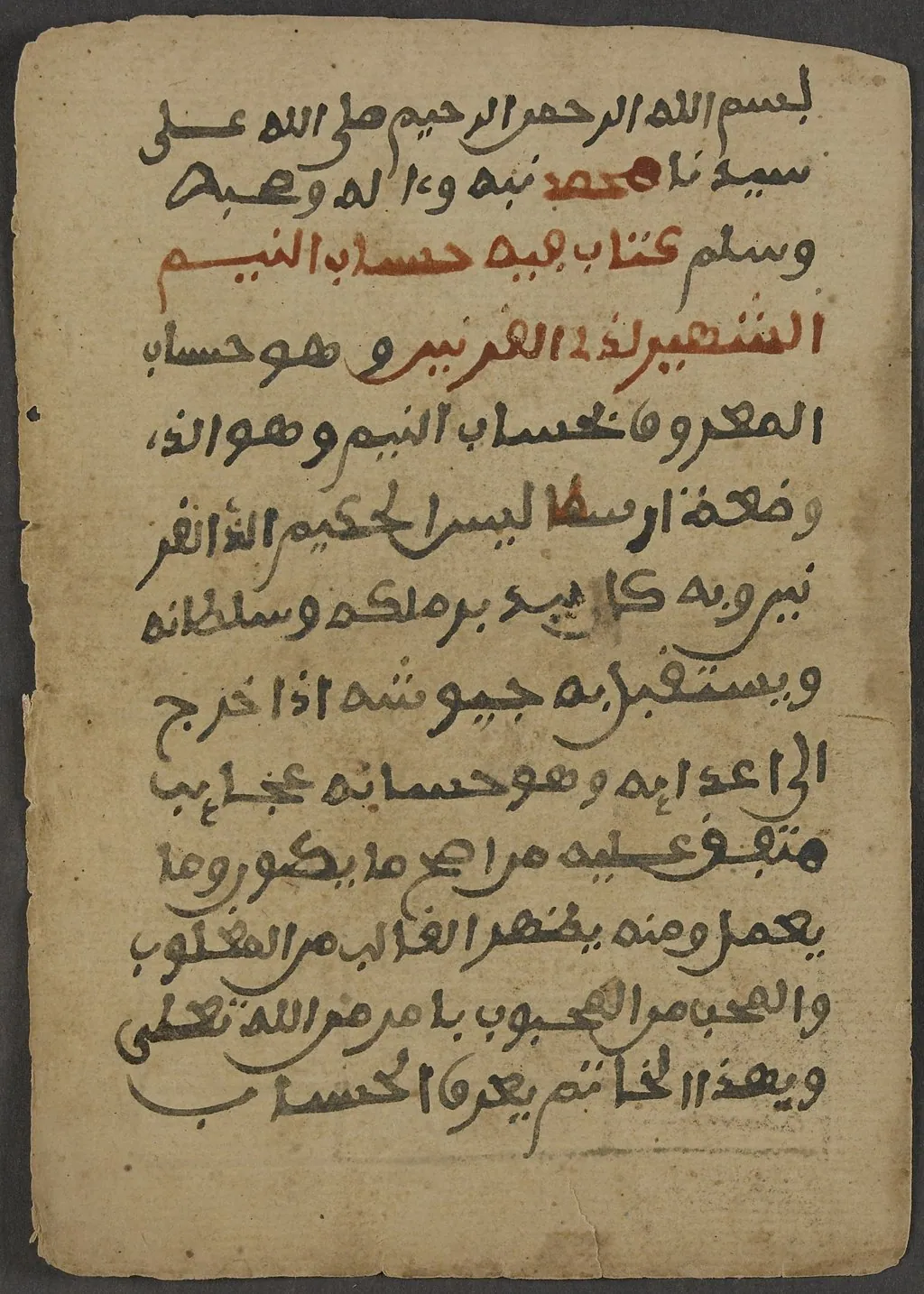
The flourishing corpus of scholarly manuscripts and library tradition at Timbuktu in Mali, West Africa, c. 13th–16th centuries. A hub of the Saharan trade routes and of mosque-colleges such as Sankore, it produced and copied works in Arabic (and Ajami) on astronomy, mathematics, law, medicine, and poetry; tens of thousands survive in family libraries. It is material proof of a literate, scientific tradition in sub-Saharan Africa; many manuscripts were rescued and smuggled out during the 2012 jihadist occupation.
Salt comes from the north, gold from the south, but the word of God and the treasures of wisdom come from Timbuktu.
—— West African proverb (c. 16th c., traditional)
History
Timbuktu stands on the southern edge of the Sahara at the bend of the Niger. From the 13th century it grew rich on the trans-Saharan trade in salt, gold, and slaves, becoming a scholarly and religious center of the Mali and Songhai empires. Colleges centered on the Sankore mosque drew scholars from afar to teach Quranic science, law, logic, astronomy, mathematics, and medicine; savants such as Ahmad Baba wrote prolifically. The city copied in Arabic texts flowing from North Africa, Egypt, and al-Andalus, and also wrote in local languages set down in Arabic script (Ajami). Tens of thousands of manuscripts, held for generations in family and private libraries, survive to this day. In 2012, when jihadist fighters occupied Timbuktu and threatened to burn the manuscripts, local librarians and residents secretly moved some 350,000 volumes to Bamako at great risk, saving this memory.
Connections
Echoes3
- The House of WisdomechoesTwo centres of Islamic learning and manuscript collecting, comparable across time and place
- The Library of AlexandriaechoesThe Library of Alexandria and the Timbuktu manuscripts, gatherings of knowledge in different civilizations, invite comparison
- Great ZimbabweechoesTwo highly organized achievements of sub-Saharan Africa in the same centuries, one in stone and the gold trade, one in writing and manuscripts, both long denied or belittled by colonial scholarship
Sources
- Shamil Jeppie & Souleymane Bachir Diagne (eds.), The Meanings of Timbuktu
- Joshua Hammer, The Bad-Ass Librarians of Timbuktu
- Timbuktu Manuscripts
Open questionspartly uncertain
- It is agreed that Timbuktu was a centre of learning in West Africa and that its manuscripts number in the tens of thousands.
- The well-known proverb about Timbuktu is traditional, and its exact origin cannot be traced.
- Because the manuscripts are scattered in private collections, their total number and date range are only estimates.
Why it matters
The Timbuktu manuscripts matter historiographically because they refute, head-on, a prejudice once uttered with full pomp—Hegel's claim that Africa had "no history," Trevor-Roper's that African history was but "the unrewarding gyrations of barbarous tribes." Hundreds of thousands of manuscripts on astronomy, mathematics, and law, written by local hands, are the calmest and strongest rebuttal to such verdicts. This is a key case for anti-Whig history: civilization, literacy, and science were never any one continent's monopoly. Timbuktu stands with the Library of Alexandria, Nalanda, and the House of Wisdom among the great gathering-places of books and scholars. The 2012 rescue gives this legacy a further present-day weight: the survival of knowledge is never guaranteed, and often depends on specific people carrying it out, volume by volume, through danger.