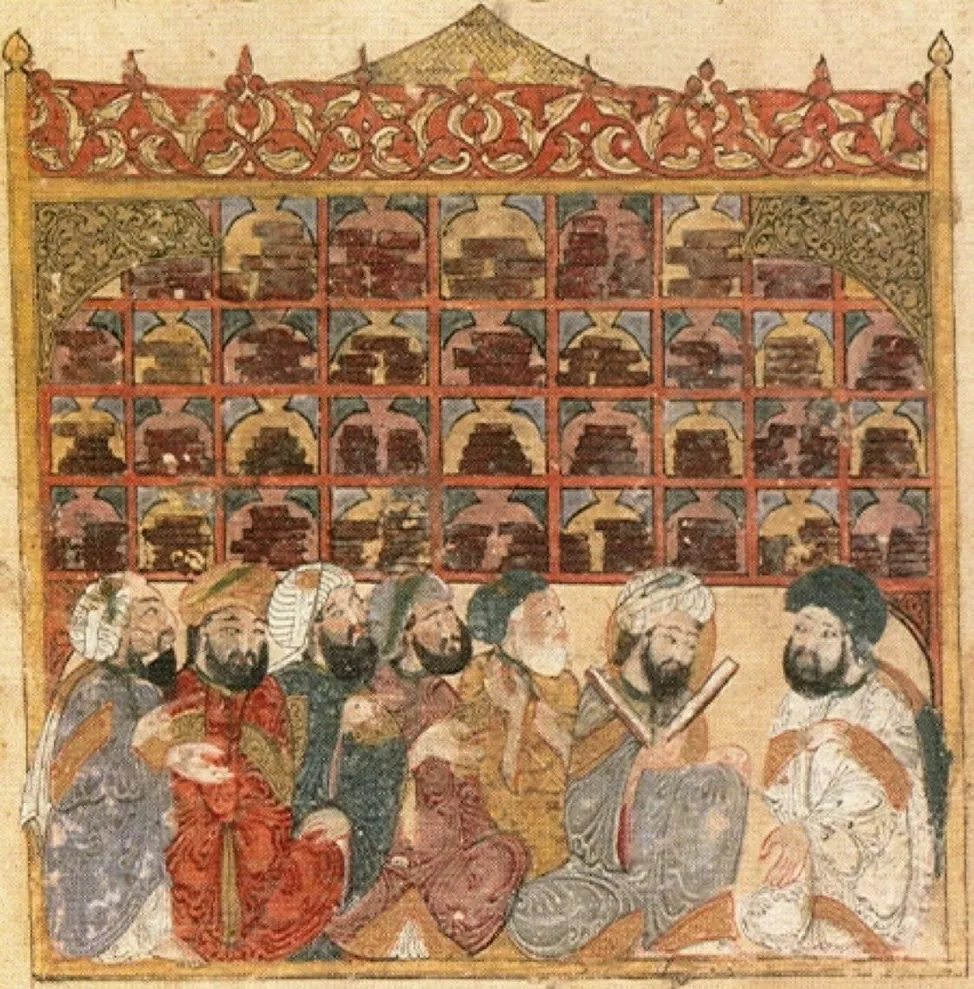
The scholarly–translation center of Abbasid Baghdad (flourishing especially under caliph al-Ma'mun, 813–833), a hub of the Greco-Arabic translation movement: rendering Greek, Persian, and Indian science into Arabic and advancing mathematics, astronomy, and medicine in its own right. al-Khwārizmī belonged to its circle. Its exact nature "as an institution" is debated. It perished in the Mongol sack of Baghdad in 1258, its books said to have been thrown into the Tigris.
That fondness for science by which God has distinguished the Imam al-Ma'mun… has encouraged me to compose a short work on calculating by al-jabr and al-muqābala.
—— al-Khwārizmī, dedication of the Algebra to al-Ma'mun (c. 820; trans. Rosen)
History
From the late 8th into the 9th century the Abbasid caliphate, capital at Baghdad, sponsored a translation movement of unprecedented scale under its caliphs, above all al-Ma'mun (r. 813–833). Scholars rendered Ptolemy's astronomy, Euclid's geometry, Galen's medicine, and Aristotle's philosophy, together with Persian and Indian star-tables and numerals, systematically into Arabic; the name "House of Wisdom" (Bayt al-Ḥikma) is often used for this center of collection, translation, and research. It was no mere warehouse "preserving" the classical inheritance: al-Khwārizmī founded algebra and algorism here, Hunayn ibn Ishaq translated the medical canon with precision, and astronomers checked Ptolemy and measured the Earth. It fused the knowledge of three civilizations and passed it east and west. In 1258 Hülegü's Mongol army stormed Baghdad; the city fell, and legend says the Tigris ran black for days with the ink of books thrown in.
Connections
Causes4
- al-KhwārizmīcontributedAl-Khwarizmi was a core scholar of the House of Wisdom
- Euclid's ElementsinspiresAl-Hajjaj translated the Elements into Arabic twice
- The Ptolemaic SysteminspiresThe Almagest was repeatedly translated in Baghdad; its very name comes from Arabic
- al-Ma'munpatronizedThe House of Wisdom flourished under his patronage
Consequences4
- Hindu–Arabic NumeralsenablesThe House of Wisdom's translation-research movement was the hub of the numerals' westward passage
- Heliocentrisminforms · disputedIslamic astronomy (the Maragha-school models) fed Copernicus (the degree is debated)
- AlgebraenablesAlgebra was founded within its scholarly circle
- Optics (Ibn al-Haytham)enablesThe translation movement's corpus of Greek optics supplied both the premise and the target of his critique
Echoes3
- The Timbuktu ManuscriptsechoesTwo centres of Islamic learning and manuscript collecting, comparable across time and place
- NalandaechoesNalanda and the House of Wisdom, centres of learning in different civilizations, invite comparison
- The Library of AlexandriaechoesThe Library of Alexandria and the House of Wisdom, centres for gathering and translating knowledge in different eras, invite comparison
Sources
- Dimitri Gutas, Greek Thought, Arabic Culture
- Jim Al-Khalili, The House of Wisdom
- House of Wisdom
Open questionspartly uncertain
- The Baghdad translation movement and al-Ma'mun's patronage of it are well established.
- Scholars disagree on whether the "House of Wisdom" was a formal academy or a collective name for a library and translation activity; Gutas takes a cautious view.
- The throwing of books into the river in 1258 is a traditional story whose numbers and details are exaggerated.
Why it matters
What the House of Wisdom most needs to correct is a still-popular Whig prejudice: that classical learning "slept in Europe for a thousand years until the Renaissance woke it." In fact the inheritance never slept: it was translated into Arabic in Baghdad, annotated, and advanced, then flowed back to Latin Europe through the translation centers of al-Andalus and Sicily. Without this link there would have been no later "Renaissance." The House of Wisdom invites comparison with the Library of Alexandria, Nalanda, and the Timbuktu manuscripts: different civilizations echoing one another in gathering, translating, and enlarging knowledge. Yet a measure of scholarly caution is due: recent work (e.g. Gutas) warns that the image of the "House of Wisdom" as a grand academy is partly a later romance—it was more likely a library and a body of translation activity than a chartered institution. Its end (1258), like Nalanda's, was another road cut by war and fire; mercifully, by then the knowledge had already spread beyond, and did not burn with the city.