A deflagrating mixture of saltpetre, sulphur, and charcoal. It began as an accident of Tang alchemy; its earliest written record is a warning in an alchemical text that sulphur, realgar and saltpetre heated together catch fire, burning hands and faces and even houses. The Wujing Zongyao (1044) preserves three military formulas, the oldest written gunpowder recipes extant anywhere; through Song and Yuan rockets, fire-lances, and hand cannon it was progressively weaponized, and its westward passage in the thirteenth century rewrote the fate of city walls and mounted knights.
Some have heated together sulphur, realgar, saltpetre and honey; smoke and flames result, so that their hands and faces have been burnt, and even the whole house burned down.
—— Zhenyuan Miaodao Yaolüe (attrib. Zheng Siyuan, c. 9th c.)
History
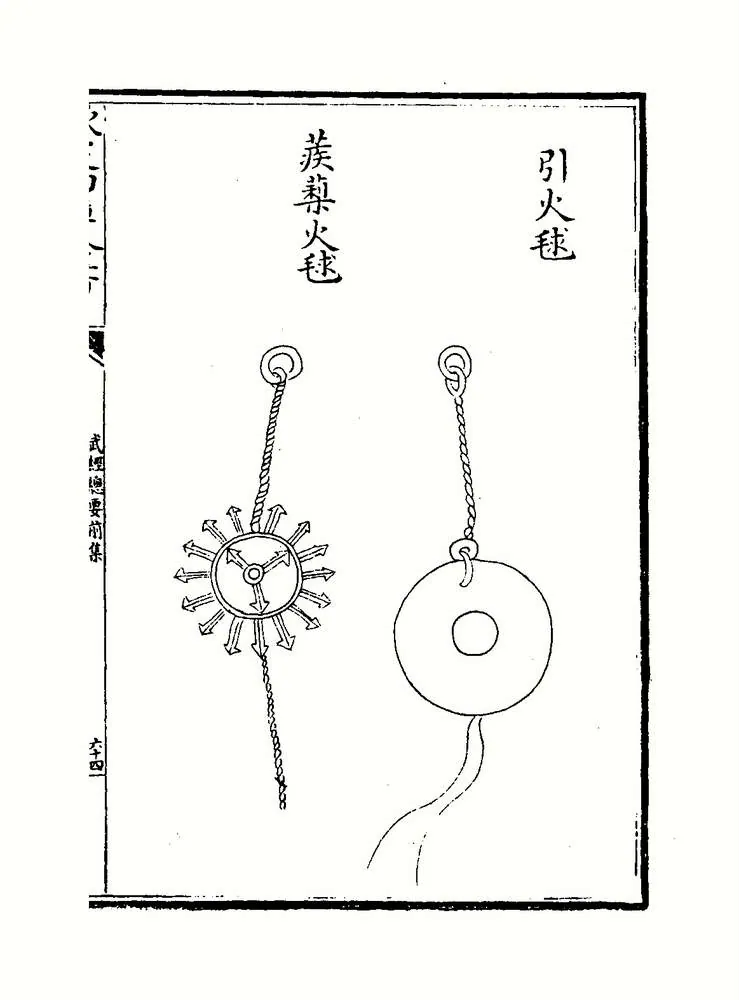
Gunpowder came out of the alchemist's furnace. Tang adepts seeking immortality repeatedly set their workshops alight while heating saltpetre, sulphur, and carbonaceous matter—hence the cautions preserved in alchemical texts such as the Zhenyuan Miaodao Yaolüe. The Wujing Zongyao, completed in 1044, records three formulas, the "poison-smoke ball," the "caltrop fire-ball," and the "fire cannon," with explicit proportions of nitrate, sulphur, and charcoal: the oldest written recipes extant. Their nitrate content is low, giving fierce burning rather than detonation, which suits the contemporary purpose of setting fires rather than breaching walls. Firearms then developed along two lines: incendiary and toxic smoke on one hand, tube-launched projectiles on the other. The Southern Song produced the fire-lance, a bamboo tube shooting pellets; the Yuan cast barrels in bronze and iron, attested by dated surviving pieces such as that of 1351. Around the mid-thirteenth century the knowledge reached the Islamic world and Europe along the routes opened by Mongol campaigns and trade; Europe was casting cannon by the fourteenth century and had corned powder by the fifteenth.
Connections
Consequences1
- Francis BaconinspiresOne of his three great inventions; he did not know that gunpowder and the compass came from China
Echoes1
- The CompassechoesTwo Song-era technologies that travelled west, with no causal link between them
Sources
- 李约瑟(Joseph Needham)等, 《中国科学技术史》第五卷第七分册·军事技术:火药的史诗
- 曾公亮、丁度等(1044), 《武经总要》
- Gunpowder
Open questionswell attested
- Warnings in 9th-century alchemical texts are the earliest written evidence, though their exact date is debated.
- The three formulas in the Wujing Zongyao (1044) are the earliest surviving written recipes; their saltpetre content is still low, so they burn rather than explode.
- The details of how gunpowder travelled west (with the Mongol campaigns or along trade routes) are disputed.
Why it matters
Gunpowder is often used as the showcase of "invented in China, perfected in the West," and thence as evidence about the character of civilizations. The story does not survive inspection. The Song–Yuan lineage of firearms is continuous and dense, running from fire-arrow to hand cannon without pause; Europe's difference lay not in greater ingenuity but in its setting—a landscape of castles, fragmented sovereignties, and sieges. Siege demand drove up bore and casting technique. Where a technology goes is decided by the form of war it lands in, not by the national endowments of its inventors. The other thing worth remembering is its parentage: experiments in pursuit of long life yielded a means of shortening it. This is not rhetorical irony but the ordinary condition of technical history, in which the road from purpose to consequence is seldom straight.