English lawyer, Lord Chancellor and philosopher whose Novum Organum (1620) called for rebuilding knowledge through observation, experiment and graduated induction, diagnosed four "idols" of the mind, and whose New Atlantis imagined a royal research foundation admired by the founders of the Royal Society.
... those three which were unknown to the ancients, and of which the origin, though recent, is obscure and inglorious; namely, printing, gunpowder, and the magnet. For these three have changed the whole face and state of things throughout the world ... insomuch that no empire, no sect, no star seems to have exerted greater power and influence in human affairs than these mechanical discoveries.
—— Francis Bacon, Novum Organum, Book I, aphorism 129 (London, 1620), trans. James Spedding, Robert Leslie Ellis and Douglas Denon Heath, Works, vol. IV (1858), p. 114
History
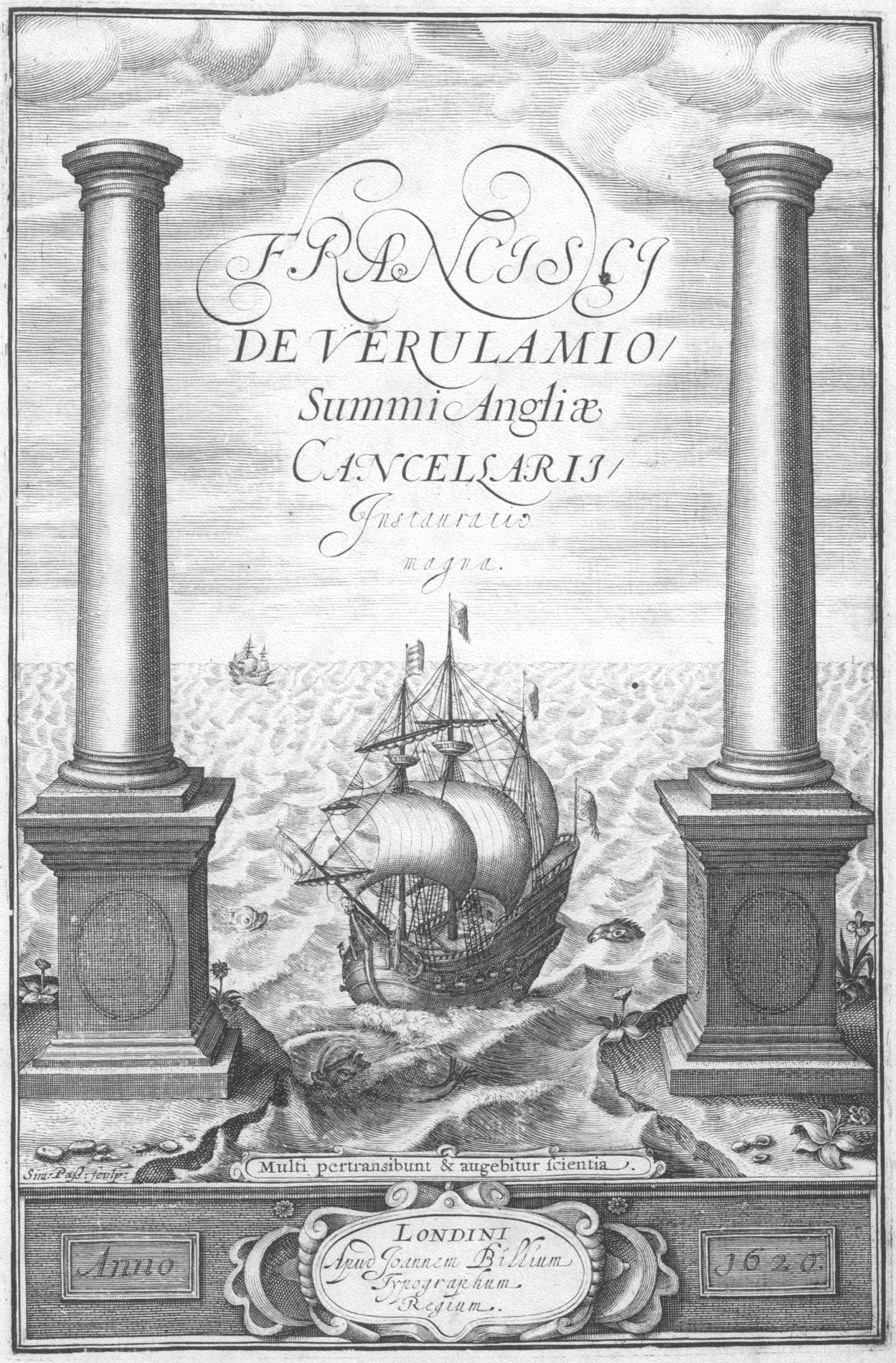
Bacon was born in London in 1561, trained in the law, sat in Parliament and rose under James I to Attorney General (1613), Lord Keeper (1617) and Lord Chancellor (1618). The Advancement of Learning (1605) surveyed the defects of existing knowledge. In 1620 he published the Instauratio Magna, whose centrepiece, the Novum Organum, was named against Aristotle's logical works, the Organon. Its aphorisms diagnose four "idols" that distort the mind (of the Tribe, the Cave, the Market-place and the Theatre) and prescribe a new procedure: tabulate instances of presence, absence and degree, then climb by stages to general axioms. Worked through on heat, the tables yield the conclusion that heat is an expansive, restrained motion among the small parts of bodies. The engraved title page shows a ship sailing out between the Pillars of Hercules over a motto from Daniel, "Many shall pass through, and knowledge shall be increased." In 1621 Parliament impeached him for taking bribes; he confessed, was fined £40,000, spent a few days in the Tower and never held office again. He died at Highgate in April 1626, by John Aubrey's account after catching a chill while stuffing a chicken with snow, a story hard to check. That year his secretary William Rawley published New Atlantis, whose Salomon's House employs thirty-six fellows in a strict division of labour, from Merchants of Light who gather foreign books to Interpreters of Nature who draw out axioms.
Connections
Causes4
- AristotleinspiresThe Novum Organum was named against Aristotle's Organon
- The Gutenberg PressinspiresBacon named printing, gunpowder and the magnet as the inventions that changed the face of the world
- GunpowderinspiresOne of his three great inventions; he did not know that gunpowder and the compass came from China
- The CompassinspiresOne of his three great inventions, the one he credited with transforming navigation
Consequences1
- The Scientific MethodcontributedThe Novum Organum (1620) called for rebuilding knowledge through induction and experiment
Sources
- James Spedding, Robert Leslie Ellis and Douglas Denon Heath (eds.), The Works of Francis Bacon, vol. IV (translations of the philosophical works, incl. Novum Organum) (1858)
- Paolo Rossi, Francis Bacon: From Magic to Science (1968)
- Lisa Jardine and Alan Stewart, Hostage to Fortune: The Troubled Life of Francis Bacon (1998)
- Perez Zagorin, Francis Bacon (1998)
Open questionswell attested
- The first edition of New Atlantis is dated to either 1626 or 1627.
- Aubrey's account of Bacon falling ill after an experiment with snow is second-hand.
- Scholars disagree about how far the Royal Society was influenced by Bacon.
- "Knowledge is power" is a later summary; the closest original wording is Novum Organum, Book I, Aphorism 3: "Human knowledge and human power meet in one".
- The printing Bacon referred to was European movable-type printing, and there is no evidence of any line of transmission between it and Chinese printing.
Why it matters
Bacon made no major discovery, and the great discoveries of his century were seldom made by his tables; he underrated mathematics, doubted the Earth's motion and scolded Gilbert for building a whole philosophy on the loadstone. His influence lay elsewhere. He described knowledge as a collective, cumulative enterprise, divided into tasks, learning from craftsmen and aimed at improving life, and the Royal Society, founded in 1660, took this as its programme; Thomas Sprat's History of the Royal Society (1667) singled him out as the one man who had "the true Imagination of the whole extent of this Enterprize". The slogan "knowledge is power" condenses a phrase in his Meditationes Sacrae (1597), "ipsa scientia potestas est", which in context concerns God's knowledge and power. His list of inventions shows an early sense that techniques can outweigh empires and creeds, though he did not know that gunpowder and the magnetic needle came from China, or that printing there long predated Gutenberg.