The printing system Gutenberg integrated at Mainz in the 1440s: mass-castable metal type (punch–matrix–hand mould), oil-based ink, and a screw press adapted from wine and paper presses. An alphabetic script needing only a few dozen sorts suited mass composition. Around 1455 it produced the 42-line Bible. It was the material engine of Europe's printing revolution.
…printed not by reed, stylus, or pen, but by the wondrous concord, proportion, and harmony of punches and types.
—— Colophon of the Catholicon, Mainz 1460 (generally attributed to Gutenberg's workshop)
History
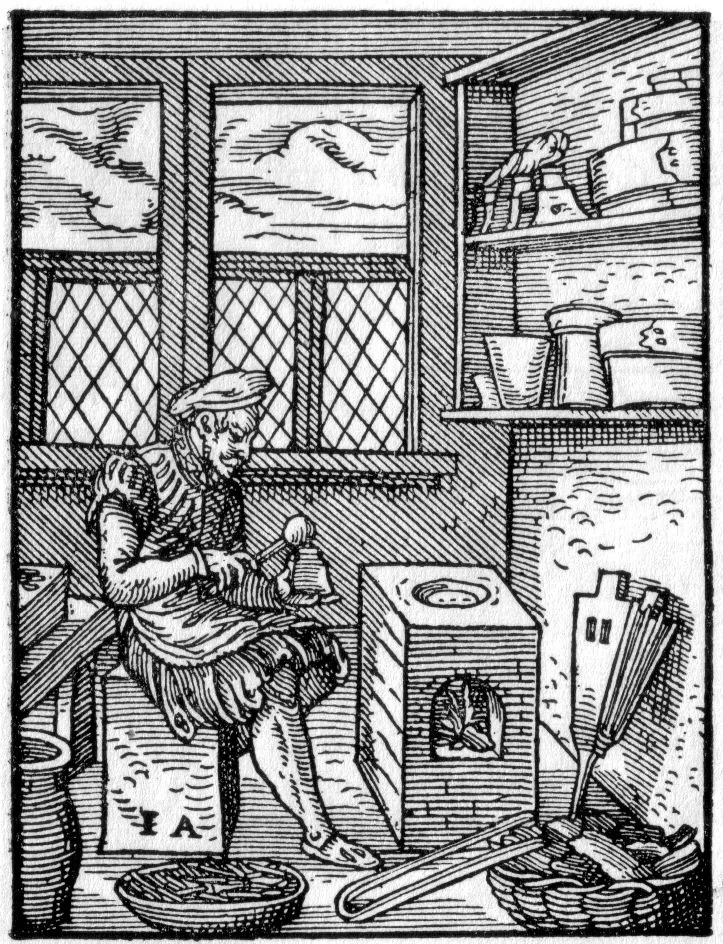
In the 1440s Johannes Gutenberg, a goldsmith of Mainz, assembled several existing techniques into a working system. At its core was the mass-casting of metal type: a steel punch struck a copper matrix, which was set in an adjustable hand mould and filled with a lead-tin-antimony alloy to reproduce thousands of letters quickly and uniformly. With oil-based ink suited to metal, and a screw press adapted from wine and paper presses, page after page could be pressed evenly onto paper. Unlike the clay and wooden type of East Asia, Europe's alphabetic script needed only a few dozen matrices and suited this logic of mass production. Around 1455 Gutenberg's workshop printed the famous 42-line Bible—as orderly as a scribe's hand, yet a machine's product.
Connections
Causes2
- Johannes GutenbergcontributedGutenberg integrated the metal-type system
- The Phoenician AlphabetappliesAn alphabet of a few dozen letters needs only a few matrices, which suited Gutenberg's type system to mass production
Consequences2
- The Printing RevolutionenablesThe material engine of the printing revolution
- Francis BaconinspiresBacon named printing, gunpowder and the magnet as the inventions that changed the face of the world
Sources
- John Man, The Gutenberg Revolution
- Febvre & Martin, L'apparition du livre
- Printing press
Open questionswell attested
- The date of the 42-line Bible (c. 1455) and the three key elements of metal type, ink and the screw press are confirmed.
- Scholars have debated whether the colophon of the Catholicon should be attributed to Gutenberg.
- The details of Gutenberg's own contribution to the hand mould for casting type are disputed.
Why it matters
The key to the Gutenberg press is often mistaken for the big press itself; the real innovation was the hand mould—a system of matrices that let one letter be reproduced endlessly and uniformly. A "revolutionary technology" is often not one astonishing invention but the deft integration of existing parts (metal casting, oil ink, screw press, matrices), its difficulty in the fit rather than any single point. Nor is the machine the same thing as the printing revolution: the machine supplied the condition, but the "revolution" belonged to the society it met (alphabet, paper, capital, competitive markets). Type under the same logic existed early in East Asia without a comparable upheaval.