The consonantal alphabet (abjad) of some 22 signs current in the Phoenician city-states by c. 1050 BCE, descended from the Proto-Sinaitic/Canaanite script (which adapted the forms of Egyptian hieroglyphs) and spread by Mediterranean maritime trade. It is the common ancestor of the Greek (which added vowels), Latin, and Aramaic–Arabic–Hebrew alphabets—the fountainhead of nearly all alphabetic writing. Its power: a small, learnable sign-set that freed literacy from a scribal caste.
These Phoenicians who came with Cadmus… introduced into Greece many kinds of learning, and above all letters, which the Greeks, it seems to me, did not have before.
—— Herodotus, Histories 5.58
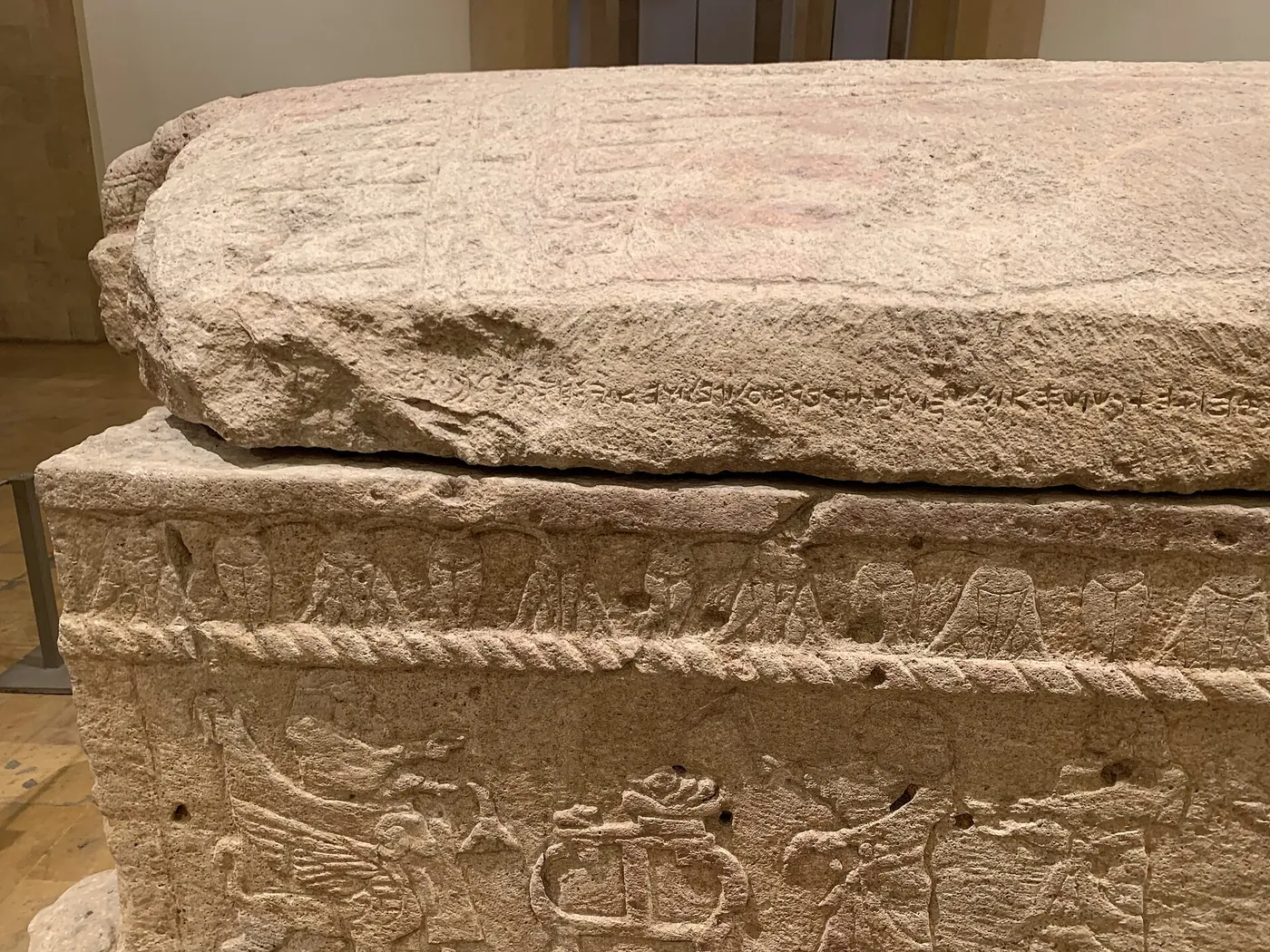
History
Cuneiform and hieroglyphs ran to hundreds or thousands of signs, mastered only by professional scribes. In the mid-2nd millennium BCE, Semitic workers in Egypt took the shapes of hieroglyphs and the first sound of the words they named to build a "Proto-Sinaitic/Canaanite" set of consonant signs—one sign, one consonant. The Phoenicians pared it to some 22 letters and carried it across the Mediterranean on the ships of Tyre and Sidon. The Greeks borrowed it around the 8th century BCE and took a decisive further step: assigning a few idle signs to vowels, they made a complete phonemic alphabet. From the Greek alphabet, by way of the Etruscans, came the Latin; the Aramaic alphabet descended directly from the Phoenician and was parent in turn of Arabic, Hebrew, and a line of Indic scripts. Almost every alphabetic script in the world today traces back to this Phoenician consonantal set.
Connections
Consequences1
- The Gutenberg PressappliesAn alphabet of a few dozen letters needs only a few matrices, which suited Gutenberg's type system to mass production
Echoes2
- Hindu–Arabic NumeralsechoesTwo notation systems that spread across civilizations, one for language and one for quantity, each mastering complexity by combining a few signs
- CuneiformechoesMesopotamian cuneiform and the Mediterranean alphabet are not a direct lineage: the alphabet descends from Egyptian hieroglyphs, and writing did not evolve along a single line
Sources
- David Diringer, The Alphabet: A Key to the History of Mankind
- Steven Roger Fischer, A History of Writing
- Phoenician alphabet
Open questionswell attested
- It is generally agreed that the Phoenician alphabet was widespread by about 1050 BCE and derived from the Proto-Sinaitic script.
- Whether the alphabet began with the Phoenicians, or with Proto-Canaanite writing that the Phoenicians merely passed on, is debated.
- Whether the Greeks took the alphabet only from the Phoenicians is disputed in its details.
Why it matters
The alphabet's revolution lay not in its signs but in their number: from thousands down to a couple of dozen, the threshold of literacy dropped by an order of magnitude, and reading and writing need no longer be the trade of court scribes. But the Whiggish cheer should be restrained. It is often said that the Greek alphabet is the "true" alphabet because it wrote vowels—there is something to this, yet it quietly sets the endpoint of "progress" in Europe. Better to say that the Phoenician consonantal set and the Greek vocalization are two successive links in one long chain, neither a "finished" state. Like paper and like numerals, the alphabet travelled by trade route, carried into the world on the freighters of Tyre rather than devised by a single genius.