The decimal, positional numeral system with ten digit-signs, including zero. It originated in India (Gupta to early medieval), was transmitted through the Islamic world (whence "Arabic numerals" in the West), and reached Europe via the works of al-Khwarizmi and al-Kindi and Fibonacci's Liber Abaci (1202), slowly displacing Roman numerals for calculation and commerce. It is the invisible infrastructure of modern computation.
The nine Indian figures are: 9 8 7 6 5 4 3 2 1. With these nine figures, and with the sign 0… any number may be written.
—— Fibonacci, Liber Abaci (1202), opening
History
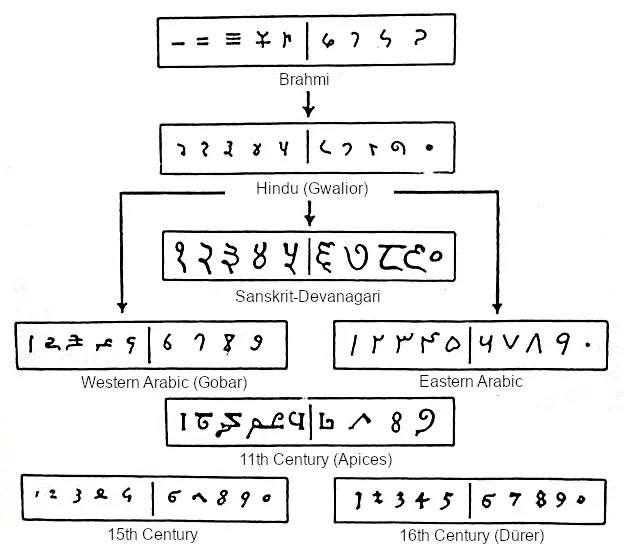
The system originated in India: by the mid-first millennium CE Indian mathematics used ten signs in positional notation, with a zero that marked an empty place and could enter into calculation. Through trade and translation it passed to the Islamic world—al-Khwarizmi wrote On the Hindu Art of Reckoning around 825, and the Latinized form of his name, Algoritmi, became our word "algorithm." Around 1202 Fibonacci, son of a Pisan merchant, introduced this "Indian reckoning" systematically to Latin Europe in the Liber Abaci, urging its convenience for commerce. Yet Europe took it up grudgingly: abacists and algorists quarrelled for centuries, and cities such as Florence briefly legislated against using Arabic numerals in ledgers, on the ground that 0, 6, and 9 were easily forged. Only in the age of print did the digits win out for good.
Connections
Causes3
- Zero and Place-ValueenablesZero and place-value are the operative core that makes the numerals calculable
- al-KhwārizmīcontributedHis treatise on Indian reckoning carried the numerals westward (the word "algorithm" comes from his name)
- The House of WisdomenablesThe House of Wisdom's translation-research movement was the hub of the numerals' westward passage
Consequences1
- Double-Entry BookkeepingenablesEasy pen-reckoning numerals paved the way for commercial arithmetic and double-entry bookkeeping
Echoes1
- The Phoenician AlphabetechoesTwo notation systems that spread across civilizations, one for language and one for quantity, each mastering complexity by combining a few signs
Sources
- Georges Ifrah, The Universal History of Numbers
- L. E. Sigler (trans.), Fibonacci's Liber Abaci
- Hindu–Arabic numeral system
Open questionswell attested
- It is generally agreed that the numerals originated in India and reached Europe through the Arab world.
- The details of how the shape of each numeral developed are disputed.
- It is a matter of record that in 1299 Florence and other places in Europe banned the use of "Arabic numerals" in account books to prevent fraud.
Why it matters
The misnomer "Arabic numerals" is itself a fossil of transmission history: it records the road the digits travelled (into Europe via the Arab world), not their birthplace (India), much as paper crept slowly west and the alphabet spread by ship. Names mistake the route for the source, a recurring confusion in the history of diffusion. More telling is Europe's resistance: a "progress" later taken for granted was for centuries opposed and legislated against, out of fear of forgery, habit, and guild interest. This punctures the Whig fantasy that advanced technology is adopted at once: a technology's victory is never automatic, and it must outlast doubt, lawsuit, and the market. The numerals owe their calculating power to zero and place value, their conceptual core; they eased commercial arithmetic and double-entry bookkeeping, though how much is debated.