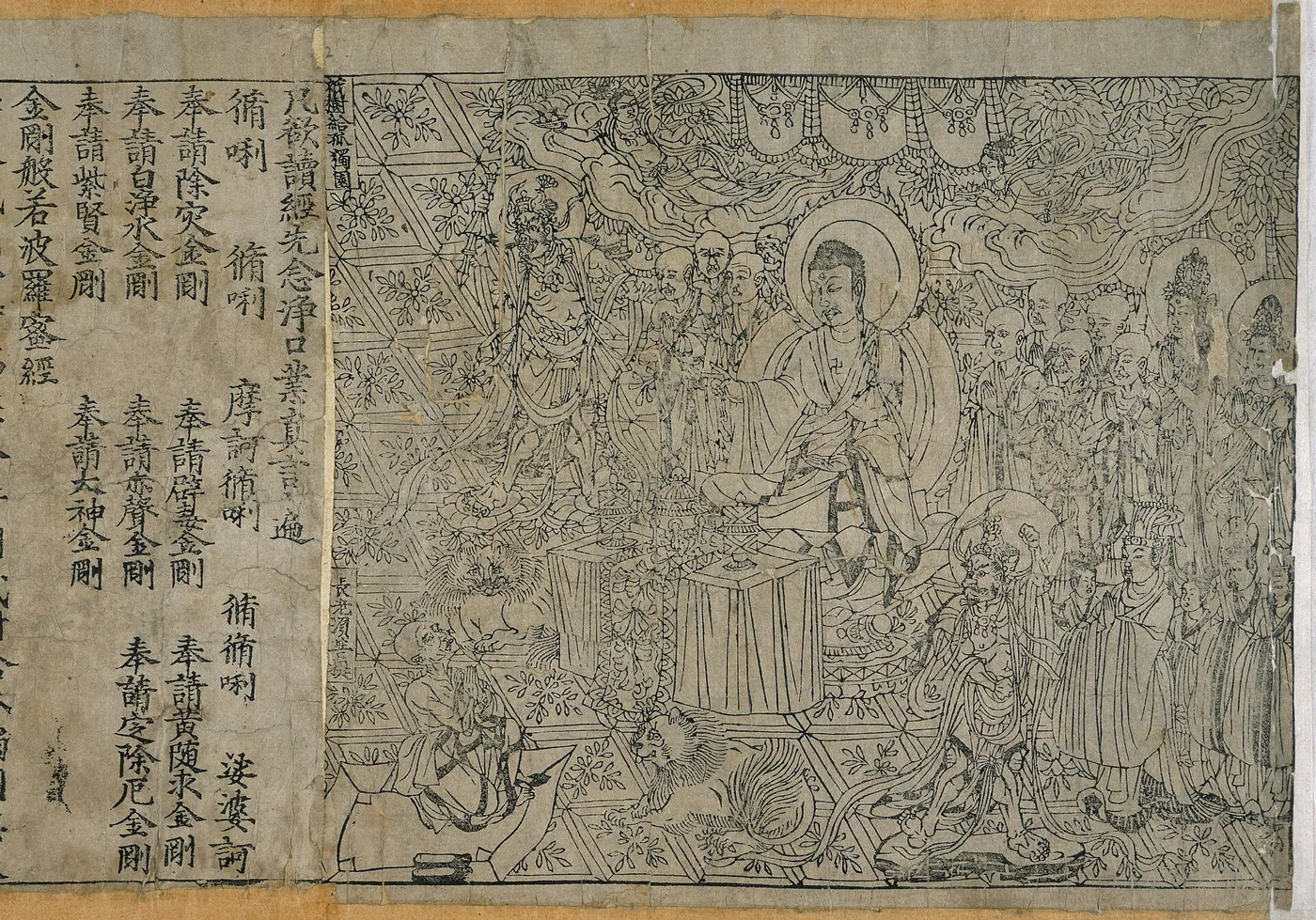
A reproduction technique in which a whole page of text and image is carved in reverse on a woodblock, inked, and impressed onto paper. Mature by the Tang, its earliest dated survivor is the Dunhuang Diamond Sutra of 868. Because one block prints one page and suits a script of many thousands of characters, woodblock rather than movable type remained China's mainstream, used for Buddhist canons, calendars, examination texts, and the Song book market.
Reverently made for universal free distribution by Wang Jie on behalf of his two parents, the 15th day of the 4th month of the 9th year of Xiantong [11 May 868].
—— Colophon of the Dunhuang Diamond Sutra (868 CE)
History
Woodblock printing matured under the Tang. A craftsman carved a whole page in reverse on a block, inked it, laid on paper, and rubbed—one block yielding hundreds of impressions. The earliest dated complete survivor is the 868 Diamond Sutra found in the Dunhuang cave-library in 1900: a finely cut frontispiece, a colophon naming donor and date, now in the British Library. Earlier still are fragments of dharani charms from the Wu Zhou period. Woodblock became the mainstream of East Asian printing: Buddhist and Confucian canons, calendars, medical formularies, examination texts, and the thriving commercial books of the Song mostly came from blocks. It was not "backward" against movable type's "advanced," but better suited: facing tens of thousands of characters, a block carved once was cheaper and more durable than type set graph by graph.
Connections
Causes2
- PapermakingenablesNo paper, no woodblock printing
- The Grand Canalenables · disputedBy linking north and south, the canal underpinned the logistics of Song commerce and the book market (the degree is debated)
Consequences1
- Movable-Type PrintingenablesThe carving and printing techniques of woodblock printing were the technical antecedents of movable type
Sources
- 钱存训, 《纸和印刷》(李约瑟《中国科学技术史》第五卷第一分册)
- The Diamond Sutra (British Library, Or.8210/P.2)
- Woodblock printing
Open questionswell attested
- The Diamond Sutra of 868 is the earliest surviving complete printed text bearing a date, and printing itself began earlier (fragments of dharani from the Wu Zhou period survive).
- The earliest possible date for the origin of woodblock printing (the late Sui or early Tang) is disputed.
Why it matters
Woodblock printing is a fine lesson in anti-Whig history: textbooks cast it as the "precursor" or "transition" to movable type, as if technology must evolve toward type. The reverse is true: in the world of Chinese characters, woodblock long remained the better solution, and movable type was the admired-but-unadopted side road. Judging a technology "advanced" cannot be divorced from the script and society it serves. Woodblock also reveals print's other parentage: its earliest heavy users were not merchants or scholars but Buddhists sowing "fields of merit."