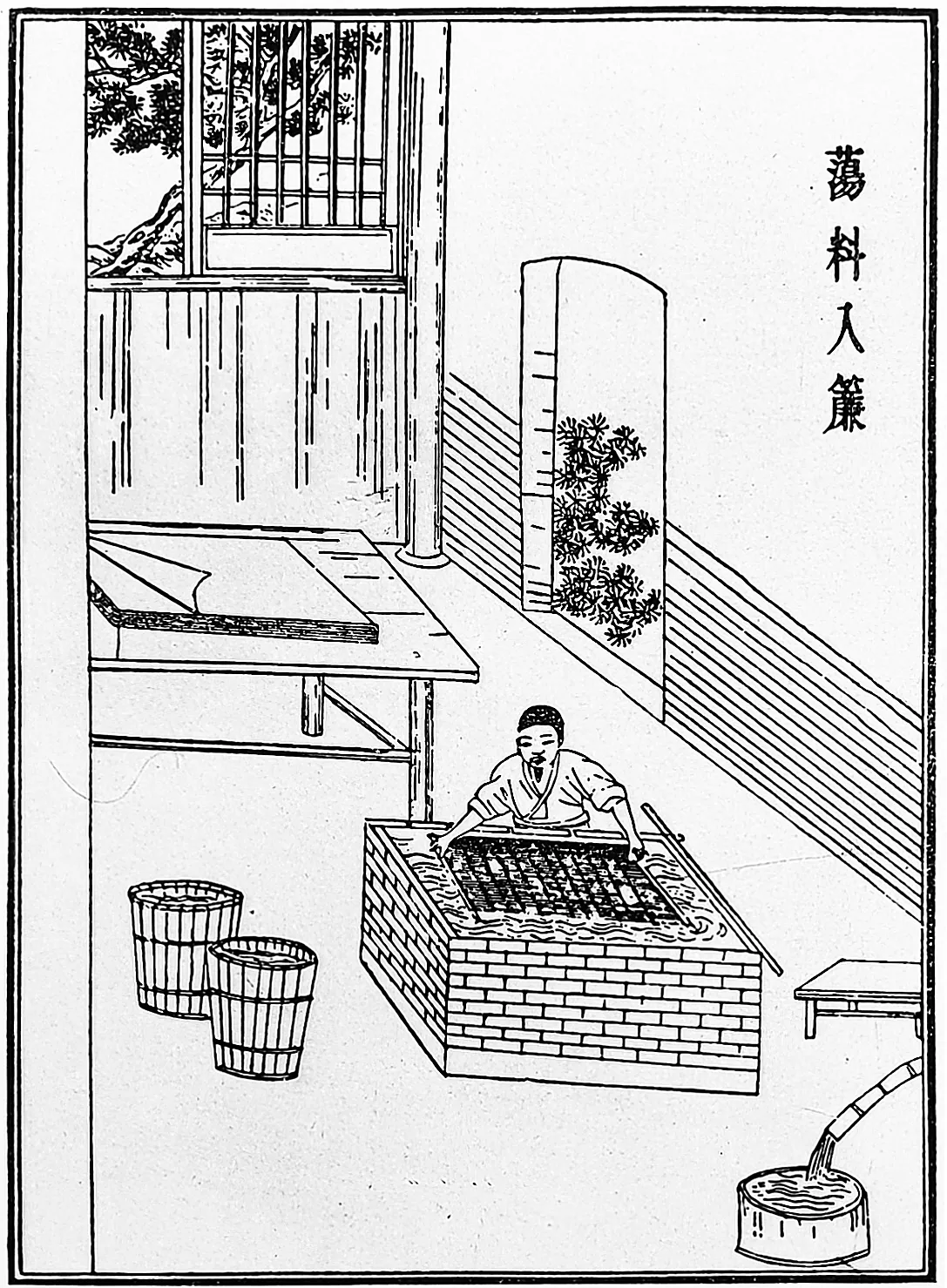
The craft of macerating plant fibre into pulp and forming it into sheets. Archaeology (Fangmatan, Baqiao) shows paper existed under the Western Han; the Eastern Han official Cai Lun (105 CE) perfected and institutionalized it, making it cheap and mass-producible. Over centuries it spread west along the Silk Road (paper mills at Samarkand and Baghdad by the 8th century), reaching Europe and furnishing the material precondition for the printing revolution.
Among the specialities of Samarkand is paper, which has driven out the papyrus of Egypt and the parchment used before it.
—— al-Thaʿālibī, The Book of Curious and Entertaining Information (c. 11th c.)
History
Paper was no single person's single day's work. Fibre-paper fragments from Western-Han Fangmatan and Baqiao show that "paper" existed centuries before Cai Lun. In 105 CE the workshop prefect Cai Lun improved the method with bark, hemp, rags, and fishing nets, making paper cheap, thin, and mass-producible, so that "from then on all adopted it." Paper then displaced bamboo and silk across East Asia. Around the 8th century the craft moved west: mills rose at Samarkand and at Baghdad (794), working flax and cotton rag, and paper entered the libraries and chanceries of the Islamic world; via al-Andalus and Italy it reached Latin Europe in the 12th–13th centuries. At each stage paper changed its fibre to suit local materials, yet remained the same technology for one purpose—making the written word cheap.
Connections
Causes1
- Cai LuncontributedCai Lun improved papermaking and promoted its institutional adoption
Consequences3
- Movable-Type PrintingenablesWithout paper there is no printing; papermaking was a precondition of movable type
- The Printing RevolutionenablesPaper, transmitted westward via the Islamic world, was a precondition of European printing
- Woodblock PrintingenablesNo paper, no woodblock printing
Echoes1
- PapyrusechoesTwo independently originated writing materials; paper finally displaced papyrus
Sources
- 钱存训, 《纸和印刷》(李约瑟《中国科学技术史》第五卷第一分册)
- Jonathan Bloom, Paper Before Print: The History and Impact of Paper in the Islamic World
- Papermaking
Open questionswell attested
- It is agreed that paper already existed under the Western Han (the Fangmatan and Baqiao fragments) and that Cai Lun improved it in 105 CE.
- That papermaking reached Central Asia through the Battle of Talas (751) is the traditional account, and its details are disputed.
- Paper mills in Samarkand and Baghdad in the 8th century are firmly attested.
Why it matters
To pin papermaking on Cai Lun alone is the old fault of the great-man view. What repays attention is paper's slowness: it took more than a thousand years to travel from Luoyang to Mainz. Technology does not diffuse automatically because it is "advanced"; it is relayed, link by link, by trade routes, war, religion, and markets. That the meeting of paper and print detonated in Europe but not in East Asia turns, again, not on paper itself but on the social conditions it met on landing.