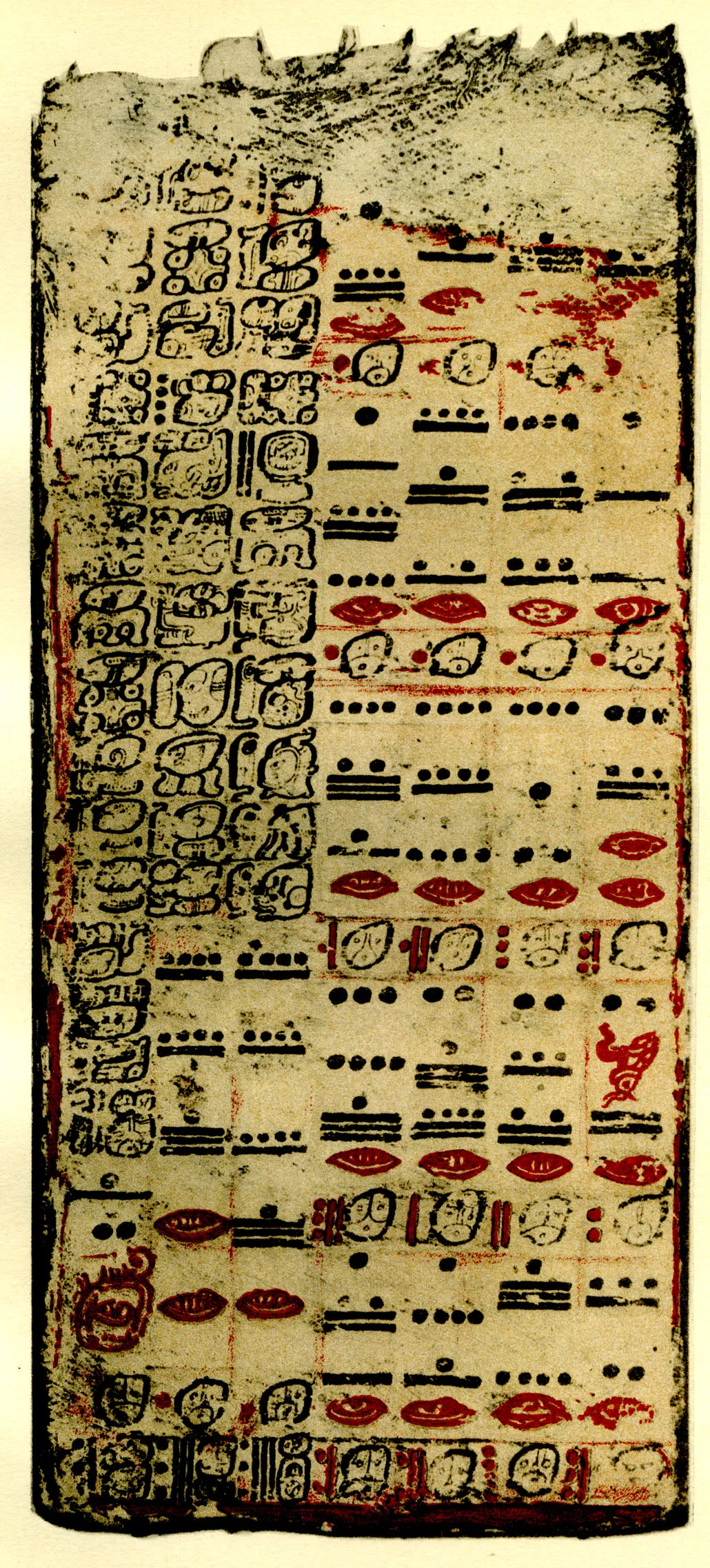
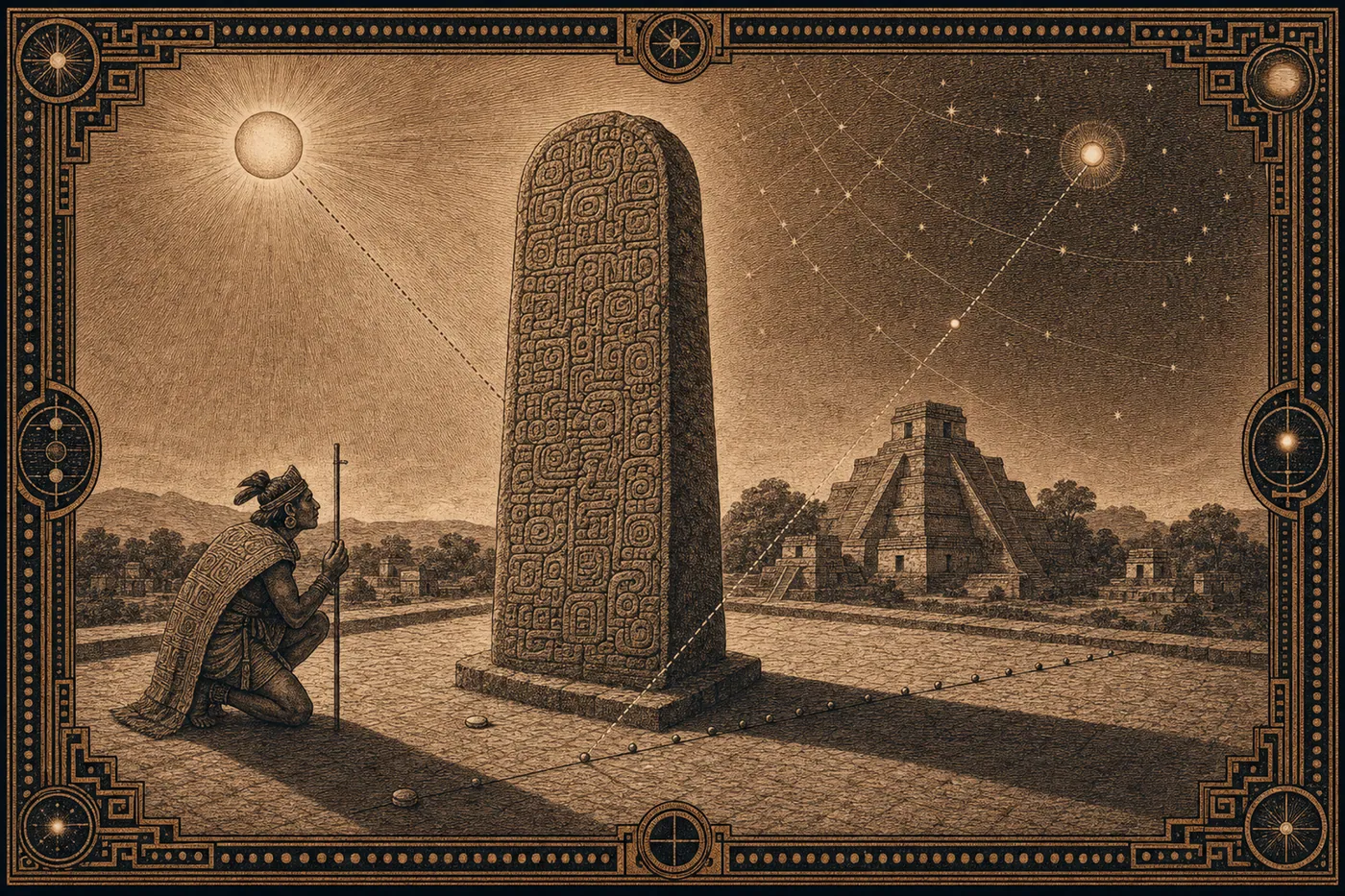
The calendrical system of the Maya, interweaving the 260-day tzolkʼin, the 365-day haabʼ, and the linear day-count of the Long Count. The Long Count tallies days from an era base around 3114 BCE, fixing any date within millennia, and in inscriptions works together with a zero sign and positional notation—one of only two or three places where the concept of zero arose independently. It served dynastic legitimacy, the choosing of days for war, and the reckoning of the Venus cycle: astronomy and political time fused in one instrument.
We found a large number of books in these characters and, as they contained nothing in which there was not to be seen superstition and lies of the devil, we burned them all, which they regretted to an amazing degree, and which caused them much affliction.
—— Diego de Landa, Relación de las cosas de Yucatán (c. 1566)
History
Maya time was measured by three systems at once. The tzolkʼin paired twenty day-names with the numbers one to thirteen, cycling every 260 days, and governed ritual and divination; the haabʼ ran eighteen months of twenty days plus five "nameless" days, 365 in all, tracking the agricultural year. Meshed together they return to the same combination only after fifty-two years, a cycle called the Calendar Round. To fix longer spans the Maya inherited and elaborated the Long Count, tallying days from an era base in five registers: baktun (144,000 days), katun (7,200), tun (360), winal (20), and kʼin (one). Under the GMT correlation the base falls around 11 August 3114 BCE. In inscriptions, positional notation and a shell-shaped zero made this count writable. With it the Maya computed the synodic cycle of Venus (the Venus table of the Dresden Codex is remarkably accurate), along with eclipses and dynastic chronology, setting accessions, wars, and sacrifices into the rhythm of the cosmos. In the sixteenth century the Franciscan Diego de Landa burned a great many codices in Yucatán, yet also recorded in his Relación the day-names, month-names, and an "alphabet"—a garbled record that, three centuries later, became the starting point for decipherment.
Connections
Echoes1
- Zero and Place-Valueechoes · disputedThe Maya Long Count independently developed a positional zero, another cross-civilizational "something from nothing"
Sources
- Michael D. Coe, Breaking the Maya Code
- Michael D. Coe & Stephen Houston, The Maya
- Maya calendar
Open questionswell attested
- Converting the Long Count epoch relies on the GMT correlation constant (584283), and alternative correlations a few days apart are still proposed.
- The Long Count was invented earlier in the Olmec–Izapan region, and the Maya adopted and developed it.
- The "end of a cycle in 2012" carried no apocalyptic meaning in the ancient inscriptions; the doomsday reading is a modern invention.
- The Maya zero sign has no historical link with the Old World zero and was an independent invention.
Why it matters
The Maya zero is independent evidence: positional notation and zero are no Old World monopoly, and humanity thought of them a second time in complete isolation. That corrects the picture of mathematics advancing along a single road: Mesoamerica needed to record dynastic time in day counts running past a million, and so it had a zero. As for the "2012 apocalypse," that is a modern imposition: the turning of a baktun carries no sense of ending in Maya inscription, just as an odometer rolling past a hundred thousand does not mean the car will fall apart. Landa remains the most instructive figure: he burned the books, and his professional compulsion to record left the key to reading them. Destroyer and preserver are often the same man, and sources never reach us innocently.