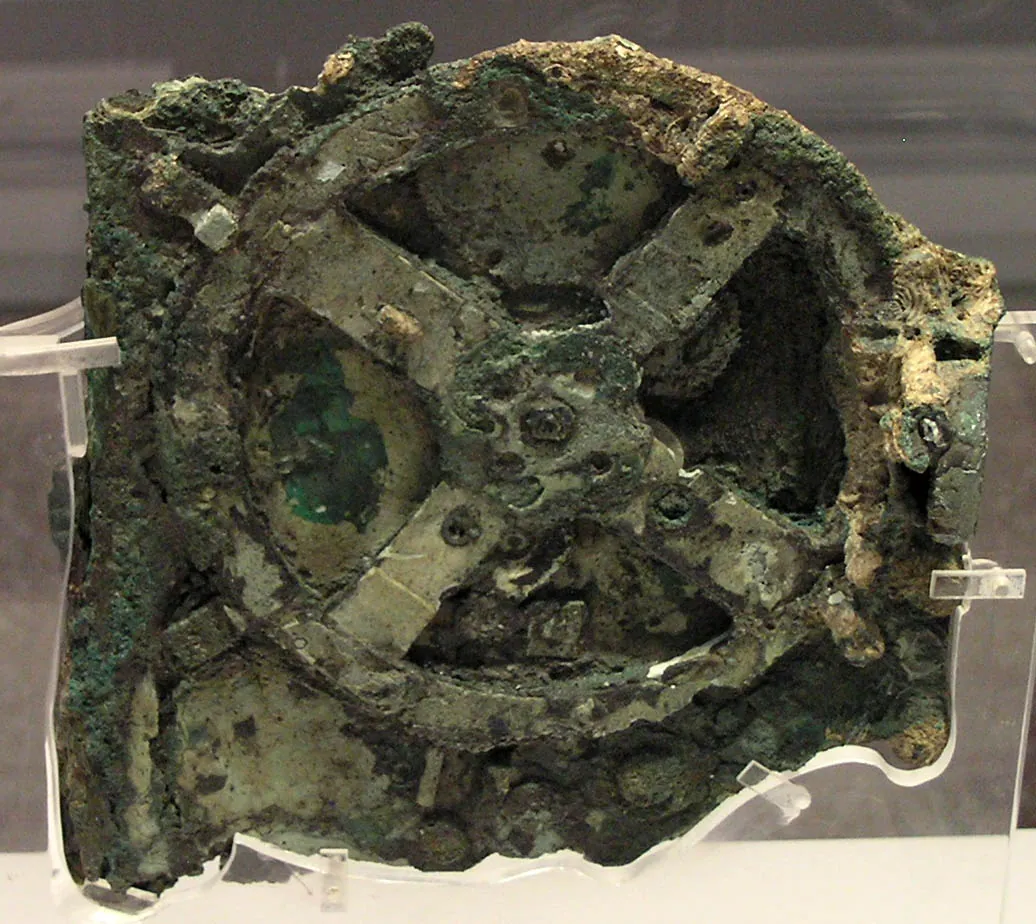
A bronze geared device raised in 1901 from a wreck off the Greek island of Antikythera. Made in the 2nd or 1st century BCE, it displayed the motions of sun and moon, lunar phases and eclipse cycles, the most complex machine surviving from antiquity.
Suppose a traveller to carry into Scythia or Britain the orrery recently constructed by our friend Posidonius, which at each revolution reproduces the same motions of the sun, the moon and the five planets that take place in the heavens every twenty-four hours, would any single native doubt that this orrery was the work of a rational being?
—— Cicero, De natura deorum II.88 (c. 45 BCE), spoken by the Stoic Balbus; trans. H. Rackham (Loeb, 1933)
History
In 1900 sponge divers from Symi found an ancient wreck some 45 metres down off Antikythera. Salvage organized by the Greek state in 1900–01 raised bronze and marble statues and a lump of corroded bronze and wood; in May 1902 the archaeologist Valerios Stais noticed a gearwheel in one piece. Coins and pottery date the wreck to about 70–60 BCE; estimates for the making of the mechanism run from around 205 BCE to the later second century. The 82 surviving fragments, perhaps a third of the original, hold 30 bronze gears, and their scales and inscriptions show what it did. On the front, concentric dials for the zodiac and the 365-day Egyptian calendar carried pointers for sun and moon and a half-silvered ball for the lunar phase. On the back, an upper spiral counted the 235 months of the Metonic cycle, with a small dial for the four-year cycle of Panhellenic games; a lower spiral counted the 223 months of the Saros eclipse cycle, with a subsidiary dial for the triple Saros. Two gears on offset axes, linked by a pin in a slot, made the moon pointer speed up and slow down, following Hipparchus' theory of the moon's uneven motion. Derek de Solla Price published the first systematic reconstruction, Gears from the Greeks, in 1974; from 2005 microfocus X-ray tomography read thousands of hidden letters.
Connections
Causes1
- Babylonian AstronomyenablesBabylonian cycles such as the Saros are engraved on its back dials
Echoes4
- The Mechanical ClockechoesPrecision gearing lost and found again
- The Electronic ComputerechoesOften called the earliest analog computing device
- Su Song's Astronomical Clock TowerechoesTwo geared machines for showing the heavens, East and West, with no known connection
- ArchimedesechoesCicero records a geared sphere made by Archimedes and taken to Rome by Marcellus
Sources
- Derek de Solla Price, Gears from the Greeks: The Antikythera Mechanism, a Calendar Computer from ca. 80 B.C. (Transactions of the American Philosophical Society 64.7) (1974)
- Tony Freeth et al., Decoding the ancient Greek astronomical calculator known as the Antikythera Mechanism (Nature 444) (2006)
- Alexander Jones, A Portable Cosmos: Revealing the Antikythera Mechanism, Scientific Wonder of the Ancient World (2017)
- Tony Freeth et al., A Model of the Cosmos in the ancient Greek Antikythera Mechanism (Scientific Reports 11) (2021)
Open questionspartly uncertain
- Estimates of when it was made vary, from around 205 BCE to the late 2nd century BCE.
- The gearing for the planetary displays does not survive, so reconstructions of it are largely conjectural.
- Where it was made and by whom are unknown; Rhodes and a Corinthian colony are among the competing suggestions.
- Calling it an "analogue computer" is a modern description.
Why it matters
The mechanism forced a revision of what ancient technology could do. The Greek gearing known before it came from the hodometers and hoists described by Hero and Vitruvius; nothing of comparable intricacy survives until the astronomical clocks of late medieval Europe, and in between there are only texts, from Cicero's spheres of Archimedes and Posidonius to Su Song's unrelated clock tower of 1092. A technique can exist and leave no lineage, especially when it lives in a few workshops rather than in books. The machine also shows Greek astronomy working with two kinds of knowledge at once, Babylonian arithmetical cycles and Greek geometrical models, both turned into ratios of gear teeth. "Analog computer" is a modern label that fits its function well enough; for Cicero's generation such a device was first of all a model of a rationally ordered cosmos. The full planetary reconstruction proposed by Tony Freeth and colleagues in 2021 is in large part hypothetical.