A machine that computes digitally at electronic speed and follows a program. Several appeared in Britain and the United States in the 1940s, with no agreed "first"; from 1948 the stored-program design, keeping instructions in memory, became standard.
We may say most aptly, that the Analytical Engine weaves algebraical patterns just as the Jacquard-loom weaves flowers and leaves.
—— Ada Lovelace, Note A to her translation of L. F. Menabrea's "Sketch of the Analytical Engine", Taylor's Scientific Memoirs, vol. 3 (London, 1843)
History
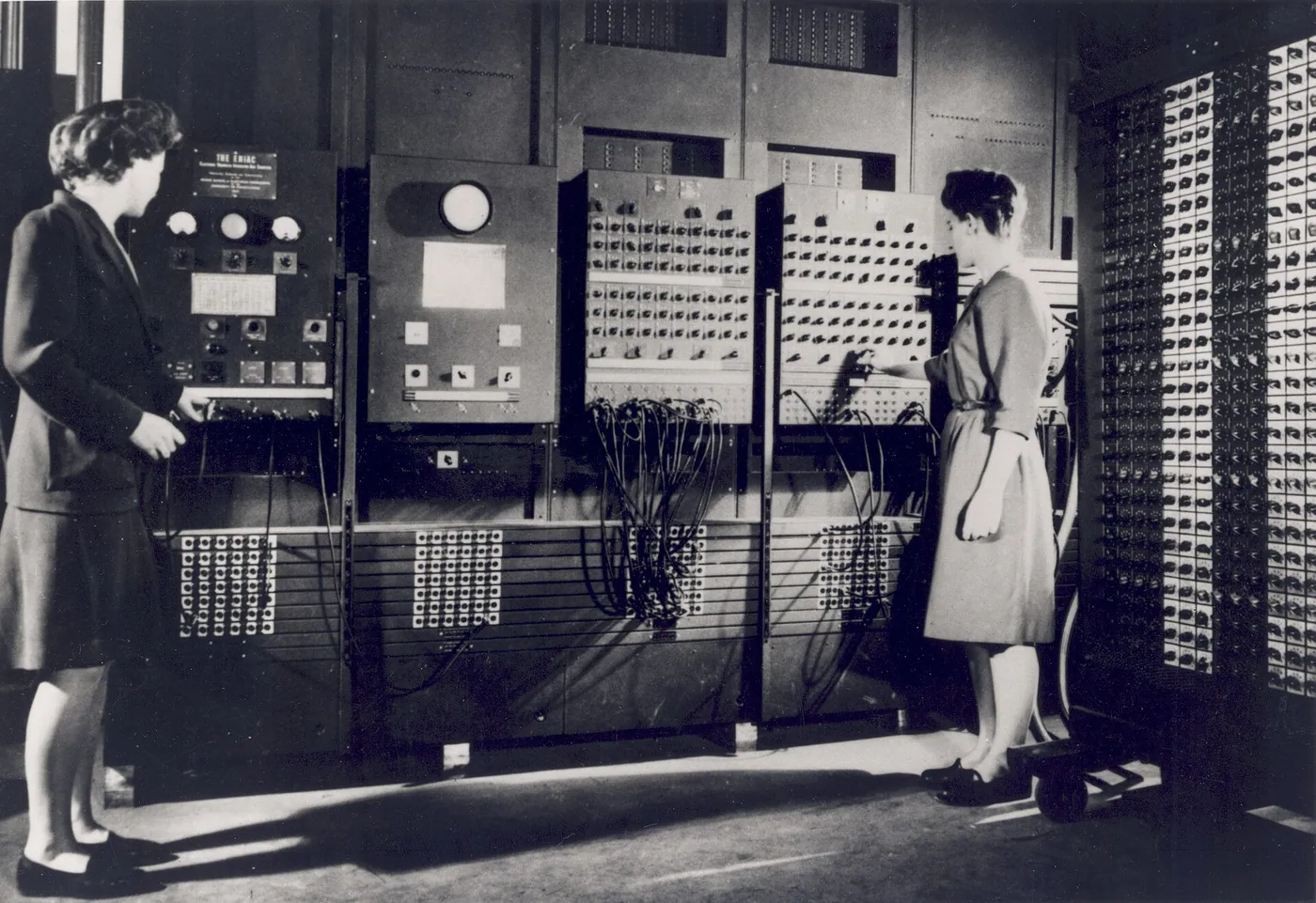
In English a "computer" was first a person who calculated for a living. From 1834 Charles Babbage designed an Analytical Engine to take instructions on punched cards borrowed from the Jacquard loom; it was never built, but in 1843 Ada Lovelace published notes on it that included a program for Bernoulli numbers. In 1941 Konrad Zuse demonstrated the relay-built, programmable Z3; in 1942 John Atanasoff and Clifford Berry in Iowa finished an electronic equation-solver that could not be programmed. Early in 1944 Colossus, designed by the Post Office engineer Tommy Flowers, went into service at Bletchley Park with about 1,600 valves to break the German Lorenz cipher; its existence stayed secret until the 1970s. At the University of Pennsylvania, J. Presper Eckert and John Mauchly built ENIAC for the US Army with some 17,500 vacuum tubes; it ran its first problem in December 1945 and was unveiled in February 1946. Its first programmers were six women drawn from the Army's computers, Kathleen McNulty, Jean Jennings, Betty Snyder, Marlyn Wescoff, Frances Bilas and Ruth Lichterman, barely mentioned at the time. It was programmed with cables and switches; changing problems could take days. Von Neumann's EDVAC report of 1945 proposed keeping the program in memory; on 21 June 1948 the Manchester "Baby" ran the first program held in electronic memory, and from May 1949 Cambridge's EDSAC ran a regular service.
Connections
Causes5
- The Division of LabourappliesProny organised human computers on Smith's principle to make tables; Babbage cited the example from 1822
- Alan TuringcontributedWartime codebreaking machines and the post-war ACE design
- Computability (the Turing Machine)enablesThe universal machine is the theoretical prototype of the stored-program computer
- Zero and Place-ValueenablesPlace-value notation underlies all mechanical and electronic calculation
- ElectricityenablesVacuum tubes and a steady supply of current
Echoes2
- The Antikythera MechanismechoesOften called the earliest analog computing device
- Information TheoryechoesThe bit: two kinds of digitisation in the same decade
Sources
- Martin Campbell-Kelly, William Aspray, Nathan Ensmenger, Jeffrey R. Yost, Computer: A History of the Information Machine (3rd ed.) (2014)
- Thomas Haigh, Mark Priestley, Crispin Rope, ENIAC in Action: Making and Remaking the Modern Computer (2016)
- David Alan Grier, When Computers Were Human (2005)
- B. Jack Copeland (ed.), Colossus: The Secrets of Bletchley Park's Codebreaking Computers (2006)
Open questionswell attested
- Which machine counts as the "first computer" depends on the criteria used.
- Two figures are commonly given for the number of vacuum tubes in ENIAC: 17,468 and about 18,000.
- Sources differ on the number of valves in Colossus Mark 1, putting it at about 1,500 to 1,600.
- The recognition of Atanasoff's priority in the Honeywell case is disputed among historians.
- ENIAC was converted in spring 1948 to read its program from the function tables; whether this counts as stored-program operation earlier than the Manchester "Baby" is debated.
Why it matters
There is no single first computer, because the answer depends on the criterion: electronic, programmable, general-purpose and stored-program each pick out a different machine. Secrecy and litigation shaped the question too. Colossus was hidden until the 1970s and so missing from early histories; in 1973 a US federal court, in Honeywell v. Sperry Rand, invalidated the ENIAC patent and held that its subject matter was derived from Atanasoff, a ruling on priority that historians have not generally endorsed. In the history of ideas the electronic computer joins two lines, the organisation of calculation into simple steps from Prony to Babbage and Turing's abstraction of computing as symbol manipulation, while wartime work on ballistics, ciphers and nuclear weapons supplied money and urgency. The first labour it displaced was that of human computers, and the six women who first programmed ENIAC came from their ranks; their work was properly documented and recognised only at the end of the century.