The principles and institutions governing research on human subjects. Its written origin is the judgment of the Nuremberg Doctors' Trial of 1947, which, alongside its sentences, set out ten points of which the first reads: "The voluntary consent of the human subject is absolutely essential." This became the Nuremberg Code. There followed the World Medical Association's Declaration of Helsinki (1964), whose 1975 revision introduced independent ethical review and the precedence of the subject's interest over those of science and society; the Belmont Report (1979), with its principles of respect for persons, beneficence, and justice; and national systems of institutional review. It is worth noting that the norms did not take effect on being stated: the Tuskegee syphilis study in the United States continued until exposed by the press in 1972, twenty-five years into the Nuremberg Code's existence. Research ethics is therefore not the product of a single act of legislation but the sum of a series of acknowledgments made after the fact.
The voluntary consent of the human subject is absolutely essential.
—— The Nuremberg Code, point 1 (1947)

History
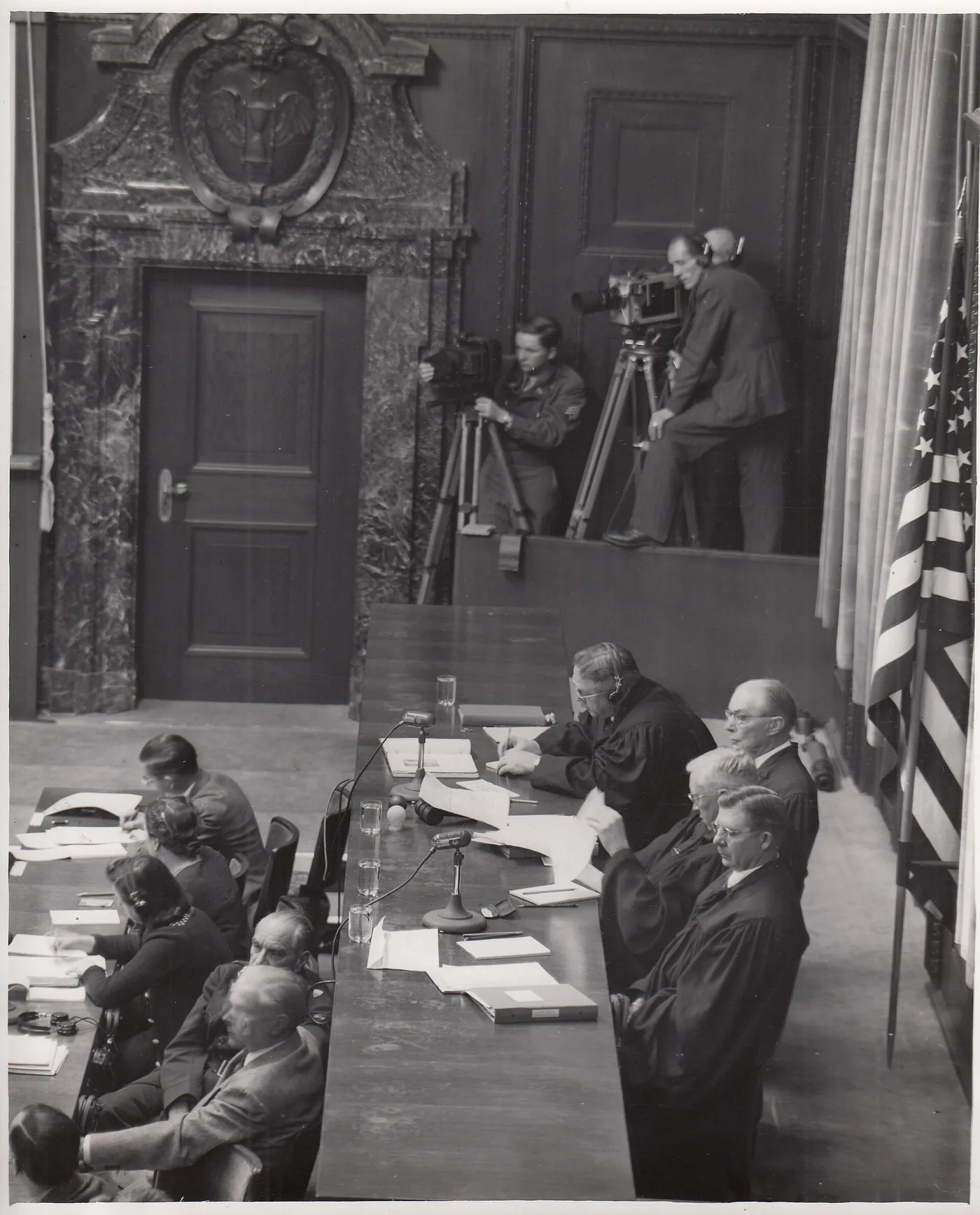
In 1946 and 1947 an American military tribunal at Nuremberg tried twenty-three Nazi physicians and health officials, the charges including experiments performed on concentration-camp prisoners without their consent. The prosecution's medical advisers, Andrew Ivy and Leo Alexander, argued in the course of the trial that the medical profession of civilized states required an explicit standard by which permissible human research might be judged. The tribunal adopted the substance of their submission and appended ten points to its judgment, known thereafter as the Nuremberg Code: voluntary consent first, and with it that experiments rest on prior animal work, that all unnecessary suffering be avoided, and that the subject may withdraw at any time. For twenty years the Code's practical influence was far smaller than is now assumed. It was widely read as an annex to a judgment on Nazi crimes, with no bearing on research in ordinary countries; the legal scholar Jay Katz later summed up the prevailing American view as "a good code for barbarians but an unnecessary code for ordinary physicians". Change came from the scandals that followed. In 1964 the World Medical Association adopted the Declaration of Helsinki; its 1975 revision referred ethical review to committees independent of the investigator and stated the precedence of the subject's interest. In 1966 Henry Beecher listed in the New England Journal of Medicine twenty-two published American studies with grave ethical defects, to the profession's shock. And in 1972 the press exposed the Tuskegee syphilis study, conducted by the United States Public Health Service in Alabama since 1932, in which several hundred Black men were left untreated while being told they were under care, long after penicillin had become available. That disclosure led directly to the National Research Act of 1974 and the Belmont Report of 1979, and institutional review became a precondition of research funding.
Connections
Causes1
- The HolocaustinspiresThe judgment of the 1947 Doctors' Trial set out ten points making voluntary consent an absolute requirement of research on human subjects
Sources
- George J. Annas & Michael A. Grodin (eds.), The Nazi Doctors and the Nuremberg Code: Human Rights in Human Experimentation
- David J. Rothman, Strangers at the Bedside: A History of How Law and Bioethics Transformed Medical Decision Making
- James H. Jones, Bad Blood: The Tuskegee Syphilis Experiment
- The Nuremberg Code (1947)
- Declaration of Helsinki
Open questionswell attested
- The legal force of the Nuremberg Code was long in doubt, since it was a set of principles appended to a judgment and had no treaty status; medical communities at first tended to see it as rules for barbarians that did not concern them (Jay Katz's phrase), and its practical binding force was established only gradually after the 1960s.
- The legal roots of informed consent predate Nuremberg (the US Schloendorff case of 1914 had already established the principle of bodily autonomy); the Code's contribution was to make it an absolute requirement specific to research.
- The Tuskegee study was not an isolated case; similar abusive studies came to light in many countries in the same period, and it is simply the best known.
- The effectiveness of ethical review varies greatly from country to country, and the gap between formal compliance and real protection remains a matter of continuing debate.
Why it matters
The history of research ethics yields a general conclusion that is unwelcome and useful: norms about what must not be done almost never arise from reasoning beforehand, but from acknowledgment after the fact of what has already been done. Each of the Nuremberg Code's ten points answers to a crime established at trial; each of the Belmont Report's three principles can be found inverted in the Tuskegee files. This is not to say the wrongness was unknown in advance—the physicians tried at Nuremberg had violated guidelines that Germany itself had issued in 1931, and issued in considerable detail. The question was never whether a norm existed but whether it was taken to apply to us. That American medicine read the Nuremberg Code for twenty years as a code for barbarians is exactly the point: a set of norms begins to work only when those bound by it concede that they too might be the sort of person who needs binding. A second layer bears more directly on the history of technology. Research ethics is the clearest instance of a disaster producing its own correction, of a kind with pesticide regulation after DDT and clean-air legislation after the Great Smog, and it is also the costliest and slowest: twenty-five years and at least one avoidable scandal separated the writing of the Code from its binding force. The existence of a corrective mechanism is not the occurrence of a correction. A last word on proportion: to call today's system of ethical review a legacy of the Holocaust is a cheap formulation, one that turns victims into the necessary cost of some improvement. It is more accurate to say that these norms were bought with what was taken from those people, and that the account never balances.