Splitting a job into simple operations, each done by different hands. Adam Smith opened The Wealth of Nations (1776) with a pin manufactory, made the division of labour the first cause of growing wealth, and warned what it did to workers' minds.
The greatest improvements in the productive powers of labour, and the greater part of the skill, dexterity, and judgment with which it is any where directed, or applied, seem to have been the effects of the division of labour.
—— Adam Smith, An Inquiry into the Nature and Causes of the Wealth of Nations (London, 1776), Book I, chapter 1, opening sentence (first-edition wording)
History
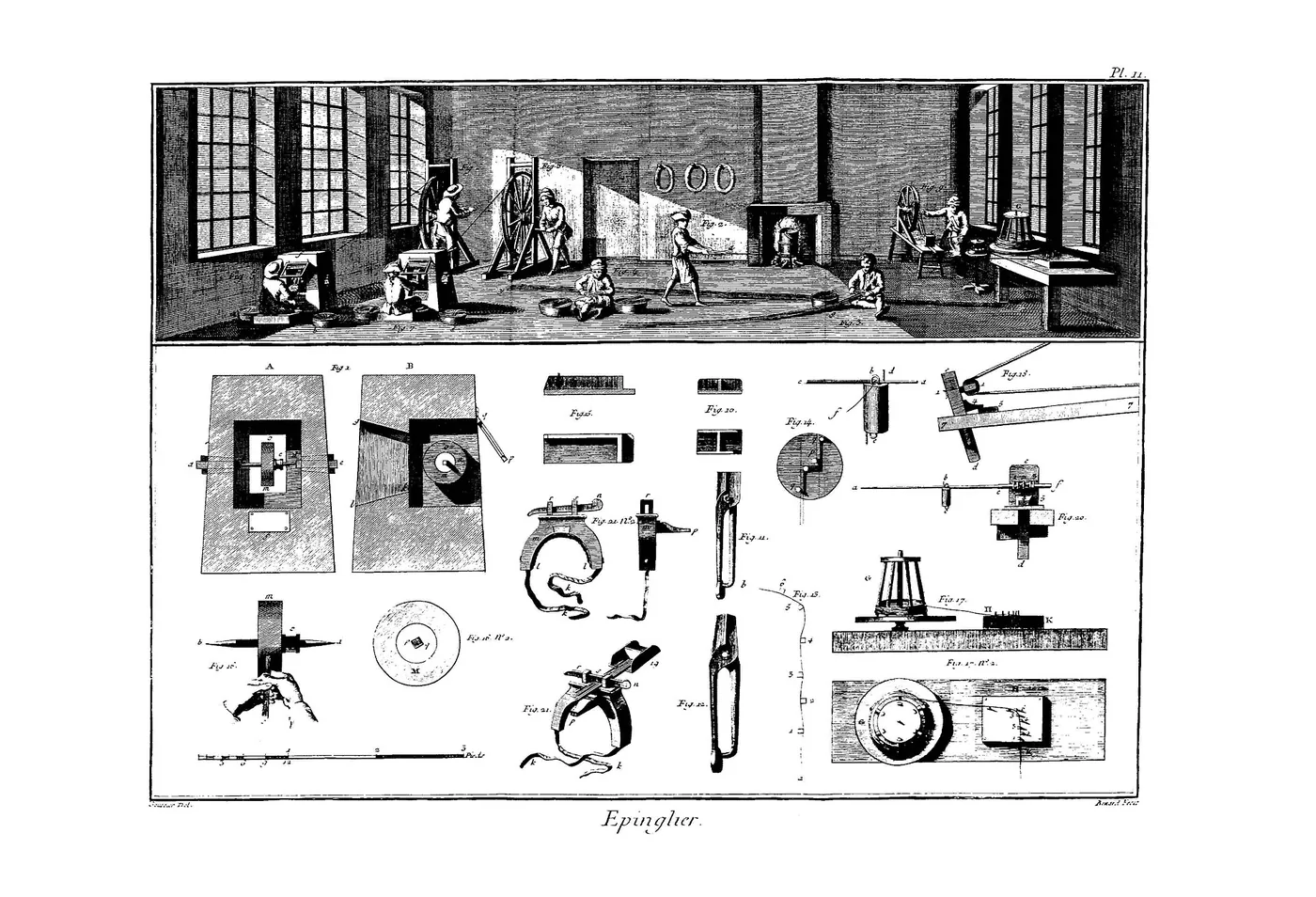
The division of labour means breaking the making of a product into simple operations, each given to different hands. Plato's Republic traced the city to each person following one trade, and William Petty and Bernard Mandeville later discussed its efficiencies. Adam Smith put it at the head of The Wealth of Nations (1776). His first chapter takes pin-making: an untrained man could scarcely make one pin a day, but in a small manufactory of ten men, where drawing, straightening, cutting, pointing and heading were split into about eighteen operations, they made upwards of 48,000 a day. Smith gave three causes: greater dexterity, time saved in passing between tasks, and the invention of machines that abridge labour. He claimed to have seen such a workshop, but his details come largely from French print; one study traces four sources, the best known being the article "Épingle" in volume five of the Encyclopédie (1755). In Book V Smith warned that a man who spends his life on a few simple operations "generally becomes as stupid and ignorant as it is possible for a human creature to become", and proposed publicly funded parish schools. In the 1790s Gaspard de Prony applied Smith's principle to computing logarithmic tables for the French cadastre, leaving the drudgery to sixty to ninety computers who needed only addition and subtraction. Darwin later borrowed the "physiological division of labour" to explain why species diverge.
Connections
Consequences3
- The Ideology of EfficiencyinspiresFrom Smith's pin manufactory to Taylor's analysis of motions
- The Electronic ComputerappliesProny organised human computers on Smith's principle to make tables; Babbage cited the example from 1822
- Natural Selectioninspires · disputedDarwin drew on the “physiological division of labour” to explain divergence
Sources
- Adam Smith, An Inquiry into the Nature and Causes of the Wealth of Nations (1776)
- Jean-Louis Peaucelle, Adam Smith's use of multiple references for his pin making example (European Journal of the History of Economic Thought 13.4) (2006)
- Jean-Louis Peaucelle, Cameron Guthrie, How Adam Smith Found Inspiration in French Texts on Pin Making in the Eighteenth Century (History of Economic Ideas 19.3) (2011)
- Charles Babbage, On the Economy of Machinery and Manufactures (1832)
Open questionswell attested
- Whether Smith saw a ten-man pin factory with his own eyes cannot be verified.
- The number of operations in pin-making and the output figures may be exaggerated.
- The claim that Prony's computers were mostly unemployed hairdressers has no known source.
- Whether Darwin's borrowing of the term "physiological division of labour" was influenced by Smith is disputed.
Why it matters
The doctrine's weight lies in moving progress from individual skill to the organisation of work. Smith already saw that the simpler an operation, the easier it is to hand to a machine; Charles Babbage, in On the Economy of Machinery and Manufactures (1832), carried the point into mental labour and imagined a calculating engine replacing Prony's lowest tier of computers. The division of labour thus became the conceptual precondition of mechanisation and automation, from the factory system to Frederick Taylor's analysis of motions. Its costs were noticed just as early. Smith worried about the worker's mind, Marx described manufacture turning the worker into a "detail labourer", and Durkheim in 1893 treated the division of labour as the source of modern social solidarity. Scholars who have checked Smith's French sources find both the number of operations and the gain in output overstated, and note that the most conspicuous division in the trade was between men and women.