The set of convictions that treats efficiency as an end in itself rather than a means to an end. Its formulation is Frederick Winslow Taylor's Principles of Scientific Management (1911): decompose the motions with a stopwatch, determine the one best way, transfer the craftsman's experiential knowledge into management's card system, and leave the worker only the execution. The doctrine at once overflowed the shop floor—Progressive-era America reorganized municipalities, schools, and housework in the name of efficiency; the Soviet planned economy claimed Taylorism as a technical inheritance; the European rationalization movement remade administration with it. Its lasting effect lies in no particular practice but in the spread of an attitude: that everything is measurable and optimizable, while the question of what is being optimized quietly leaves the frame.
In the past the man has been first; in the future the system must be first.
—— F. W. Taylor, The Principles of Scientific Management (1911)

History
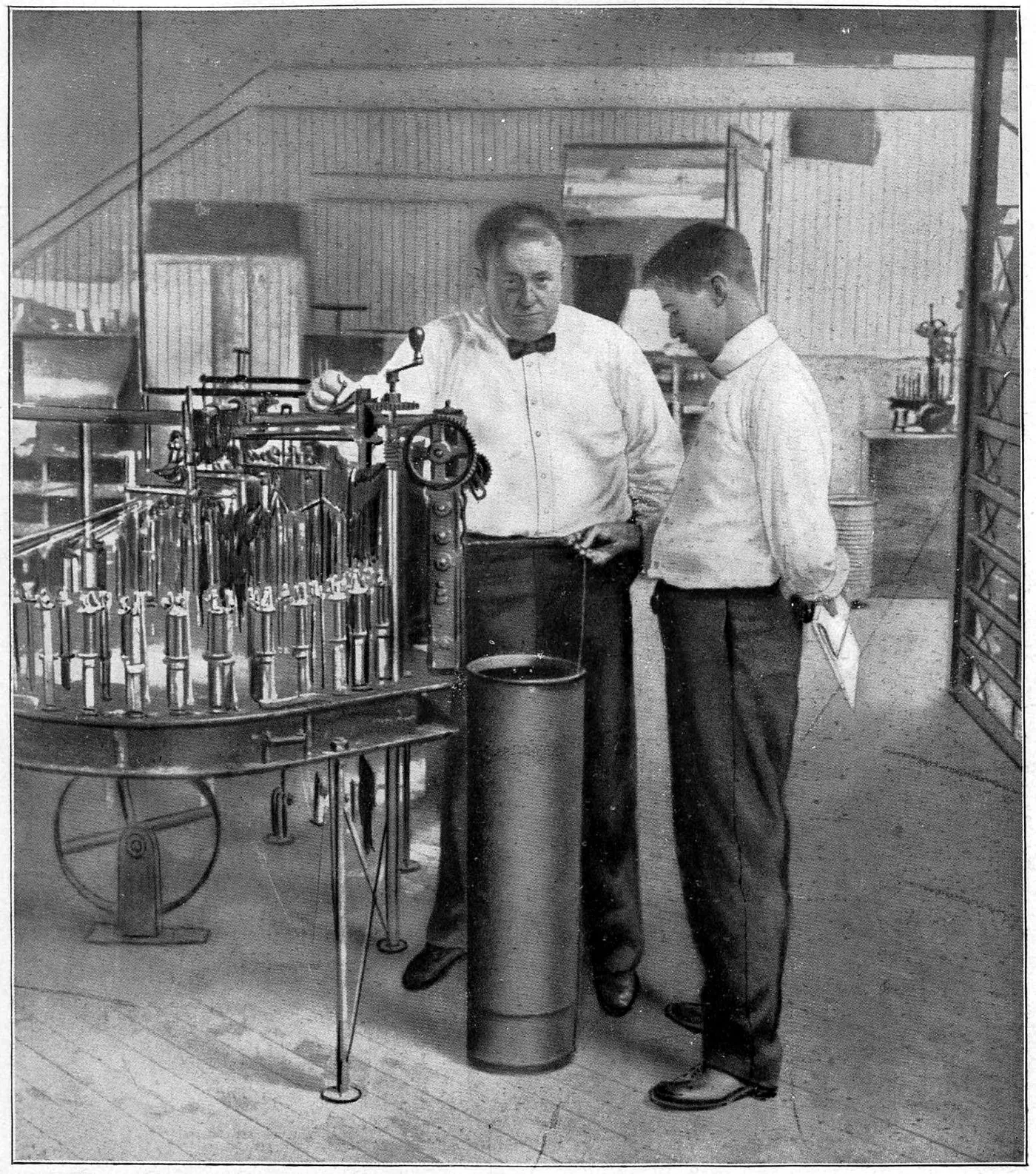
Working as a foreman at the Midvale Steel plant in Philadelphia in the 1880s, Taylor concluded that soldiering, or deliberate underworking, was rational behaviour: in a piece-rate shop, any man whose output rose saw his rate cut, so everyone tacitly held something back. His answer was not exhortation but the dismantling of the work itself: time each motion with a stopwatch, discard the superfluous, recombine the rest into the one best way, and set from it a quota beyond argument. The Principles of Scientific Management appeared in 1911 and became one of the most widely circulated management texts of the century. Its core was not timing alone. Management, Taylor wrote, must gather the experiential knowledge that had always lived in the craftsman's head and hands, classify it, and reduce it to cards, so that knowledge thereafter belonged to the system rather than to the person. In the same years Frank and Lillian Gilbreth used photography to decompose motion, carrying efficiency from the factory into the operating theatre and the housewife's kitchen; Progressive municipal reformers recast budgets and school timetables by it; the German rationalization movement of the 1920s and the Soviet movement for the scientific organization of labour each took a share—Lenin denouncing Taylorism as a refinement of bourgeois exploitation while insisting it must be learned. Wherever it went, efficiency turned from an adjective for comparing means into a goal able to stand on its own.
Connections
Causes1
- The Division of LabourinspiresFrom Smith's pin manufactory to Taylor's analysis of motions
Consequences2
- The Assembly LineappliesFord's moving line put the ideology of efficiency into the organization of production: Taylorism decomposed the motions, the line fixed the tempo
- The Holocaustinforms · disputedOn Bauman's thesis the ideology of efficiency supplied part of the killing's organizational vocabulary; critics reply that it cannot explain the shootings in the East and dilutes the antisemitic ideology
Sources
- Frederick Winslow Taylor (1911), The Principles of Scientific Management
- Robert Kanigel, The One Best Way: Frederick Winslow Taylor and the Enigma of Efficiency
- Harry Braverman, Labor and Monopoly Capital: The Degradation of Work in the Twentieth Century
- Zygmunt Bauman, Modernity and the Holocaust
- Scientific management
Open questionspartly uncertain
- Wrege and other scholars have shown that Taylor's own measurements (above all the famous pig-iron handling case at Bethlehem Steel) were considerably tidied up and exaggerated after the fact, so their "scientific" standing should not be taken at face value.
- Taylorism was put into practice far less widely than its reputation suggests; most factories adopted only piece rates and time study, and full functional foremanship was rarely implemented.
- The line running from Taylorism through bureaucratic rationality to the Holocaust belongs to a Bauman-style explanation, which has also been criticized, and should not be read as a causal claim.
- Scholars agree that efficiency discourse had affinities with fascism, the Soviet system and American Progressivism, but the three took it up with very different emphases and should not be lumped together.
Why it matters
Efficiency is dangerous precisely because it does not look like a value. To say "I am for faster and cheaper" sounds like stating a commonplace rather than advocating anything, and for that reason it can occupy without argument a position other values must argue for. In Labor and Monopoly Capital, Harry Braverman argued that Taylorism's real product was not efficiency but deskilling: once conception and execution are institutionally separated, what the worker loses is not only autonomy but any grasp of the whole of what he does. Bauman, in Modernity and the Holocaust, extended the line: an organization whose supreme instruction is to do the job well, and which refers the question of what job to those above, is morally hollow—every link may be discharged conscientiously by decent people while what is made by the whole is no one's responsibility. This is among the gravest indictments of the twentieth century, and it must be read together with its rebuttal: critics observe that the account cannot explain some one and a half million face-to-face shootings in the East, where no bureaucratic distance existed at all, and that reducing the killing to a general property of modernity dilutes the specific antisemitic ideology that was decisive. The dispute remains unsettled. The narrower thing that can be said is that efficiency is knowledge about how, which not only gives no answer to the question of what, but by its own persuasiveness makes one forget that the question requires one.