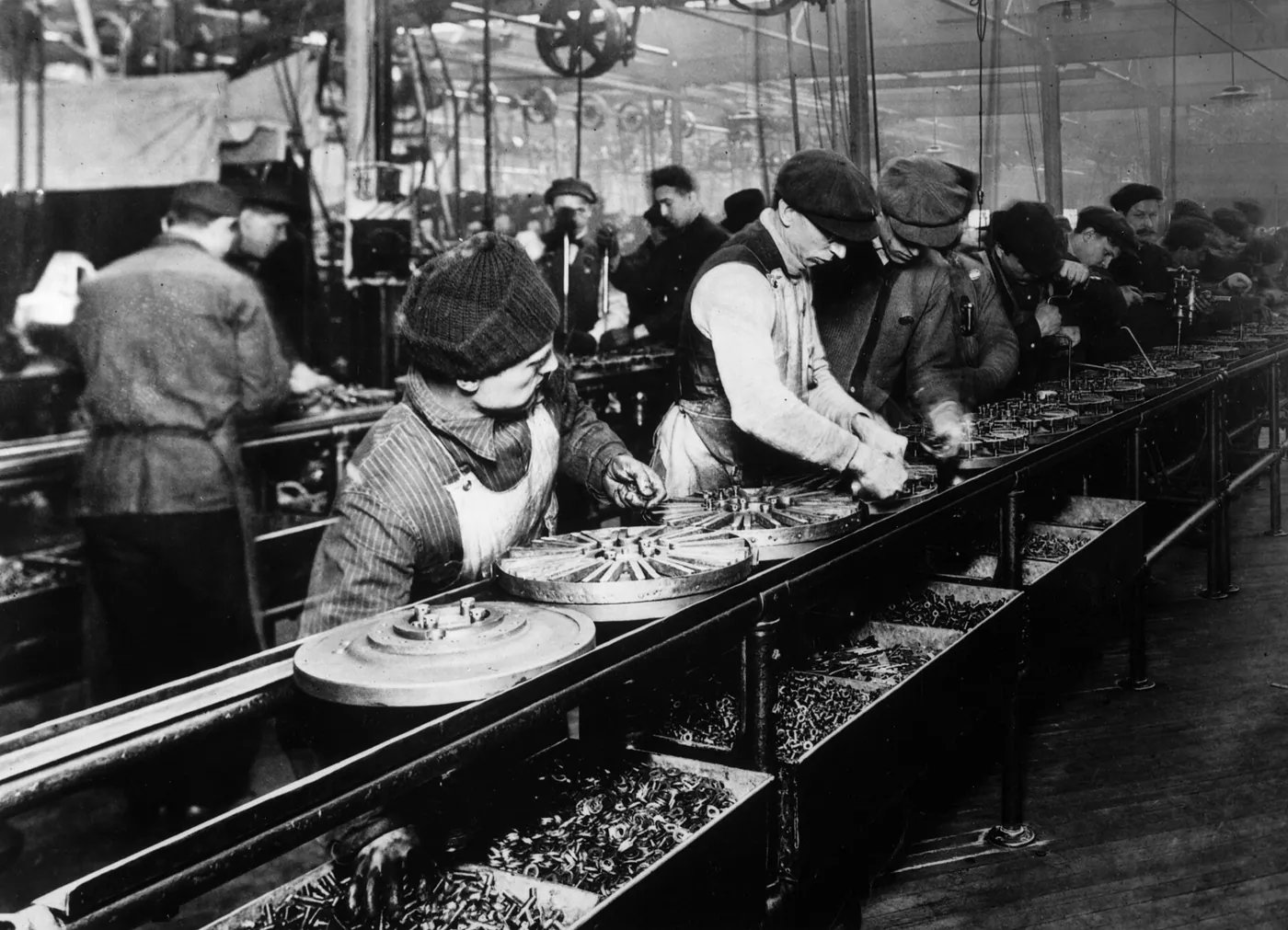
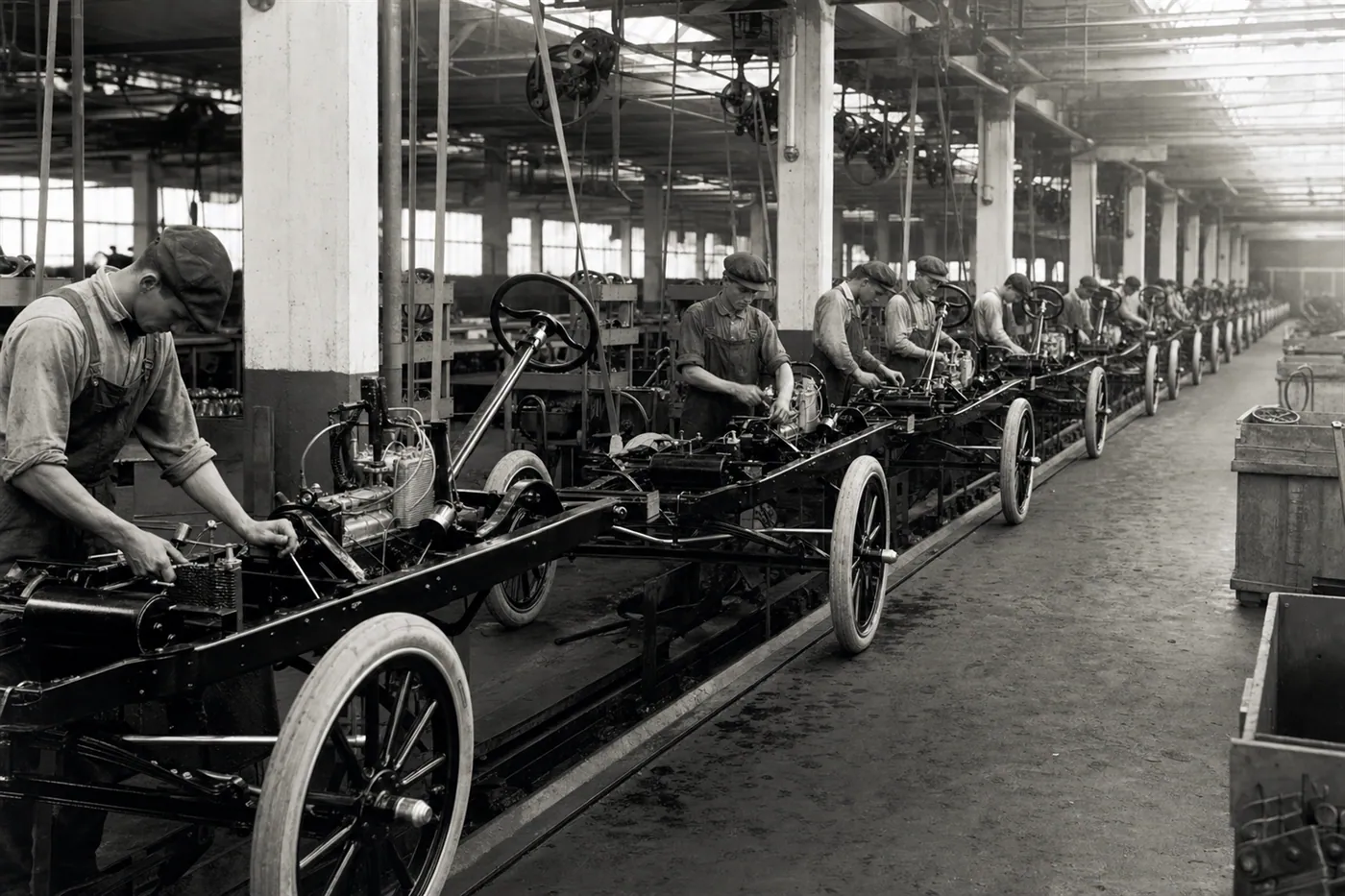
A form of production in which the object under assembly moves between stations at a fixed tempo while each station repeats a single operation upon it. Ford applied it to whole-car assembly at Highland Park in Detroit in 1913: chassis drawn slowly by winch past men who stood in place and repeated one motion, cutting the labour time of a Model T from about twelve hours to roughly ninety minutes and bringing the price within reach of an ordinary worker. Its precondition is interchangeable parts—if components must be filed to fit, the line cannot move a step. Its cost falls on people: the tempo is set by the machine rather than the worker, and the work is divided down to cycles of seconds. Annual turnover at Ford reached some 370 per cent in 1913, and only the five-dollar day kept the workforce in place. For a century since, the assembly line has been both the synonym of productive efficiency and the readiest image of persons handled as stages in a process.
The man who places a part does not fasten it.
—— Henry Ford, My Life and Work (1922), on the principles of the line
History
Continuous flow was not Ford's invention. The slaughterhouses of Cincinnati and Chicago had by the later nineteenth century hung carcasses on overhead rails, each man along the line making his one cut (Ford himself named them as his source), and flour mills and canneries had similar arrangements. Ford's novelty was twofold: he applied continuous flow to assembly, the composition of a complex machine from a thousand parts rather than the dismemberment of an animal; and he paid the price this required in interchangeability, retooling any component that could not be made to fit without filing. At Highland Park in 1913 the method was first tried on magneto assembly, cutting the operation from twenty minutes to five; the chassis line followed, a winch drawing the frame slowly past a hundred men each fixed at a station. Turnover in the plant rose sharply the same year, since work reduced to a cycle of seconds proved unendurable for most, and only the five-dollar day of 1914, nearly doubling the wage, held the workforce. The price of a Model T fell from something over eight hundred dollars in 1908 to under three hundred by the 1920s, and the motor car passed from a rich man's toy to a common possession. The line then travelled on the drawings of Ford's own buildings: the Gorky works in the USSR, Volkswagen in Germany, Toyota in Japan all took from it—and the just-in-time and autonomation that Toyota later developed are precisely a counter-thesis to one feature of it, that the tempo is set by the machine and the worker may not stop the line.
Connections
Causes2
- The Ideology of EfficiencyappliesFord's moving line put the ideology of efficiency into the organization of production: Taylorism decomposed the motions, the line fixed the tempo
- Interchangeable PartsenablesIf parts must be filed to fit, the line cannot move a step: interchangeability is the hard precondition of continuous assembly
Consequences1
- The Holocaustinforms · disputedThe assembly line is what the metaphor of industrialized killing points to, but the metaphor has limits: some one and a half million people were shot, not processed
Sources
- Henry Ford (1922), My Life and Work
- James P. Womack, Daniel T. Jones & Daniel Roos, The Machine That Changed the World
- Harry Braverman, Labor and Monopoly Capital: The Degradation of Work in the Twentieth Century
- Assembly line
Open questionswell attested
- "Ford invented the assembly line" is a popular simplification; continuous flow was already long established in the disassembly lines of Chicago's meatpackers, in flour mills and in canneries, and Ford's contribution was to apply it to the final assembly of a complex product, backed by strict interchangeability of parts.
- The fall in Model T assembly time from 12 hours to 93 minutes is the Ford company's own figure; since sources quote slightly different numbers, the safer wording is from about twelve hours to about ninety minutes.
- The five-dollar day had several motives (keeping workers, holding off unions and creating consumers); scholars still debate their relative weight, so no single explanation should be adopted.
- Linking the assembly line with the Holocaust is a matter of imagery and implies no causal connection.
Why it matters
The assembly line is one of the rare inventions whose gains and losses are equally plain. The gains need no defence: it brought motor cars, appliances, and medicines within reach of ordinary households, and a considerable share of the general improvement in twentieth-century material life belongs to its account. The losses need none either: it rewrote what work means. Before it, a worker's skill was that he could make a whole thing; after it, the skill lay in the machines and the jigs, and what the person supplied was a replaceable stretch of motion. Braverman called this deskilling; Chaplin played it as comedy in Modern Times with two wrenches; and Ford's 370 per cent turnover in 1913 is the same fact without the comedy. It is the third layer that requires care. The line became an image: any organization that handles persons as items and moves them station by station is called assembly-line—including, in many descriptions, the Nazi extermination camps. The metaphor catches something true (registration, numbering, processing in order, a division of labour in which no one faces the whole) and conceals something equally true: some one and a half million people were shot face to face in the East, where there was no conveyor and no procedure to hide behind. The more readily a metaphor comes to hand, the more one should mistrust the thinking it saves us. As for the line itself, it required nothing of anyone; it only made completing one's own step in time so natural a way to work that every organization since which asks people to work that way can claim to be doing no more than the obvious.