A manufacturing system in which parts of the same pattern can be assembled interchangeably. Its core is not a single invention but the institutionalization of gauges, jigs, and tolerances—defining "correct" by fixed inspection gauges rather than a craftsman's feel. Honoré Blanc was making musket locks this way in 1780s France; Eli Whitney's celebrated demonstration of 1801 has been shown to use pre-fitted parts. What made it a system was sustained investment at the U.S. federal armories in the first half of the nineteenth century, whence it passed through sewing machines, clocks, and bicycles to the automobile, becoming known as the "American system of manufactures."
The tools which I contemplate are similar to an engraving on copper plate from which may be taken a great number of impressions perceptibly alike.
—— Eli Whitney to Treasury Secretary Oliver Wolcott, 1799
History
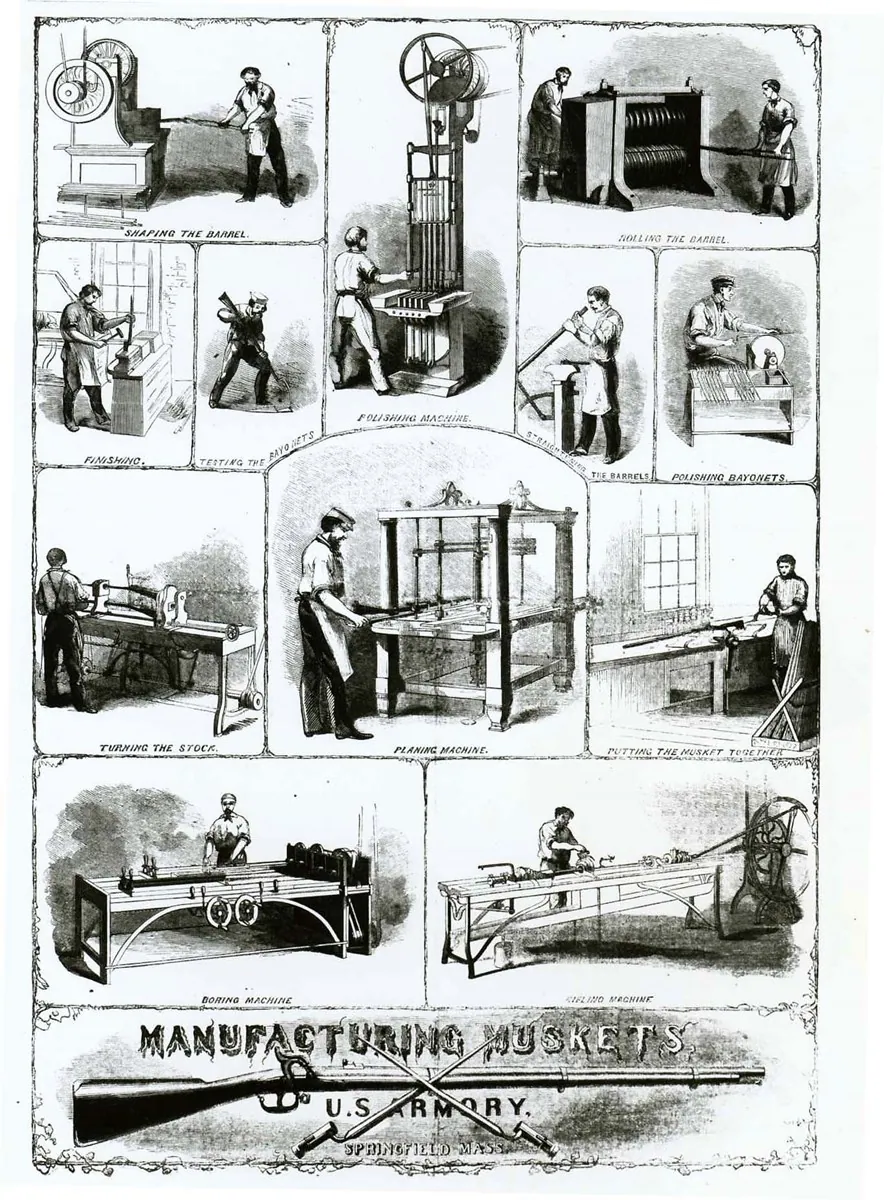
In the age of handcraft each musket's parts were fitted by one smith to that one musket, and a breakage meant filing a new part to fit. In the 1780s the French gunsmith Honoré Blanc demonstrated interchangeable flintlock mechanisms: Thomas Jefferson, then minister in Paris, watched him assemble locks from bins of parts taken at random, was much struck, and wrote home about it. The French Revolution cut that thread. In 1798 Eli Whitney won a federal contract for ten thousand muskets on a promise of interchangeability and in 1801 assembled arms before Congress—archival work in the twentieth century, notably by Merritt Roe Smith, showed the parts had been numbered and matched in advance, the demonstration carefully staged; his deliveries ran years late. The real advance came from the federal armories: Springfield and Harpers Ferry invested for decades in gauges, jigs, patterns, and milling machines, shifting the definition of "correct" from the craftsman's feel to hard inspection gauges, and reached practical interchangeability around the 1840s. The method then left the armories for sewing machines, clocks, agricultural implements, and bicycles; British commissioners in the 1850s named it "the American system of manufactures," and in the early twentieth century, joined to Ford's moving line, it became the basis of mass production.
Connections
Consequences2
- The LudditesinspiresDeskilling as the other face of what the artisans resisted
- The Assembly LineenablesIf parts must be filed to fit, the line cannot move a step: interchangeability is the hard precondition of continuous assembly
Sources
- Merritt Roe Smith, Harpers Ferry Armory and the New Technology: The Challenge of Change
- Nathan Rosenberg (ed.), The American System of Manufactures
- Interchangeable parts
Open questionswell attested
- The parts in Whitney's 1801 demonstration before Congress had been numbered and matched in advance and were not truly interchangeable, as archival research by Merritt Roe Smith and others has confirmed.
- Honoré Blanc's work in the 1780s came earlier and was cut short by the French Revolution.
- The name "American system of manufactures" comes from a British commission of the 1850s and was not a name Americans used at the time.
- Full interchangeability had to wait for gauges and milling machines to mature in the mid-nineteenth century.
Why it matters
The history of interchangeable parts punctures two myths. The first is the heroic inventor: Whitney's demonstration was theatre, and what made interchangeability real was decades of unglamorous gauge-and-process work inside the armories—the protagonists of technical history frequently have no names. The second is that technology is a thing: interchangeable parts involve almost no new physical principle, and consist essentially in an organizational settlement about precision, inspection, and standards. Its deeper consequences are organizational as well: assembly could now be done by the unskilled, as the craftsman's knowledge migrated into machines and gauges. This is the beginning of deskilling, and what the Luddites fought was another face of the same process.