English mathematician. He defined computability in 1936, helped break Enigma at Bletchley Park, designed a stored-program computer and proposed the imitation game. Convicted in 1952 for homosexual acts, he died of cyanide poisoning in 1954.
We can only see a short distance ahead, but we can see plenty there that needs to be done.
—— Alan Turing, "Computing Machinery and Intelligence", Mind 59, no. 236 (October 1950), closing sentence
History
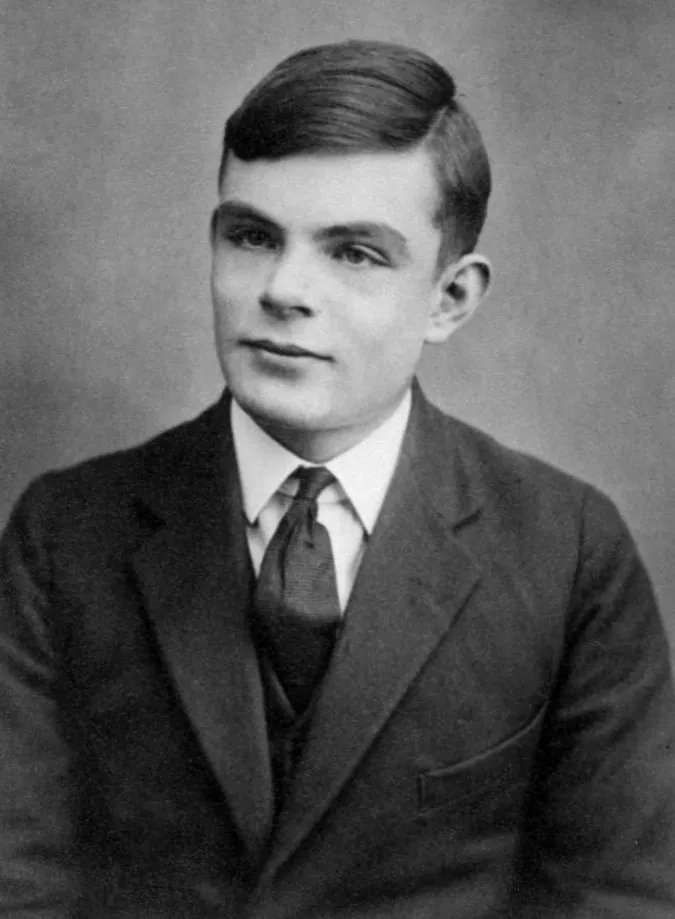
Alan Turing was born in London in 1912 and read mathematics at King's College, Cambridge. In May 1936 he completed "On Computable Numbers, with an Application to the Entscheidungsproblem", which defined computability through an imaginary machine and answered Hilbert's decision problem in the negative; he then took a doctorate under Alonzo Church at Princeton (1938). On 4 September 1939 he reported to the Government Code and Cypher School at Bletchley Park. Within weeks he had specified the bombe, an electromechanical machine for finding Enigma settings, developed from a Polish device and improved by Gordon Welchman; the first was installed in March 1940, and he went on to lead Hut 8 against German naval Enigma. In February 1946 he gave the National Physical Laboratory his design for the ACE, among the first complete stored-program designs; a pilot version ran only in 1950. Having moved to Manchester in 1948, he published "Computing Machinery and Intelligence" (Mind, 1950), which replaced the question whether machines can think with the imitation game; a 1951 lecture expected machines eventually "to take control", citing Samuel Butler's Erewhon; in 1952 he published a chemical theory of morphogenesis. In March 1952 he was convicted of "gross indecency" over a relationship with a young man, chose probation conditional on a year of oestrogen "treatment", and lost his security clearance. On 7 June 1954 he died of cyanide poisoning at home in Wilmslow; the inquest returned a verdict of suicide.
Connections
Consequences2
- Computability (the Turing Machine)contributedOn Computable Numbers (1936)
- The Electronic ComputercontributedWartime codebreaking machines and the post-war ACE design
Echoes1
- Charles DarwinechoesButler imagined machines evolving in “Darwin among the Machines”; Turing cited Butler in 1951
Sources
- Andrew Hodges, Alan Turing: The Enigma (1983)
- B. Jack Copeland (ed.), The Essential Turing (2004)
- A. M. Turing, Computing Machinery and Intelligence (Mind 59.236) (1950)
Open questionswell attested
- The bombe was a collective achievement, and the earlier Polish work and Gordon Welchman's improvements were indispensable to it.
- The extent of Turing's influence on von Neumann's EDVAC design is debated.
- The inquest returned a verdict of suicide, but Jack Copeland and others argue that an accident cannot be ruled out.
- The bitten apple beside his bed was never tested.
Why it matters
Turing's weight comes from standing at once in logic, engineering and philosophy. The 1936 paper turned a question in the foundations of mathematics into a question about machines, and its universal machine, able to imitate any other, became the frame for understanding the stored-program computer; wartime codebreaking then made him at home among large electromechanical and electronic installations. The 1950 paper turned the question whether machines can think into an operational test and answered objections one by one, among them one drawn from Ada Lovelace; it still frames arguments about artificial intelligence. His last years were shaped by British law criminalising sex between men and by early Cold War security vetting. Gordon Brown apologised on behalf of the government in 2009, a royal pardon followed in 2013, and a 2017 law extended pardons to others convicted under such laws. Andrew Hodges accepts the inquest's verdict; Jack Copeland argues that the evidence does not exclude accidental inhalation.