English naturalist. After nearly five years aboard HMS Beagle he hit on natural selection in 1838, spent twenty years gathering evidence, and published On the Origin of Species in 1859.
In October 1838, that is, fifteen months after I had begun my systematic enquiry, I happened to read for amusement 'Malthus on Population,' ... it at once struck me that under these circumstances favourable variations would tend to be preserved, and unfavourable ones to be destroyed. The result of this would be the formation of new species. Here then I had at last got a theory by which to work.
—— Charles Darwin, Autobiography (written 1876), in The Life and Letters of Charles Darwin, ed. Francis Darwin (1887)
History
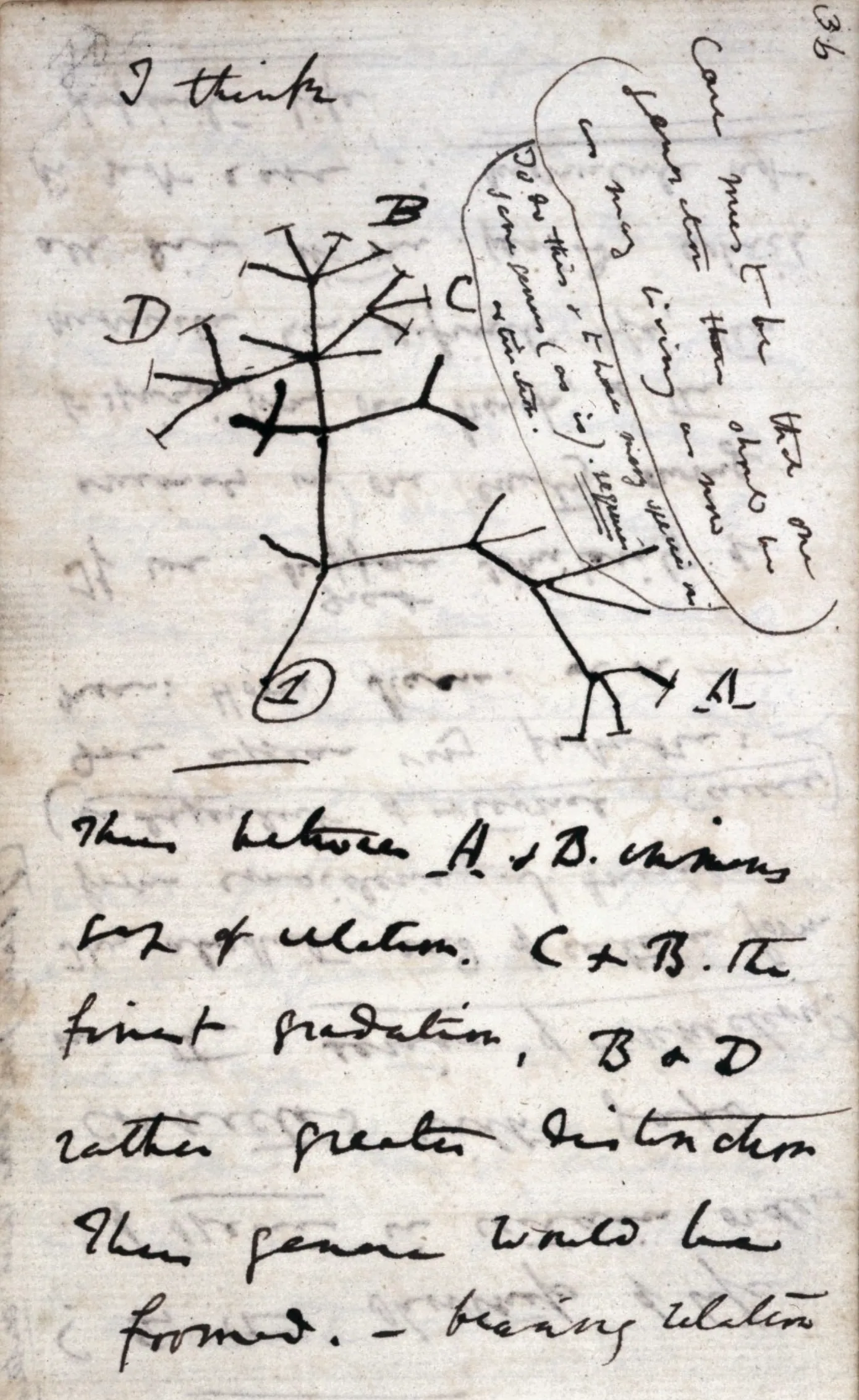
Charles Darwin was born in Shrewsbury in 1809. He abandoned medicine at Edinburgh, went to Cambridge intending to become a clergyman, and in December 1831 sailed as a gentleman naturalist on HMS Beagle, returning in October 1836. In the Galápagos it was the mockingbirds, different from island to island, that caught his attention; the finches he did not even label by island. In January 1837 John Gould identified them as a new group of closely related species, and the name and legend of "Darwin's finches" belong to the twentieth century. In mid-1837 he opened his notebooks on the transmutation of species and in Notebook B sketched a branching tree headed "I think". On 28 September 1838 he recorded the idea that came from reading Malthus. He wrote a 35-page sketch in 1842 and a 230-page essay in 1844, with a letter asking his wife to publish it should he die. Eight years on barnacle taxonomy followed, then pigeon-breeding at Down House and a vast correspondence with breeders and naturalists. In June 1858 an essay arrived from Alfred Russel Wallace in the Malay Archipelago; Charles Lyell and Joseph Hooker had both men's papers read at the Linnean Society on 1 July. On the Origin of Species appeared on 24 November 1859 in 1,250 copies, and The Descent of Man in 1871. He died at Down House in 1882 and was buried in Westminster Abbey.
Connections
Consequences1
- Natural SelectioncontributedOn the Origin of Species (1859)
Echoes1
- Alan TuringechoesButler imagined machines evolving in “Darwin among the Machines”; Turing cited Butler in 1951
Sources
- Charles Darwin, On the Origin of Species by Means of Natural Selection (1859)
- Janet Browne, Charles Darwin: Voyaging; Charles Darwin: The Power of Place (1995, 2002)
- Frank J. Sulloway, Darwin and His Finches: The Evolution of a Legend (Journal of the History of Biology 15.1) (1982)
- John van Wyhe, Mind the Gap: Did Darwin Avoid Publishing His Theory for Many Years? (Notes and Records of the Royal Society 61.2) (2007)
Open questionswell attested
- His Autobiography dates his reading of Malthus to October 1838, whereas his notebooks give 28 September.
- The date on which he received Wallace's paper has been questioned; the usual date is 18 June 1858.
- Whether his twenty-year delay in publishing was deliberate avoidance is debated.
- The "I think" branching diagram dates from around the summer or autumn of 1837; its exact date is uncertain.
Why it matters
Darwin offered an explanation of adaptation that needs no designer: the fit between organisms and their surroundings can accumulate from countless small differences sifted over generations. Its sources bear the marks of the age. Breeders' artificial selection supplied the analogy, Malthus the picture of struggle, imperial voyages and colonial correspondents the evidence, and historians have long noted its kinship with Victorian political economy. Why he waited twenty years was once put down to fear of religious and social reaction; John van Wyhe, having read through the correspondence, argues that there was no deliberate delay, only the research Darwin thought the theory required. His way of working is itself instructive: from a country house, by letters, questionnaires, a greenhouse and a pigeon loft, a science conducted largely outside universities and laboratories. Wallace's essay forced him into print, yet the joint discovery is still usually filed under one name.