The mechanism of evolution proposed by Darwin and Wallace: heritable differences among individuals, more offspring than can survive, and better-suited variants leaving more descendants, so that differences accumulate into new species.
There is grandeur in this view of life, with its several powers, having been originally breathed into a few forms or into one; and that, whilst this planet has gone cycling on according to the fixed law of gravity, from so simple a beginning endless forms most beautiful and most wonderful have been, and are being, evolved.
—— Charles Darwin, On the Origin of Species (London, 1859), last sentence of the first edition; from the second edition (1860) "by the Creator" follows "breathed"
History
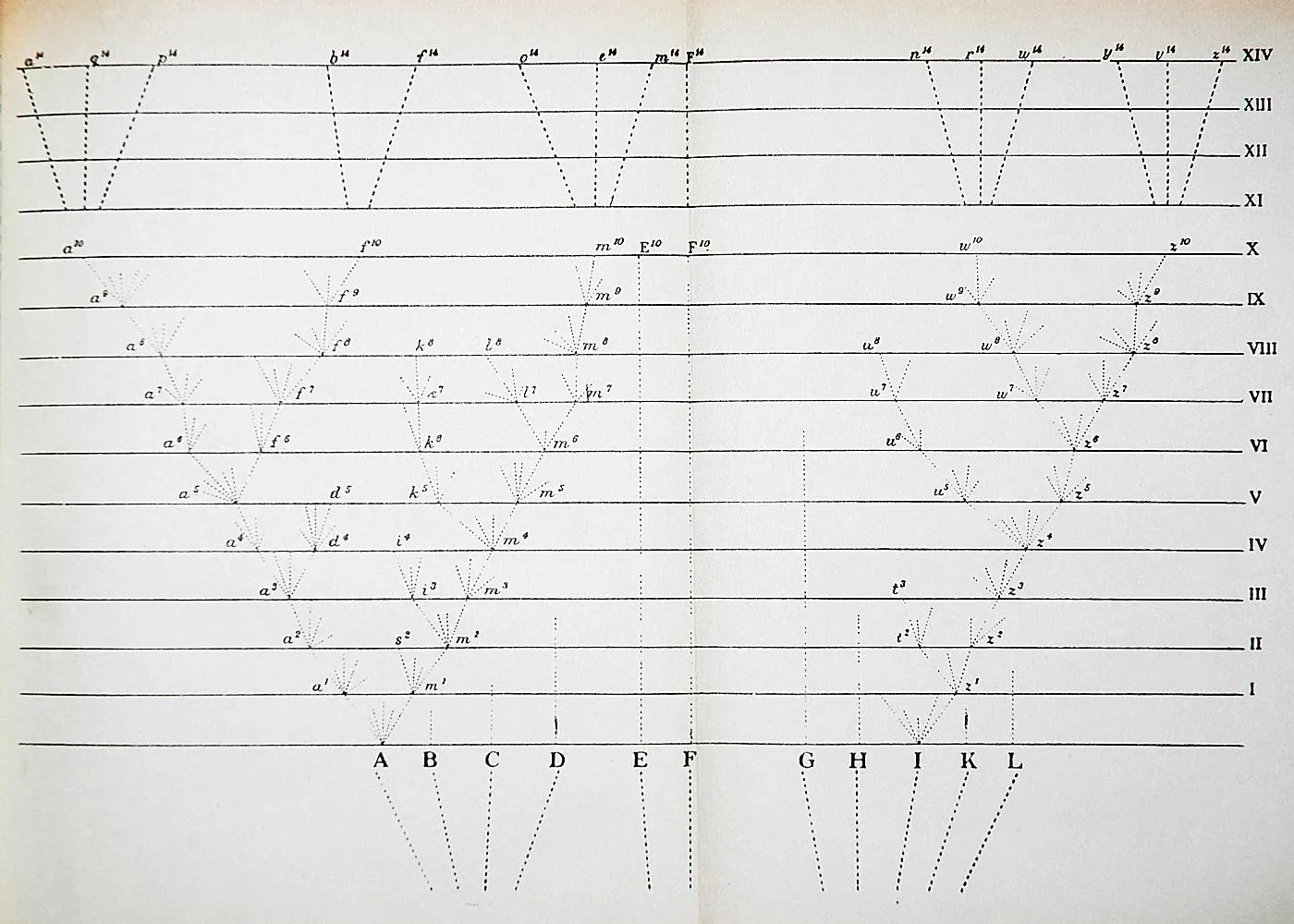
Natural selection is the process by which, where individuals differ in heritable ways and more are born than can survive, those slightly better suited leave on average more offspring, so that differences accumulate over generations. Darwin reached the idea in 1838 and Alfred Russel Wallace, independently, in 1858; both men's papers were read at the Linnean Society that July. On the Origin of Species (1859) argues from breeders' selection of pigeons, dogs and grain to show how the "struggle for existence" sifts variation in the wild; its only illustration is a branching diagram of descent. Darwin also borrowed Henri Milne-Edwards's "physiological division of labour" to explain why species diverge. The weak point was heredity. Darwin's "pangenesis" (1868) won no support, and in 1867 the engineer Fleeming Jenkin objected that if inheritance blended parental traits, a favourable variation would be diluted away. Gregor Mendel's pea experiments, published in 1866, were rediscovered only in 1900 and at first set against selection; from the 1930s R. A. Fisher, J. B. S. Haldane and Sewall Wright joined genetics to selection, and Julian Huxley in 1942 called the result the "modern synthesis". "Survival of the fittest" was Herbert Spencer's phrase (1864), adopted by Darwin from 1869. In 1863 Samuel Butler's "Darwin among the Machines", a letter to a New Zealand newspaper, imagined machines evolving until they ruled their makers.
Connections
Causes3
- The Division of Labourinspires · disputedDarwin drew on the “physiological division of labour” to explain divergence
- Charles DarwincontributedOn the Origin of Species (1859)
- The Origins of Agriculture (Neolithic Revolution)inspiresDarwin argued from breeders' artificial selection to natural selection
Consequences1
- EugenicsinspiresDarwin's half-cousin Francis Galton carried selection into human society; a misappropriation, not an inference
Sources
- Charles Darwin, On the Origin of Species by Means of Natural Selection (1859)
- Peter J. Bowler, Evolution: The History of an Idea (3rd ed.) (2003)
- Ernst Mayr, William B. Provine (eds.), The Evolutionary Synthesis: Perspectives on the Unification of Biology (1980)
- Samuel Butler, Darwin among the Machines (letter to The Press, Christchurch, 13 June 1863) (1863)
Open questionswell attested
- Patrick Matthew (1831) and others had made similar statements, and priority is debated.
- "Social Darwinism" is mostly a label applied by critics, and what it refers to varies.
- Darwin did not entirely rule out other mechanisms, such as use and disuse.
- How far the analogy between technological and biological evolution can be taken is disputed.
Why it matters
Natural selection matters to the history of ideas in two ways. It explained adaptation without purpose: the appearance of design could arise from blind accumulation, which undermined arguments such as William Paley's Natural Theology (1802). And it came from a technique. Darwin understood nature by way of breeding; selection was first a human operation and only then generalised into a natural process. That pedigree made it easy to run the analogy backwards. In the late nineteenth century "survival of the fittest" was invoked to justify unfettered competition, colonial expansion and social hierarchy, and Darwin's cousin Francis Galton coined "eugenics" in 1883 to propose selection among humans. None of this follows from the biology; it treats a description of a natural process as a norm for society. Butler's evolving machines have descendants in theories of technological evolution, though technical variation is mostly deliberate design, passed on through texts, drawings and apprenticeship, and how far the analogy holds is still debated.