The technical system by which electricity is generated, transmitted, and used as a controllable form of energy. Its history as technology begins with Volta's pile of 1800, which for the first time gave a steady continuous current; Faraday's induction of 1831 supplied the principle by which mechanical and electrical energy are exchanged, and from it came the generator and the motor. In the 1880s Edison's direct-current system contended with the alternating-current system of Tesla and Westinghouse over the mode of distribution; alternating current prevailed because it could be transformed and sent far, and electricity ceased to be a laboratory phenomenon and became urban infrastructure. What distinguishes it from every earlier form of power is that it travels: the work of a steam engine must be used where it is made, whereas electricity may be generated a hundred kilometres away and spent here. The layout of factories, the shape of housework, and the length of the evening were all rearranged accordingly.
We will make electricity so cheap that only the rich will burn candles.
—— Attributed to Thomas Edison, c. 1880 (widely quoted; original source uncertain)
History
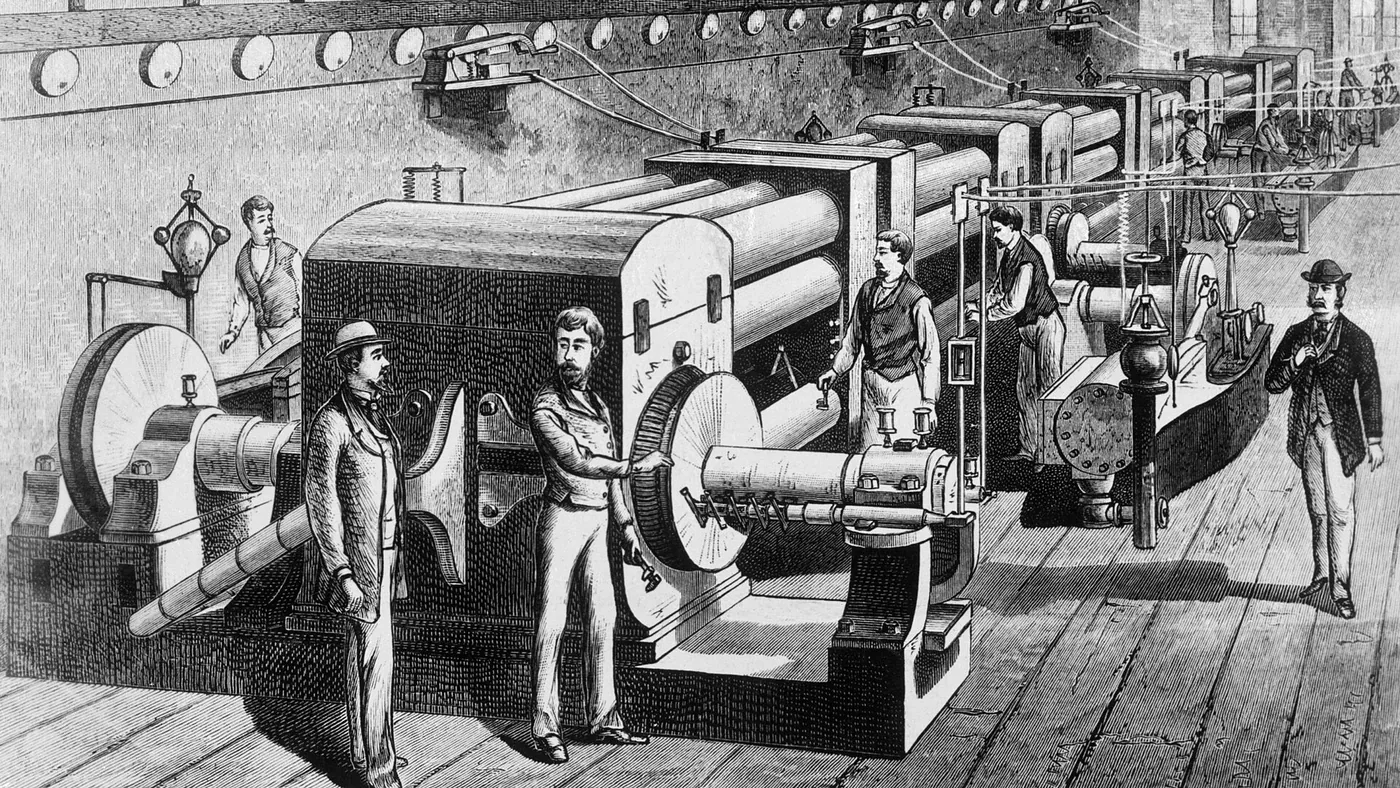
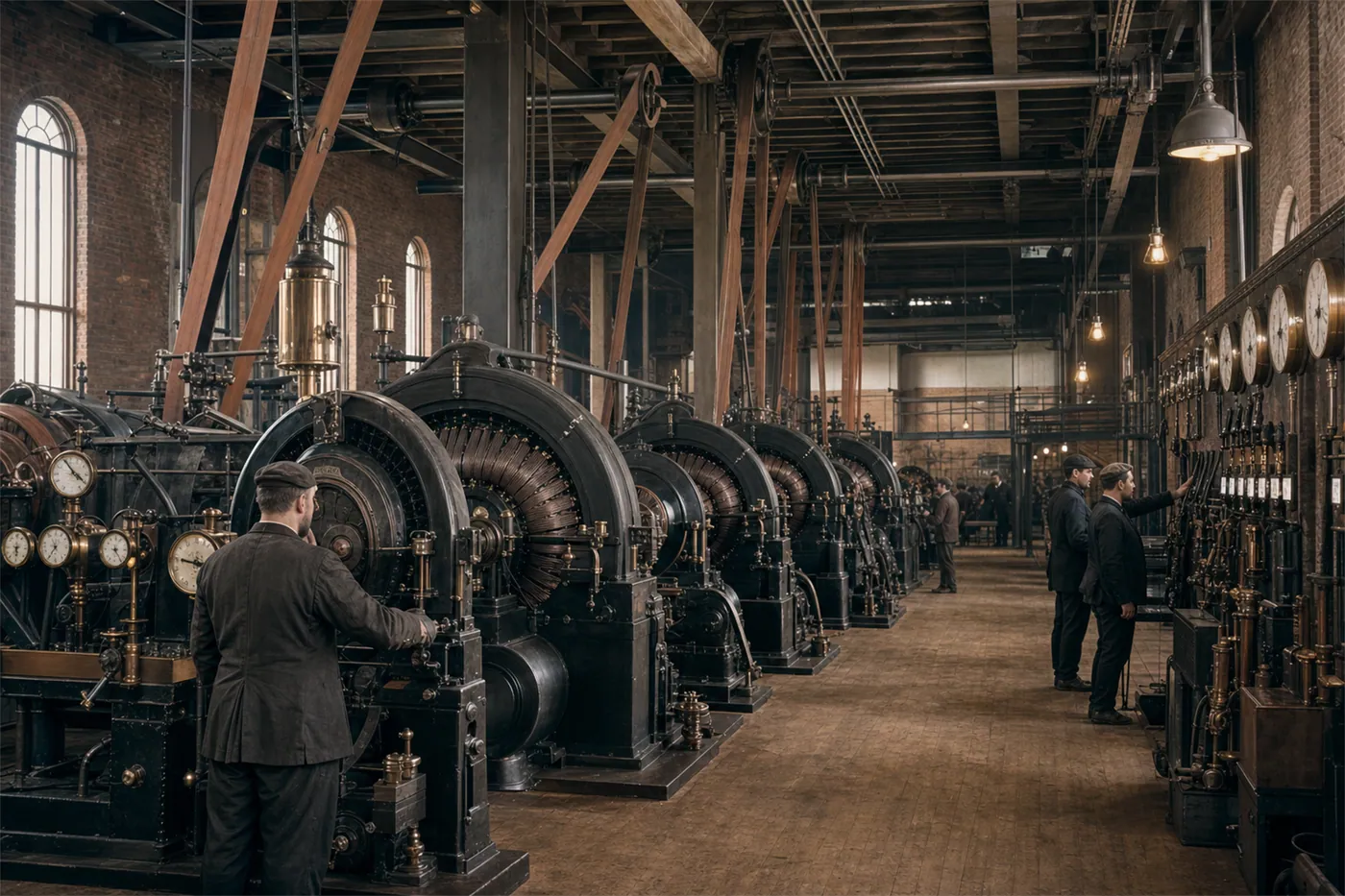
Static electricity had been known since antiquity, and by the eighteenth century friction machines and Leyden jars were salon entertainments, but all of it was momentary discharge. In 1800 Volta stacked zinc and copper discs with brine-soaked cloth into a pile, and for the first time there was a steady continuous current: the study passed from static electricity to current electricity, and could now be experimented with and put to work. In 1820 Ørsted found that a current deflects a magnetic needle; in 1831 Faraday showed the converse, that a changing magnetic field generates a current. That exchange is the common basis of generator and motor. For the next half-century electricity served chiefly telegraphy, from the 1840s, and electroplating, until the demand for light pushed it toward supply at scale. Around 1879 Edison and Swan each produced a serviceable incandescent lamp; in 1882 Edison's Pearl Street station in New York supplied direct current to several hundred customers nearby. Direct current could not be transformed, so line losses limited its reach and a station was needed every kilometre or two. Westinghouse bought the transformer patents and engaged Tesla, sending alternating current at high voltage and stepping it down at the customer's end. A fierce commercial and public campaign followed in the late 1880s; the lighting of the Chicago World's Fair in 1893 and the Niagara plant of 1895 both took alternating current, and the contest was substantially settled. The decisive figures thereafter were not inventors but system builders: in the era of the power networks described by Thomas Hughes, the problems were load curves, tariff structure, and interconnection—how to make day and night, factory and household, fill in one another's demand.
Connections
Causes1
- Electromagnetic Field TheoryenablesFaraday's induction (1831) is the principle of the generator
Consequences3
- The TelegraphenablesA steady continuous current, from the voltaic pile onward, is the material precondition of the electric telegraph, which was electricity's first large-scale application
- Electromagnetic Field TheoryinformsThe steady current of the voltaic pile made electromagnetic experiments possible
- The Electronic ComputerenablesVacuum tubes and a steady supply of current
Sources
- Thomas P. Hughes, Networks of Power: Electrification in Western Society, 1880–1930
- Jill Jonnes, Empires of Light: Edison, Tesla, Westinghouse, and the Race to Electrify the World
- Michael Faraday (1839–1855), Experimental Researches in Electricity
- Electricity
Open questionswell attested
- The "War of the Currents" was a commercial and technological contest between Edison General Electric and Westinghouse, though it is often told as a personal duel between Edison and Tesla; in the end AC also took over some DC practices.
- The invention of the voltaic pile was preceded by the dispute over Galvani's "animal electricity", and the disagreement between the two men was itself part of how the concepts of electricity took shape, so it should not be left out.
- The original source of the epigraph is doubtful; this is flagged accordingly, and the quotation is not used as historical evidence.
- The effect of electrification on productivity came only after a marked time lag (reorganizing factory layouts took decades), and the research of Paul David and others on this is a classic case of "general-purpose technologies needing complementary organizational change".
Why it matters
What most deserves the historian's notice in electricity is that it moved the weight of the word technology from the device to the system. The incandescent lamp is an easy invention to narrate, and the lamp by itself was worth nothing: Edison's real work was to design at once the generator, the cable, the switch, the meter, the basis of billing, and a whole course of negotiation for municipal franchises, without any one of which the lamp is a glass bulb. Hughes called such things large technological systems, and their development is driven not by single inventions but by imbalance among their parts: where one element runs ahead, a bottleneck forms elsewhere, and the bottleneck becomes the direction of the next investment. The model has since been applied to railways, telecommunications, and the internet, and is among the few analytical tools in the history of technology with predictive purchase. A second layer concerns delay. Electric motors could replace steam engines by the 1890s, yet American manufacturing productivity did not rise accordingly, because plants were still laid out for steam: one great engine drove the whole works through line shafting and belts, and machines had to crowd beneath the shaft. To gain what electricity offered required a motor on each machine and a building rearranged by process rather than by transmission, which meant demolition and rebuilding. The change took some thirty years, and only then did productivity jump. The returns of a general-purpose technology are usually realized not when it is adopted but after the organization around it has been rewritten—which is electrification's standard answer to every subsequent question of why the new technology has not yet shown results.