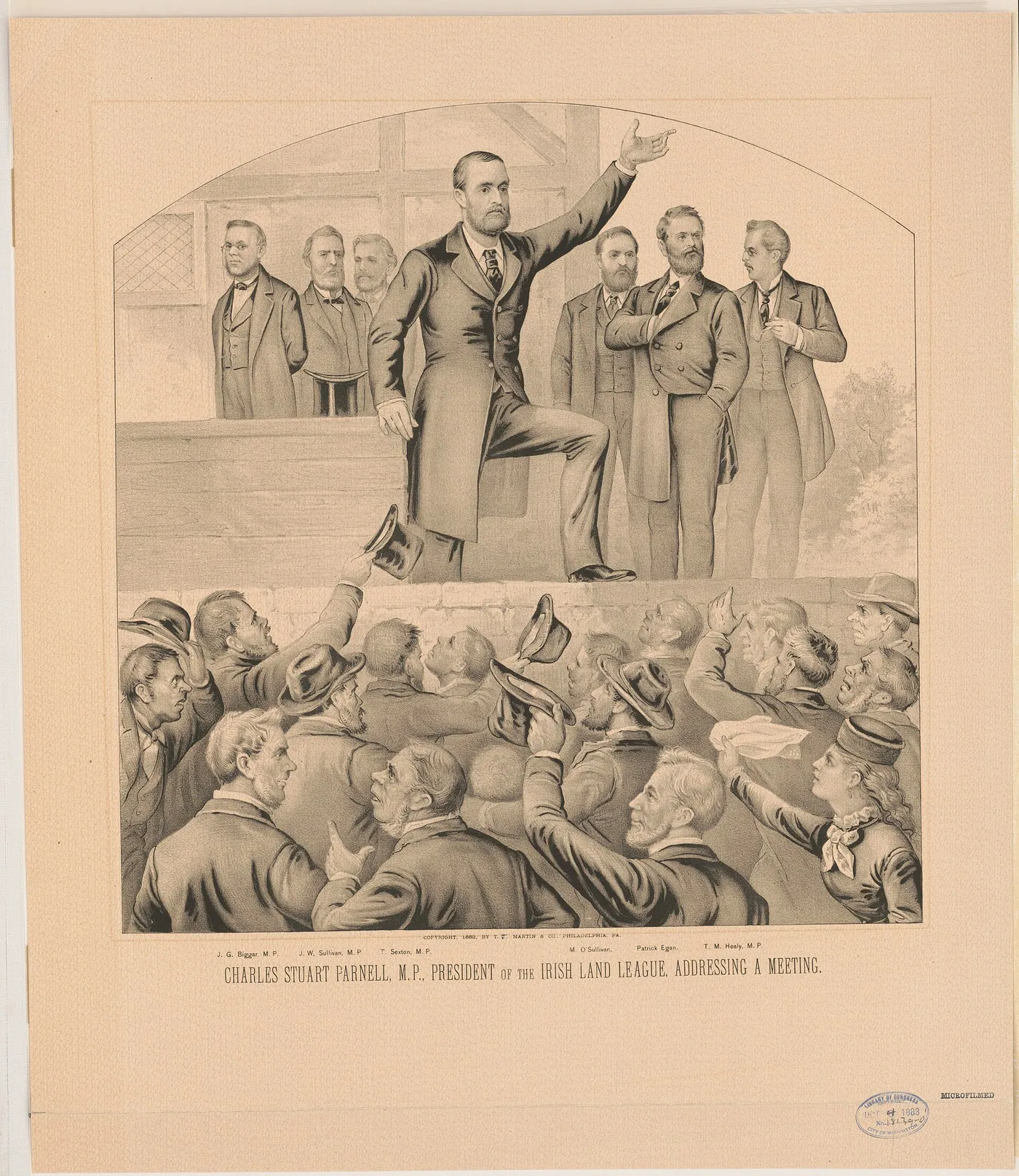
The political movement for Irish self-government and independence from the mid-nineteenth century onward. The Great Famine both cut and scattered the population and engraved in successive generations the judgement that the famine was a crime of governance rather than an act of nature—the central narrative of later mobilization. The Fenian Brotherhood was founded simultaneously in New York and Dublin in 1858, with much of its money and manpower from the emigrant communities; in 1879 the Land League fused the land question with the national question, and the word "boycott" comes from that struggle.
You must show him on the roadside when you meet him… by isolating him from the rest of his country as if he were the leper of old.
—— Charles Stewart Parnell, speech at Ennis, 19 September 1880
History
In 1848, at the depth of the famine, Young Ireland launched a rising that failed quickly; its exiles nonetheless became the cadre of the next generation's organizations. In 1858 the Fenian Brotherhood (the Irish Republican Brotherhood) was founded in Dublin and New York at once—a two-city structure that was itself a product of the famine, since mass emigration had created an overseas community with income, political space, and a strong grievance toward the old country, whose remittances and subscriptions would sustain the movement at home for decades. When harvests failed and rents pressed again in 1879, Michael Davitt and Parnell formed the Land League and demanded the "three Fs": fair rent, fixity of tenure, free sale. In his Ennis speech Parnell proposed meeting anyone who took over a farm from an evicted tenant not with violence but with social isolation; days later tenants in County Mayo applied the method to the land agent Charles Boycott, leaving him without labour or trade, and "boycott" entered the English language. The Land War eventually produced a series of Land Acts, and the purchase acts of the late nineteenth century let tenants borrow to buy their holdings, dissolving landlordism by degrees. Politically, Home Rule was repeatedly frustrated; the Easter Rising of 1916 and the war that followed led to the state of 1922.
Connections
Causes2
- The Great Famine (An Gorta Mór)inspiresProvoked nationalism and the Fenian movement
- Transatlantic EmigrationenablesRemittances and organizational space in the diaspora sustained the movement at home
Sources
- R. F. Foster, Modern Ireland 1600–1972
- M. J. Kelly, The Fenian Ideal and Irish Nationalism, 1882–1916
- Irish Land League
Open questionspartly uncertain
- A causal link between memory of the Famine and nationalism is the mainstream interpretation, but its weight and the mechanisms of transmission (especially the role of the diaspora) are still debated.
- It is well established that the word "boycott" comes from the 1880 ostracism of the land agent Charles Boycott.
- The period covered ends with the founding of the state in 1922 and does not extend to later developments.
Why it matters
The path from a disaster to a national movement is easily written glibly, as though suffering converted automatically into awakening. The reality is more complicated. The famine's immediate effect was dissolution, not mobilization: the poorest died or left, and those who remained were occupied with survival, so the rising of 1848 met almost no response. What converted famine into political energy was time and distance—a generation later, in New York and Boston, the memory was retold, organized, and funded. Between a disaster and its political consequences lies the institutionalization of memory: who tells it, and to whom. The word "boycott" is worth noting too. A land agent's surname became the world's common term for a form of struggle.