The mass movement of Europeans to the Americas across the nineteenth and early twentieth centuries—some fifty million and more crossed between 1815 and 1914. Steamships, railways, and the telegraph turned emigration from an irreversible farewell into something organizable, affordable, and even reversible; remittances and chain migration bound origin and destination into a single transoceanic social network. Ireland is the extreme case: in the decades after the famine, nearly two in five Irish-born people were living abroad.
They held a wake for the one who was leaving, as for the dead—for most would not be seen again.
—— Summarized from folklore records of the Irish 'American wake'
History
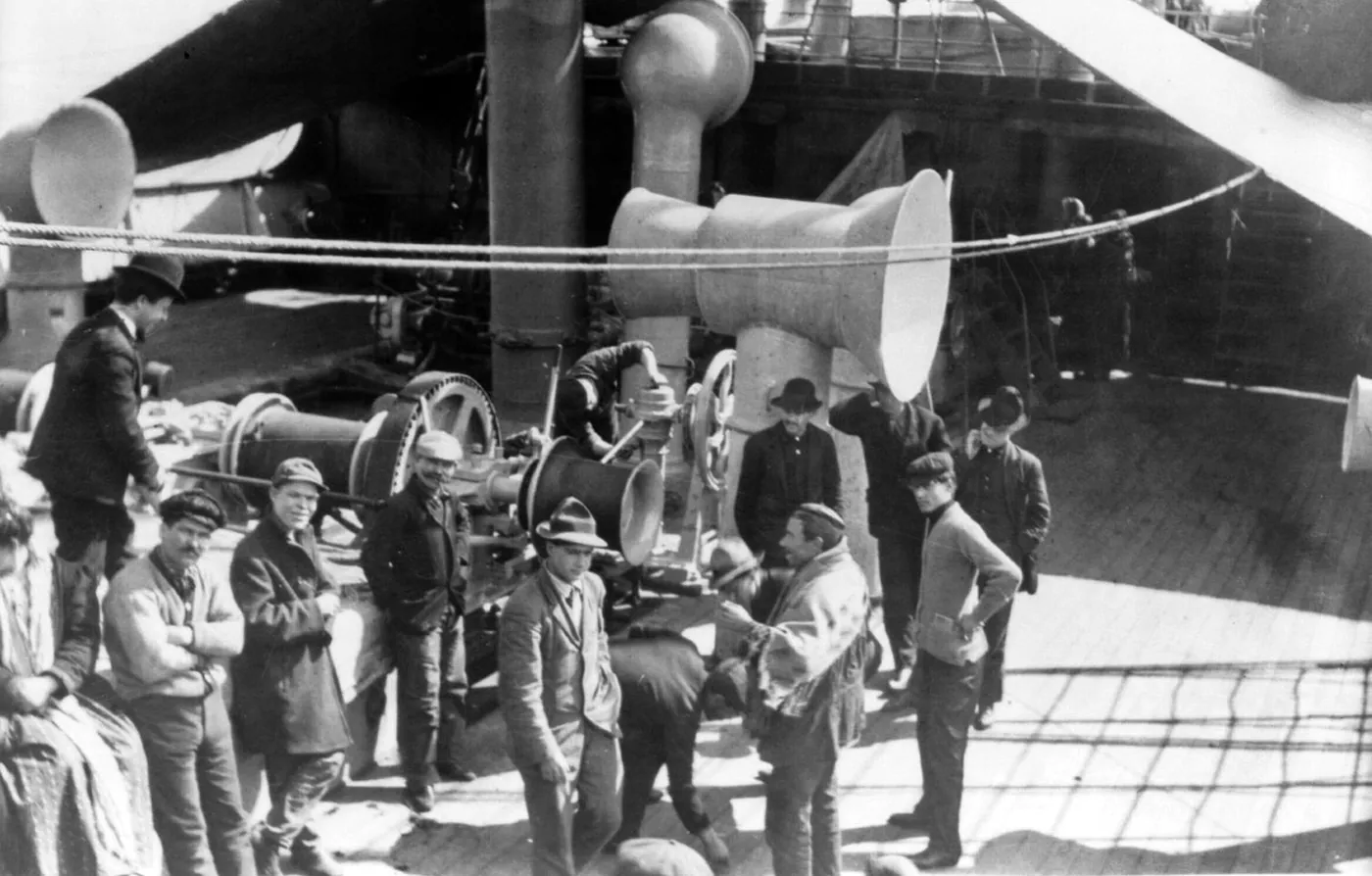
In the first half of the nineteenth century crossings were made under sail, taking weeks to months in wretched conditions; on some 1847 sailings at the height of the Irish famine mortality exceeded twenty percent, whence the name "coffin ships." Then technology transformed the crossing. From the 1850s steamships progressively displaced sail, cutting the crossing to about ten days and making it predictable; railways in the European interior carried people to the ports and American railways carried them inland; the telegraph moved sailing schedules, wage rates, and family letters quickly. The result was not only greater numbers but a change in the form of migration: no longer a whole family staking everything on one departure, but chain migration—one person going first, sending back a prepaid ticket and remittances, then bringing the next; and no longer necessarily one-way, with substantial return rates for some groups by the century's end. Ireland is the extreme case: some two million left during the famine decade and outflow continued for decades after, until nearly two in five Irish-born people lived abroad and remittances were the principal income of many households at home. Over the same period German, Scandinavian, Italian, and East European migrations followed one another, joining Europe's demographic pressure to America's land and industrial demand in a single transoceanic system.
Connections
Causes1
- The Great Famine (An Gorta Mór)inspiresThe famine drove mass transatlantic emigration
Consequences1
- Irish NationalismenablesRemittances and organizational space in the diaspora sustained the movement at home
Sources
- Kerby A. Miller, Emigrants and Exiles: Ireland and the Irish Exodus to North America
- Raymond L. Cohn, Mass Migration under Sail: European Immigration to the Antebellum United States
- Immigration to the United States
Open questionswell attested
- The usual estimate for 1815–1914 is 50 to 60 million emigrants, and national statistics were compiled on different bases.
- Mortality on the "coffin ships" was highest on the Irish voyages of 1847 (over a fifth on some sailings) and was not typical of the whole period.
- Estimates of the scale of remittances vary widely, but their importance to the economies of the places of origin is not disputed.
- The quotation summarizes a folk custom and is not the original wording of any particular source.
Why it matters
Migration history is often written as the economics of push and pull, with technology as backdrop. In fact transport and communication changed the nature of the thing: under sail, emigration was an irreversible gamble; under steam and telegraph it became a family strategy that could be staged, revised, and reversed. The social consequences run deep—diaspora communities could maintain continuous contact with home, and so send back both the remittances that changed a home economy and the funds that changed its politics. The real subject, then, is not the ship but the reorganization of what it means to leave. And the custom of the American wake marks the threshold precisely: while people were still burying the living with the rites of the dead, technology had not yet narrowed the Atlantic.