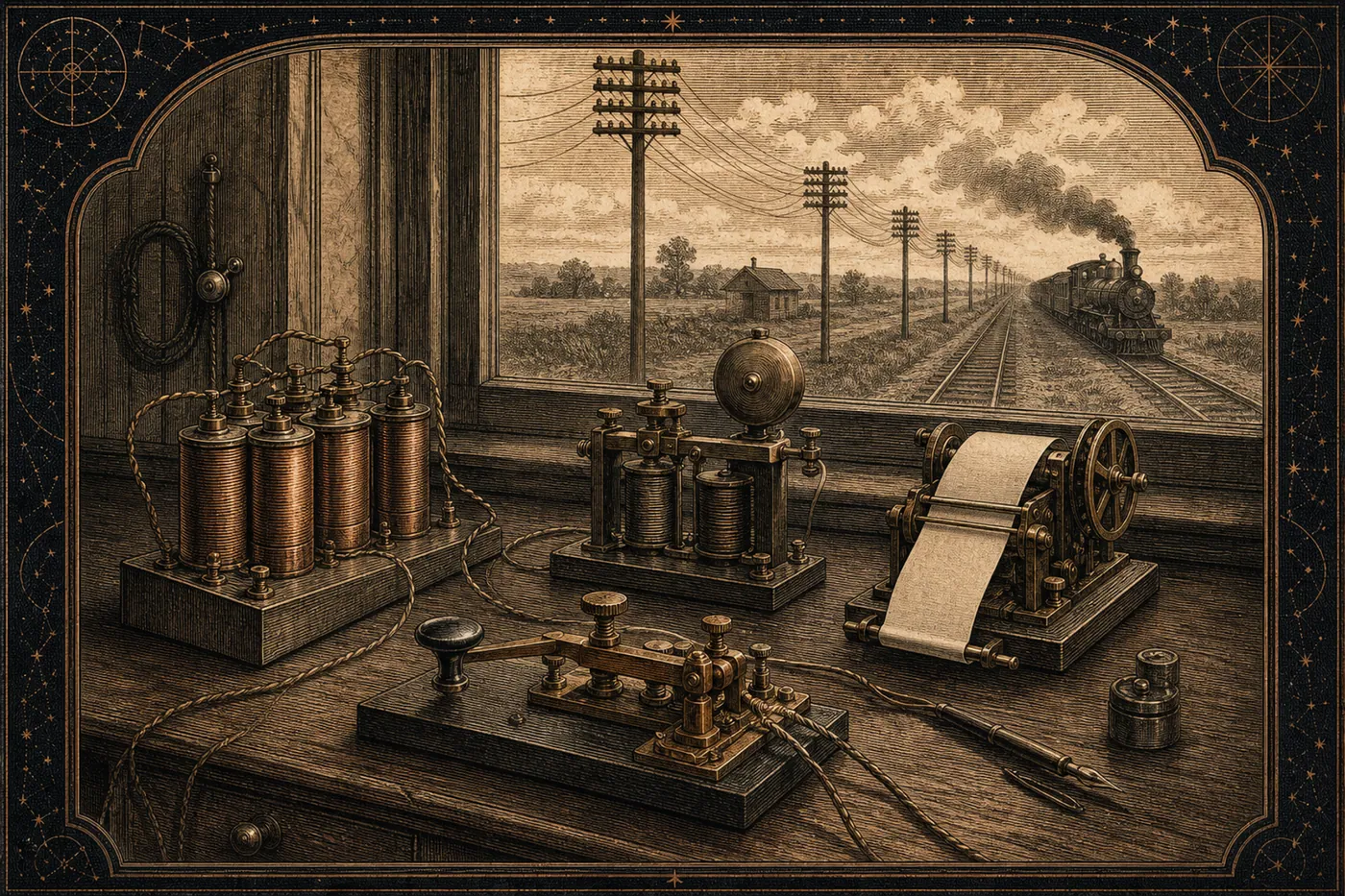
The transmission of coded messages by electric current along wires. Working systems appeared in 1837 with Cooke and Wheatstone in Britain and Morse in the United States; the Washington–Baltimore line opened in 1844; a Channel cable followed in 1851 and a successful transatlantic cable in 1866. From then on news no longer had to cross the sea by ship. The telegraph reshaped news, finance, war, and colonial administration, and brought standard time—and in the Indian famines of 1876–78 it and the railway moved grain efficiently away from the starving.
What hath God wrought!
—— Morse's first public message, Washington to Baltimore, 24 May 1844 (Numbers 23:23)
History
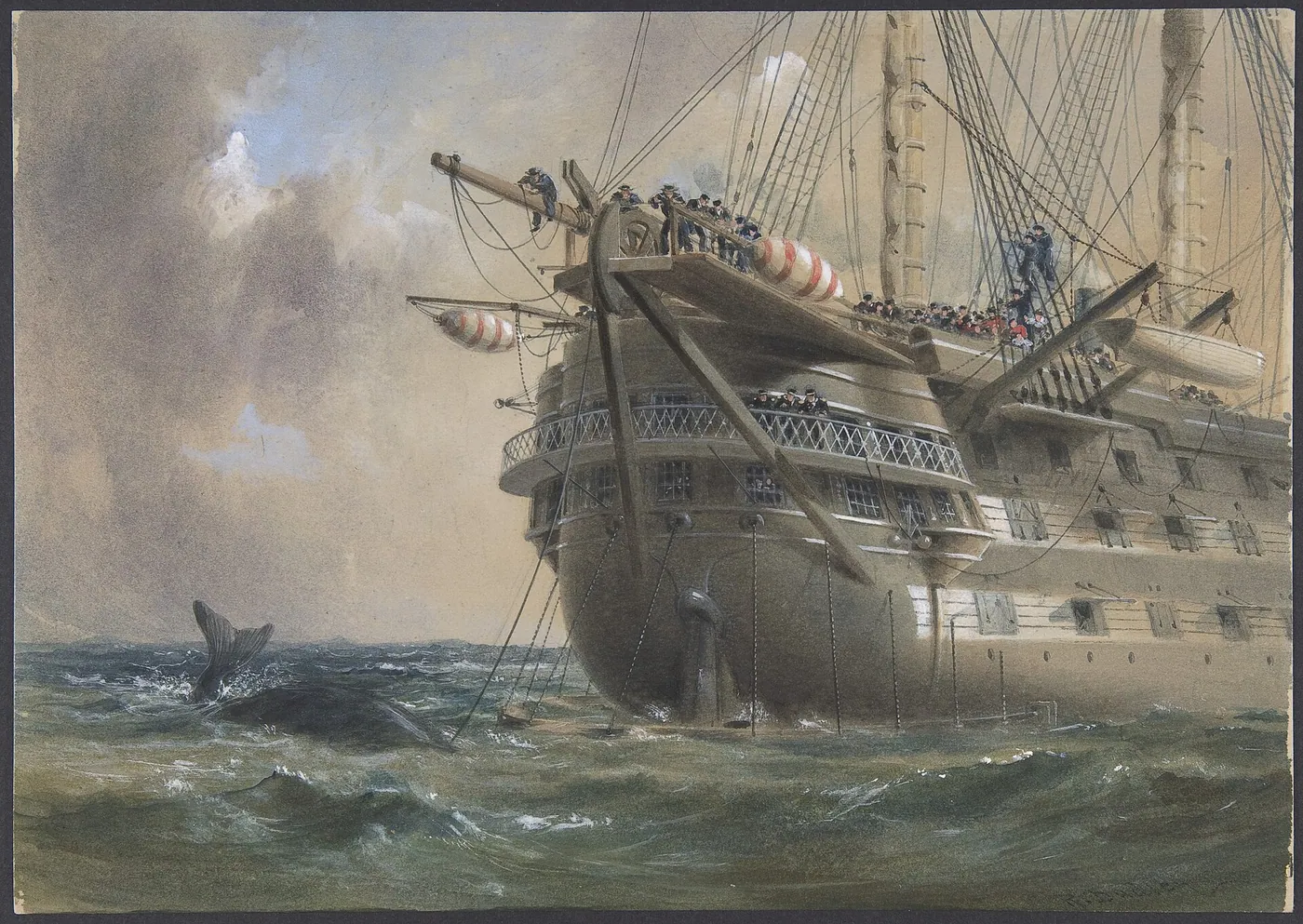
By the 1830s the experimental results of electromagnetism were ripe for engineering. In 1837 Cooke and Wheatstone patented a five-needle telegraph in Britain and applied it to railway signalling; the same year Morse proposed a single wire with a code, and the Washington–Baltimore line opened in 1844 with a first message that ran in every newspaper. Over the next twenty years land lines spread along the railways and submarine cables followed: Dover–Calais in 1851, a transatlantic cable in 1858 that failed within weeks, and a durable one in 1866. By the end of the century cables crossed every ocean and London could reach Bombay or Shanghai within hours. Consequences opened on every side: journalism turned to the bulletin and agencies such as Reuters arose; price differentials in commodity and securities markets were rapidly arbitraged away; armies gained command at a distance; and railways, needing to avoid collisions, forced the adoption of uniform time, from which standard time zones followed. Colonial administration benefited above all—after the rebellion of 1857 Britain wired South Asia extensively, and the telegraph became the nervous system of empire.
Connections
Causes3
- The RailwayenablesTelegraph lines were largely strung along railways, whose signalling needs were the early telegraph's main customer
- ElectricityenablesA steady continuous current, from the voltaic pile onward, is the material precondition of the electric telegraph, which was electricity's first large-scale application
- Electromagnetic Field TheoryenablesElectromagnets and galvanometers formed the telegraph's sending and receiving apparatus
Consequences2
- Standard TimeinformsThe telegraph carried Greenwich time signals to distant places, so that a common time could be enforced and not merely proposed
- Information TheoryenablesNyquist's and Hartley's work on telegraph transmission led directly to Shannon
Echoes1
- CuneiformechoesTelegraph literally means “writing at a distance”
Sources
- Tom Standage, The Victorian Internet
- Mike Davis, Late Victorian Holocausts: El Niño Famines and the Making of the Third World
- Electrical telegraph
Open questionswell attested
- The first transatlantic cable of 1858 failed after a few weeks of service, and a stable link was achieved only in 1866.
- Much of the actual form of Morse code came from Alfred Vail, and the credit for it is disputed.
- The argument that railways and the telegraph increased grain exports during the Indian famines comes from Mike Davis and others; some historians have also criticised his "Late Victorian Holocausts" framework (for example over how much weight to give market and climatic factors), so the competing views should be presented side by side.
Why it matters
The telegraph is often called the Victorian internet, a comparison that captures its speed but tends to miss its directionality. Where information flows, and for whom, depends on who lays the wire. The Indian famines of 1876–78 are the gravest illustration: South Asia by then had a considerable density of railway and telegraph, in principle enough to move relief grain in time. What happened instead was that the telegraph rapidly linked prices across regions and the railway carried grain efficiently from failing districts to the export ports—technology integrated the market, and the integrated market sent grain where the money was, not where the hunger was. Mike Davis argued from this to his thesis of "late Victorian holocausts"; other historians hold that his weighting of climate (El Niño) against colonial policy is open to revision. The dispute is unresolved, but one fact cannot be evaded: the same technologies can be used to bring relief or to carry the grain away, and the choice does not lie with the technology.