A land transport system of flanged vehicles on fixed track, drawn by locomotives. Its ancestor is the horse-drawn mine wagonway on timber rails (from the sixteenth century); in 1825 the Stockton and Darlington first put steam locomotives to work on a public railway (chiefly for coal; its early passenger service was horse-drawn under contract), and the Liverpool and Manchester of 1830 proved that both passengers and freight could pay. Within fifty years track covered Europe, North America, and the colonial world. The railway was the first thing to bring overland carriage into competition with water, and the first to require that a country keep a single clock—Greenwich time became Britain's legal time in 1880 because timetables demanded it.
Even the elementary concepts of time and space have begun to vacillate. Space is killed by the railways, and we are left with time alone.
—— Heinrich Heine, Lutetia (1843)
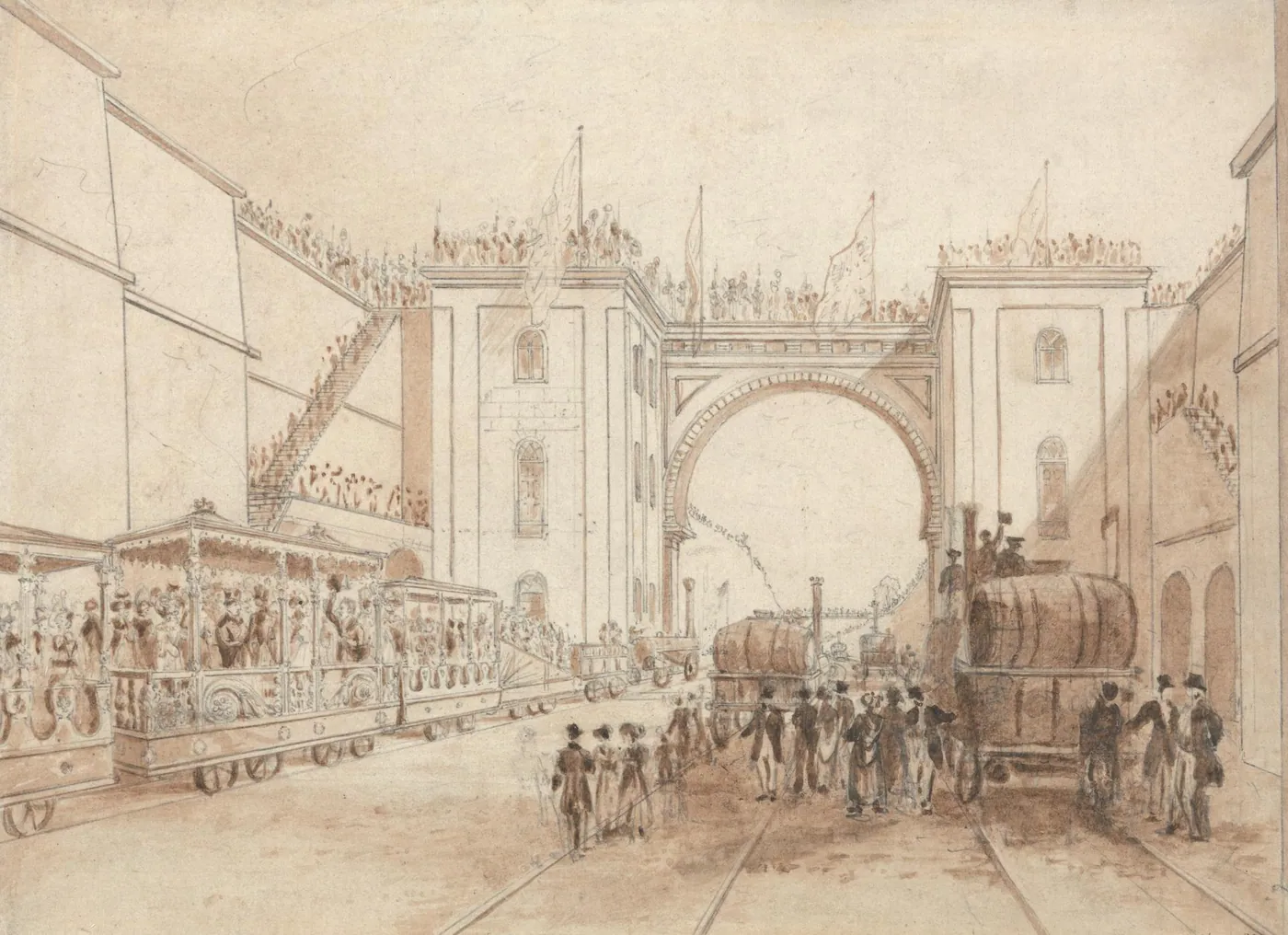
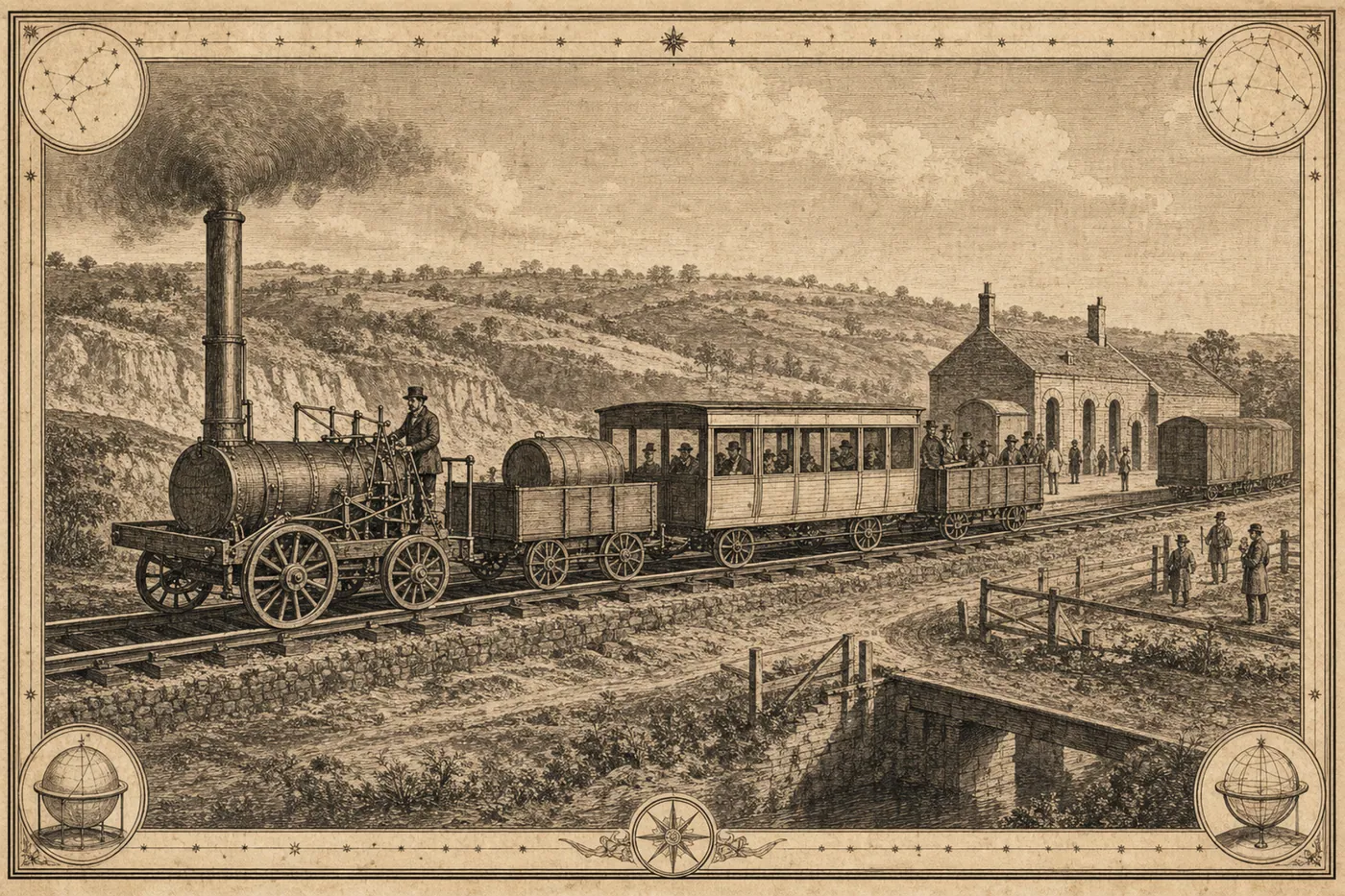
History
The railway's ancestors are in the mine. From the sixteenth century, mines in central Europe and Britain ran horse-drawn tubs on timber rails, replaced by iron in the later eighteenth. In 1804 Trevithick's locomotive drew the first steam-hauled train in South Wales, but the track could not bear it. The Stockton and Darlington opened to public traffic in 1825—steam hauled chiefly the coal trains, while for its first years the passenger service ran as horse-drawn coaches under contract; after the Rainhill Trials of 1829, the Liverpool and Manchester of 1830 proved that both passengers and freight could pay. On its opening day the Member of Parliament William Huskisson was struck by a locomotive and killed, the first widely known fatality in railway history; the line carried nearly half a million passengers within the year. Laying track then became a national enterprise: Britain had over ten thousand kilometres by 1850; the United States drove its transcontinentals with land grants; India was built from 1853 by British capital under a colonial government guarantee of return. The battle of the gauges ended in victory for 1,435 millimetres. Time was standardized too: in 1840 the Great Western adopted London time across its system, where British towns had until then each kept the sun's hour, and in 1880 Greenwich time became legal time.
Connections
Causes2
- The Steam EngineenablesMounting the high-pressure steam engine on wheels is the precondition of the locomotive
- The WheelenablesThe wheel is a distant ancestor of the railway; the flanged wheel held by a guiding rail is its immediate form
Consequences2
- The TelegraphenablesTelegraph lines were largely strung along railways, whose signalling needs were the early telegraph's main customer
- Standard TimeinformsSingle-track lines pass by the timetable, so clocks that disagree risk collision; the railway companies adopted a common time before any legislation
Sources
- Wolfgang Schivelbusch, The Railway Journey: The Industrialization of Time and Space
- Mike Davis, Late Victorian Holocausts: El Niño Famines and the Making of the Third World
- Tirthankar Roy, The Economic History of India, 1857–1947
- Rail transport
Open questionswell attested
- The Stockton and Darlington of 1825 was the first public railway to use steam locomotives, but its early passenger services were horse-drawn under contract and steam was used mainly for coal (according to National Railway Museum material), and rail haulage in mines dates back to the sixteenth century, so "railways began in 1825" is only a convenient shorthand.
- The role of railways in Indian famines is a major historiographical controversy: Davis argues that railways made it easier to ship grain out to wherever prices were highest and transmitted price shocks nationwide, while Roy and others argue that in the long run lower freight costs relieved local harvest failures; both views are presented without choosing between them.
- "The railways created standard time" holds for Britain and the United States, but elsewhere the unification of time had other, political motives.
- The combination of gauge, rights of way and state capital varied enormously between countries, so Britain and India serve as the main examples and not as a general model.
Why it matters
The nineteenth century believed that railways and the telegraph would end famine: grain could be moved wherever it was short, and news could outrun death. The Great Famine of 1876–78 fell upon a subcontinent that already had a rail network and telegraph lines, and killed millions. Mike Davis argued that the railway did not prevent the famine but eased the movement of grain out of stricken districts toward the ports at whatever price commanded, transmitting local price shocks nationwide within days. Economic historians including Tirthankar Roy reply that over the long run the railway markedly lowered carriage costs and did relieve local harvest failures, and that blaming the rails misplaces the cause. The two differ on weight, but they share a premise: capacity is not relief, and a conduit is not a willingness. A railway that can carry grain away can carry grain in; what decides the direction has never been the locomotive but who writes the invoice, at what price, answerable to whom. For the same reason the famine should not be laid at the door of the railway itself.