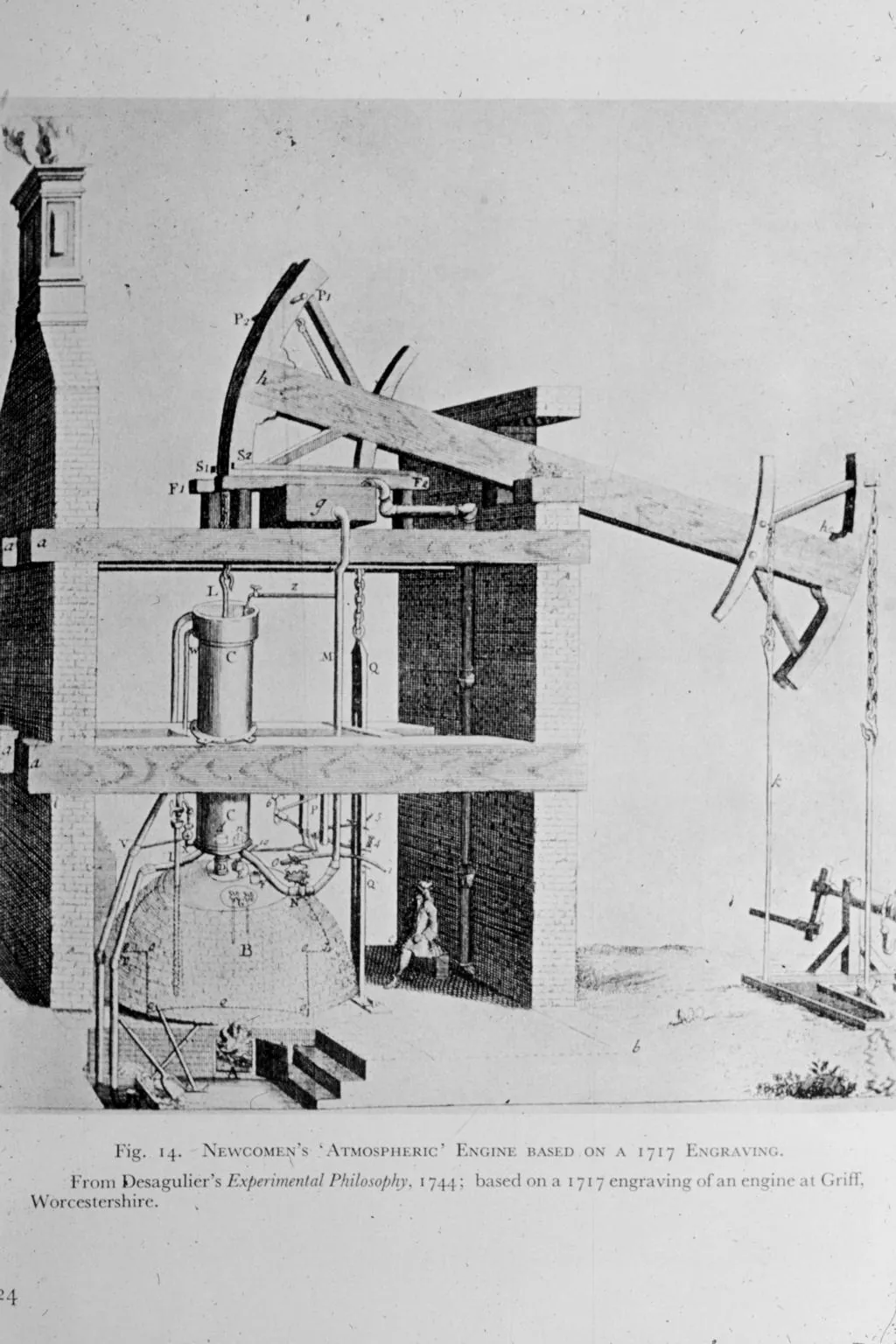
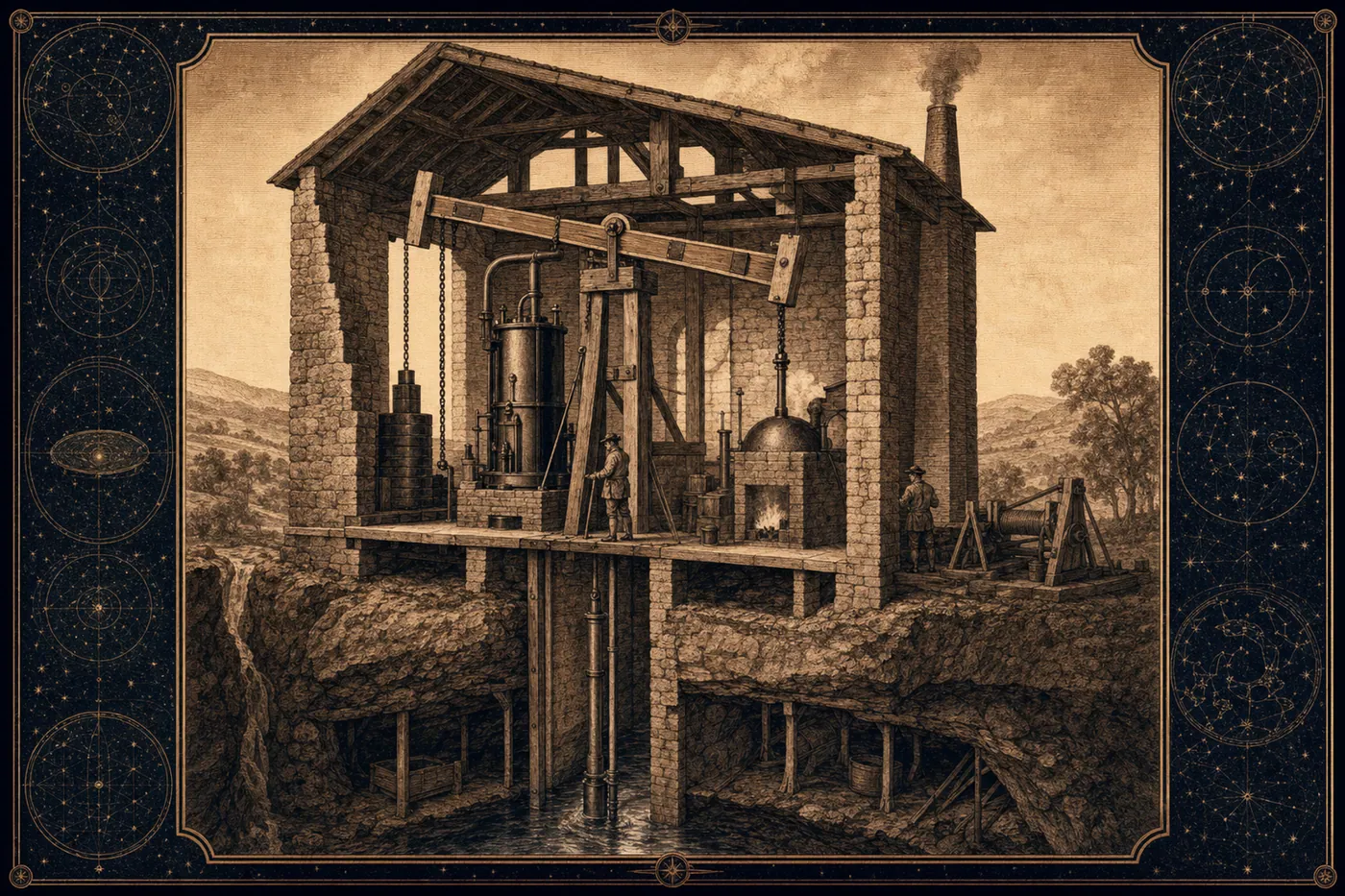
A heat engine driven by the pressure and condensation of steam. Newcomen's atmospheric engine of 1712 was the first practical one, pumping water from mines; Watt's separate condenser of 1765 cut fuel consumption sharply, and his sun-and-planet gear of 1781 turned reciprocation into rotation, so that power could drive factory machinery and, later, vehicles and ships. The order of theory is worth noting: thermodynamics was drawn out of the working machine by Carnot in 1824, more than a century after Newcomen.
I can think of nothing else but this machine.
—— James Watt, letter of 1765, on the idea of the separate condenser
History
By the late seventeenth century mines were deep enough that drainage had become an industrial bottleneck. Savery's Miner's Friend of 1698 raised water directly by the vacuum of condensing steam; it had no piston, worked at low efficiency, and was dangerous. In 1712 Newcomen built an atmospheric engine with cylinder and piston: steam admitted to the cylinder was condensed by a water spray, and atmospheric pressure drove the piston down, working a rocking beam to pump. It burned coal prodigiously, but at the pithead coal was nearly free, and such engines were installed across the British coalfields. In 1765 James Watt, an instrument-maker at Glasgow repairing a model Newcomen engine, saw that the fault lay in cooling and reheating the whole cylinder every cycle—move the condensation to a separate vessel and the cylinder could stay hot. That was the separate condenser, and fuel consumption fell to roughly a third. In partnership with Matthew Boulton, Watt added the sun-and-planet gear in 1781, converting reciprocation to rotation, and steam power left the mine for the textile mill and the flour mill. After 1801 Trevithick and others turned to high-pressure steam, which made engines small enough for railways and steamships. The theory of heat-engine efficiency arrived only with Carnot's Reflections on the Motive Power of Fire in 1824.
Connections
Causes1
- James WattcontributedConceived the separate condenser in 1765, patented it in 1769
Consequences3
- The LudditesinspiresMechanized power provoked the artisans' resistance
- The RailwayenablesMounting the high-pressure steam engine on wheels is the precondition of the locomotive
- ThermodynamicsinformsCarnot founded thermodynamics by asking how efficient a heat engine could be
Sources
- David S. Landes, The Unbound Prometheus: Technological Change and Industrial Development in Western Europe from 1750 to the Present
- Abbott Payson Usher, The Origins of Feedback Control / A History of Mechanical Inventions
- Steam engine
Open questionswell attested
- Savery's "Miner's Friend" of 1698 was an earlier working device, but it had no piston and was extremely inefficient.
- Watt improved the Newcomen engine; popular accounts often wrongly say that he invented the steam engine.
- Scholars debate whether the extension of Watt's patent to 1800 held back the development of high-pressure steam (the line pursued by Trevithick).
- Carnot's Reflections on the Motive Power of Fire (1824) appeared more than a century after the engine came into practical use, a classic case of practice preceding theory.
Why it matters
The most instructive thing about the steam engine is that it inverts the familiar picture of science guiding technology. Newcomen was an ironmonger and Watt an instrument-maker; neither commanded thermodynamics, because there was none. It was precisely in order to explain why these already-working machines had a ceiling of efficiency that Carnot wrote the paper from which the second law descends. Technology went first here, and by more than a century. The patent is worth noticing too: Watt's was extended by Act of Parliament to 1800, during which he firmly resisted the high-pressure route, constraining Trevithick and others—a counterexample to the commonplace that intellectual property protects innovation, and a reminder that institutions supply both incentives and roadblocks. As for "Watt invented the steam engine," the phrase is inaccurate. He improved someone else's machine, which is the ordinary condition of technical history: most inventions come out of repairing other people's things.