The deliberate introduction of a weakened or related pathogen to provoke immunity against later natural infection. Its predecessor, variolation, is recorded in China by the sixteenth century at the latest (scabs from a mild case ground and blown into the nose), and reached England by way of the Ottoman Empire; Lady Mary Wortley Montagu promoted its trial in London in 1721. Variolation worked but carried risk: the inoculated took a true, if usually mild, case of smallpox, with a mortality of one or two per cent, and were infectious meanwhile. In 1796 Edward Jenner, following the country observation that milkmaids did not take smallpox, inoculated a boy with cowpox and then challenged him with smallpox without effect, and the risk fell sharply. What is notable about the technique is its order in time: it worked for roughly a century before the germ theory existed, known to be effective without being understood, and only at the end of the nineteenth century did immunology supply the reason. In 1980 the World Health Assembly declared smallpox eradicated, the only human infectious disease so far wholly eliminated.
The small-pox, so fatal and so general amongst us, is here entirely harmless by the invention of engrafting.
—— Lady Mary Wortley Montagu, letter from Adrianople (1717)

History
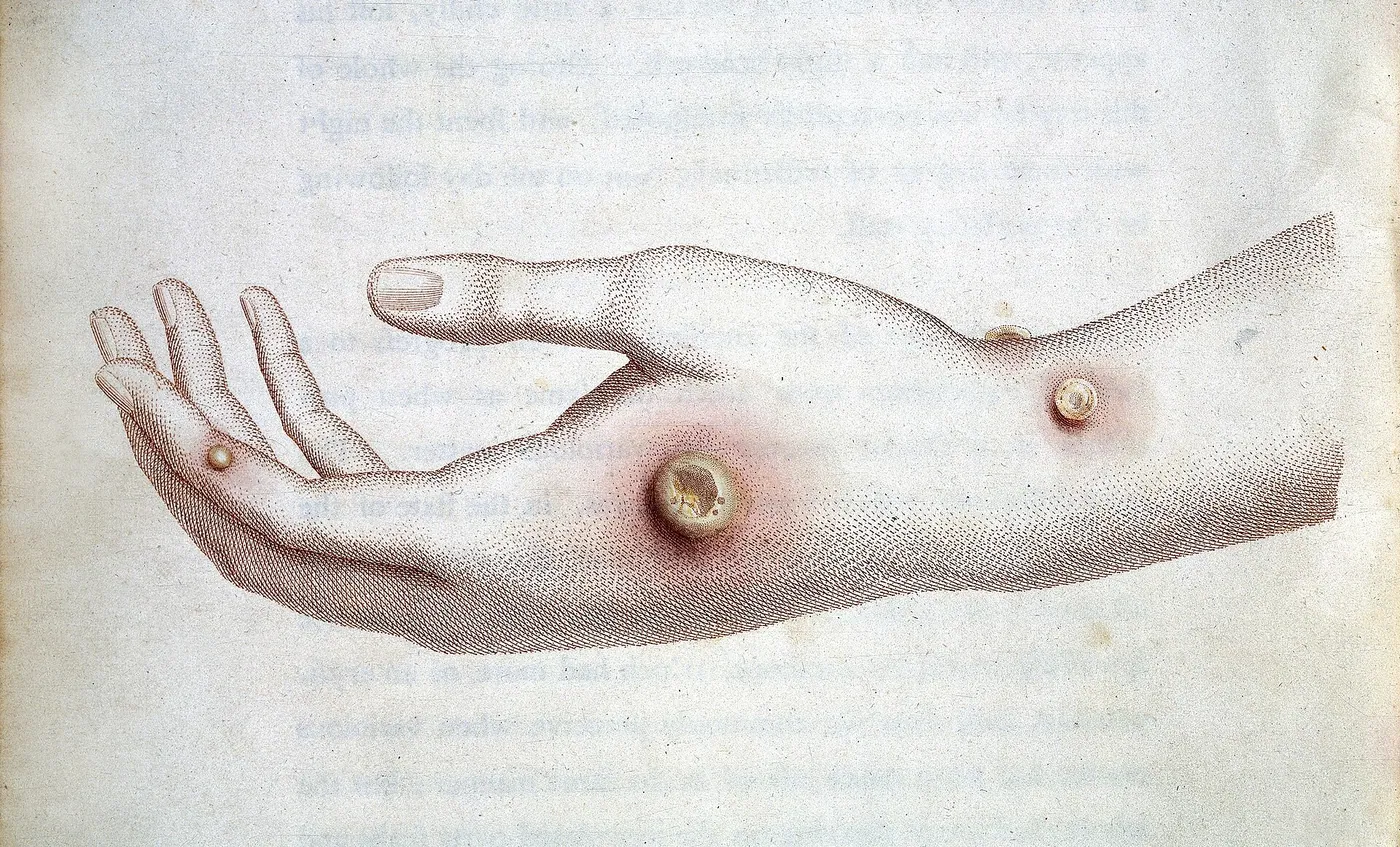
Before there was a vaccine, smallpox was an ordinary cause of death, killing perhaps four hundred thousand a year in eighteenth-century Europe and leaving most survivors scarred and some blind. Variolation took scab or fluid from a mild case and introduced it through the nose or through the skin, to produce one controlled and usually mild illness and lifelong immunity thereafter. China has clear records by the sixteenth century of the insufflation method, together with the practice of selecting "matured" material passaged until its virulence had fallen; the Ottoman Empire and India had their own methods, generally by incision in the arm. In 1717 Lady Mary Wortley Montagu, wife of the British ambassador, saw the practice at Adrianople; the next year she had her son inoculated in Constantinople, and on returning home she had her daughter done and pressed the method vigorously. After trials on condemned prisoners (1721) and orphans (1722) succeeded in London, inoculation spread through polite society. The risk was plain: the inoculated took true smallpox, one or two in a hundred died, and while ill they were infectious and could start an outbreak. In 1796 Edward Jenner, a country physician in Gloucestershire, took note of the local saying that milkmaids who had had cowpox on their hands did not take smallpox. He took matter from a milkmaid's hand, inoculated the eight-year-old James Phipps, and six weeks later challenged him with smallpox; the boy did not sicken. His Inquiry into the Causes and Effects of the Variolae Vaccinae, published at his own expense in 1798, gave the practice its name, from the Latin vacca, a cow. Far less dangerous than variolation, it spread within decades through Europe, the Americas, and Asia. The reason it worked remained open—until in the 1880s Pasteur prepared attenuated vaccines against fowl cholera and anthrax and, in deference to Jenner, extended the word vaccine to all such preparations, and the account of immunity came gradually with bacteriology and immunology. The WHO began its global eradication programme in 1967, replacing mass vaccination with surveillance and ring vaccination; the last natural case occurred in Somalia in 1977, and eradication was declared in 1980.
Connections
Consequences1
- The Germ Theory of DiseaseinformsThe practice worked roughly a century before the mechanism was known: it posed the theory's question rather than applying it, and Pasteur named his attenuated preparations after Jenner's
Sources
- Edward Jenner (1798), An Inquiry into the Causes and Effects of the Variolae Vaccinae
- Lady Mary Wortley Montagu (1763), The Turkish Embassy Letters
- F. Fenner et al., World Health Organization (1988), Smallpox and Its Eradication
- 范行准, 《中国医学史·人痘接种法》
- Vaccination
Open questionswell attested
- Accounts of the earliest date of variolation in China vary; claims of a Song-dynasty origin lack reliable support, and the first verifiable records date from the Ming dynasty in the 16th century.
- The death rate of about 1–2 per cent for variolation is the order of magnitude found in several 18th-century British tallies, and practice and record-keeping varied widely from place to place.
- Farmers such as Benjamin Jesty had already inoculated people with cowpox before Jenner; his contribution lay in systematic observation, challenge testing and publication.
- The eradication of smallpox is unique in public health: it was possible only because of special conditions, such as the absence of an animal reservoir and conspicuous, easily recognised symptoms, and should not be taken as a general expectation.
Why it matters
Vaccination matters historically not only for the number of lives it saved, vast though that is, but for how plainly it sets out the question of whether technology or science comes first. The textbook order is that science finds the principle and technology applies it. Vaccination runs the other way: variolation was practised for centuries in China and cowpox for a century in England while no one knew what immunity was. Theory was not its precondition but the question it posed. Such cases are far commoner in the history of technology than the converse: the steam engine preceded thermodynamics, smelting preceded chemistry, breeding preceded genetics. To say that technology is applied science is to mistake an exception for the rule. A second layer concerns where knowledge comes from. Jenner's clue came from the experience of country milkmaids, Montagu's from the everyday practice of Ottoman women, and the Chinese selection of matured material from generations of inoculators' observation—three bodies of working knowledge unrecorded by any learned system, and each of them right. This is of a kind with the nixtamalization that was lost when maize crossed the ocean: the reliability of operational common sense outside formal knowledge is habitually underrated, and the cost of losing it is underrated further. A third layer requires honesty. There is a part of this history that should not be passed over: the London trials of 1721 used condemned prisoners and orphans as subjects, whose consent would not stand by any present standard; and compulsory vaccination during the spread of the cowpox method provoked decades of resistance in Britain, comprising both reasonable misgivings about state power and claims that later evidence refuted.