Instrument-maker at Glasgow who conceived the separate condenser in 1765 and, in partnership with Matthew Boulton, turned Newcomen's mine pump into a general source of power. He did not invent the steam engine, and the boyhood kettle is a later legend.
I sell here, Sir, what all the world desires to have—POWER.
—— James Boswell, Life of Samuel Johnson (1791), entry for 22 March 1776, recording what Matthew Boulton said while showing him round the Soho works
History
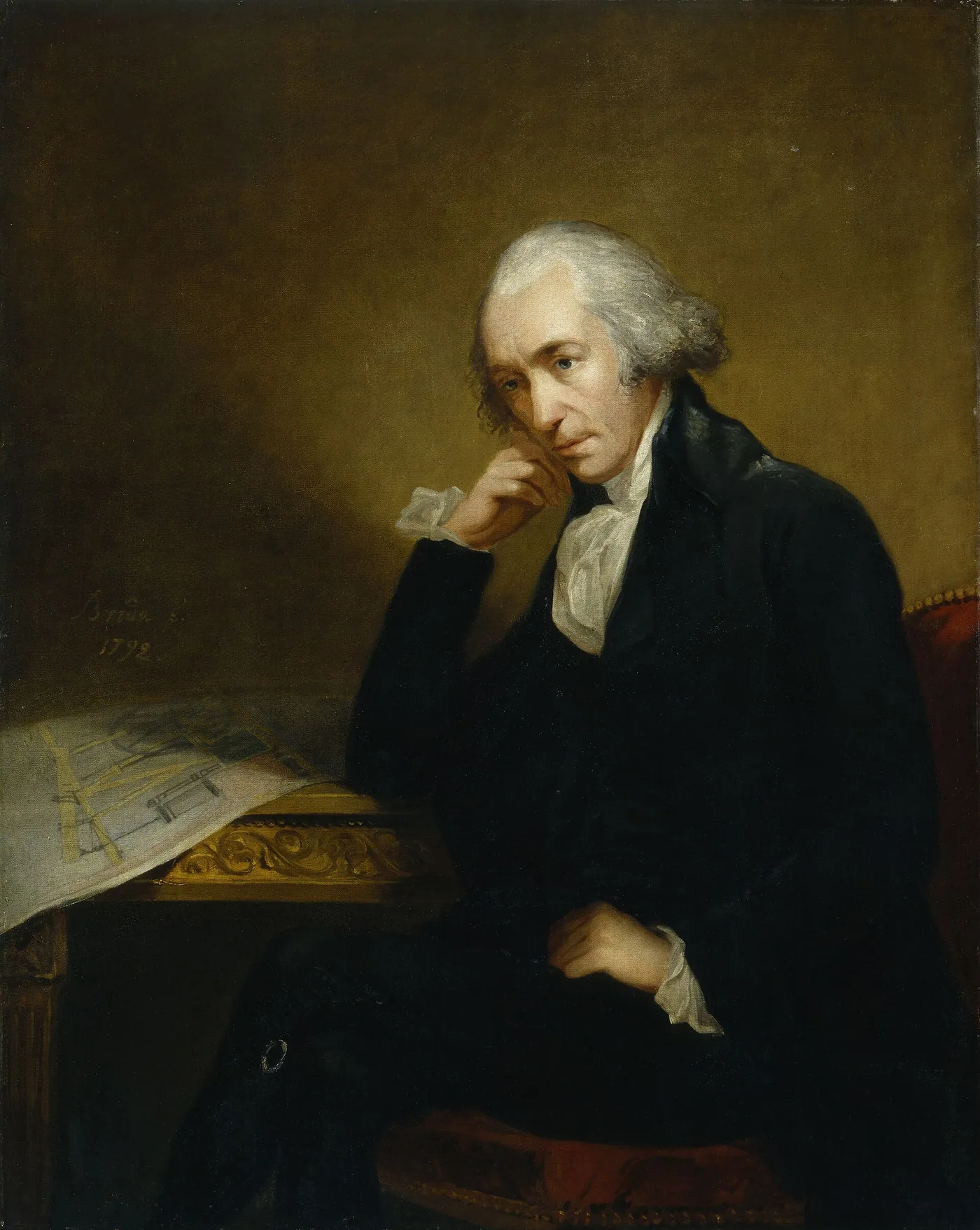
James Watt was born in Greenock in 1736 and from 1757 kept an instrument workshop at the University of Glasgow. In the winter of 1763–64 he repaired the university's model Newcomen engine and found that every stroke cooled and reheated the whole cylinder, so most of the steam went into warming metal. In May 1765 he saw the remedy: condense the steam in a separate vessel and keep the cylinder hot. His patent of January 1769 was financed by John Roebuck; when Roebuck went bankrupt, his share passed to the Birmingham manufacturer Matthew Boulton. Watt moved to Birmingham in 1774, an Act of Parliament of 1775 extended the patent to 1800, and the two became partners. John Wilkinson's boring mill made sufficiently true cylinders, and in the spring of 1776 the first commercial engines started work at a colliery in Tipton and at Wilkinson's ironworks. Customers paid yearly a third of the value of the coal saved over an old engine. Patents for the sun-and-planet gear (1781), double action (1782) and parallel motion (1784) followed; in 1788 he fitted the millwrights' centrifugal governor to his engines, and he defined the horsepower. Like Boulton, he belonged to the Lunar Society of Birmingham. He retired when the patent expired in 1800 and died in 1819. The boy gazing at a kettle comes from a cousin's memorandum of 1798, made famous by François Arago's éloge to the Académie des sciences in 1834.
Connections
Consequences1
- The Steam EnginecontributedConceived the separate condenser in 1765, patented it in 1769
Sources
- Richard L. Hills, James Watt (3 vols.) (2002–2006)
- David Philip Miller, The Life and Legend of James Watt: Collaboration, Natural Philosophy, and the Improvement of the Steam Engine (2019)
- Ben Marsden, Watt's Perfect Engine: Steam and the Age of Invention (2002)
- George Selgin, John L. Turner, Strong Steam, Weak Patents, or the Myth of Watt's Innovation-Blocking Monopoly, Exploded (Journal of Law and Economics 54.4) (2011)
Open questionswell attested
- The sun-and-planet gear may have been designed by his employee William Murdoch.
- Those involved gave differing accounts of how the separate condenser related to Black's theory of latent heat.
- Whether the 1775 extension of his patent held back the high-pressure steam engine is debated.
- The kettle story is found only in a relative's recollections of 1798.
Why it matters
Watt is usually reduced to an invention, yet the separate condenser was a repair to Newcomen's machine. What made it industrial power was an arrangement: Boulton's capital and customers, Wilkinson's boring mill, fitters such as William Murdoch who installed and improved engines on site, and contracts priced by the coal saved. Charging for power meant measuring it, hence the horsepower and the indicator diagram, used in secret from 1796, which plotted pressure against volume as Clapeyron's diagram of Carnot's cycle would later do. Traffic with science ran both ways. Joseph Black and John Robison credited the condenser to Black's theory of latent heat; Watt replied that he had merely "stumbled upon one of the material facts by which that beautiful theory is supported." The nineteenth century made him Britain's emblem of inventive genius, and the kettle story spread with the reputation. Economic historians still dispute whether the 1775 extension held back high-pressure steam.