Newton's law of 1687: every body attracts every other with a force proportional to the product of their masses and inversely proportional to the square of the distance between them, explaining falling stones, planetary orbits, tides and comets alike.
But hitherto I have not been able to discover the cause of those properties of gravity from phenomena, and I frame no hypotheses ... And to us it is enough, that gravity does really exist, and act according to the laws which we have explained, and abundantly serves to account for all the motions of the celestial bodies, and of our sea.
—— Newton, Principia, 2nd edn (1713), Book III, General Scholium, trans. Andrew Motte (1729), vol. II, p. 392; spelling modernized
History
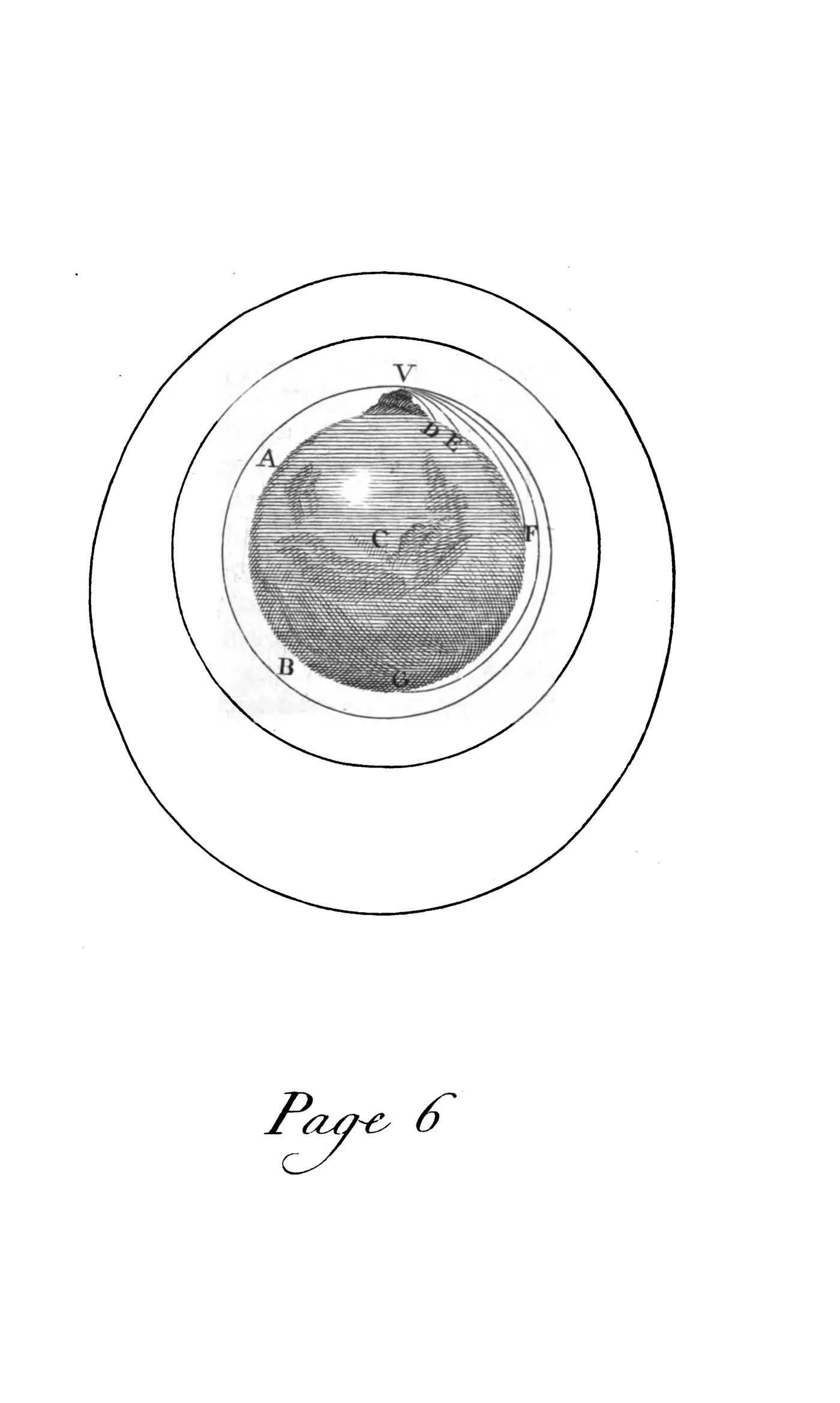
Universal gravitation, the attraction that every body exerts on every other, was set out in the Principia of 1687. Laid out like Euclid, the book starts from definitions and three laws of motion and proves geometrically that a body moving on an ellipse about a centre of force at one focus is pulled by a force varying inversely as the square of the distance. Book III, "The System of the World", extends the force to all bodies. The Moon, about sixty Earth radii away, falls towards the Earth some 15 Paris feet in a minute, about what a stone near the ground falls in a second, so the force that holds the Moon is gravity; the same force accounts for the tides, the precession of the equinoxes, the paths of comets and the flattening of the Earth at the poles. Hooke, Wren and Halley had already discussed the inverse square, and Hooke claimed priority. The book also imagines a cannonball fired from a mountain fast enough to circle the Earth. The two famous tests came after Newton's death. In 1736–37 a French expedition under Maupertuis measured a degree of the meridian in Lapland and confirmed the flattening. Halley had predicted that the comet of 1682 would return about 1758; Clairaut and his colleagues, allowing for the pull of Jupiter and Saturn, put its perihelion near 13 April 1759, give or take a month. It came on 13 March.
Connections
Causes5
- Euclid's ElementsenablesThe Principia argues in the form of Euclidean geometry
- Galileo GalileienablesHis kinematics of falling and projected bodies passed to Newton
- Johannes KeplerenablesNewton derived the inverse-square force from Kepler's laws
- The Mechanical PhilosophyenablesNewton worked within the mechanical philosophy and strained it with action at a distance
- Isaac NewtoncontributedThe Principia (1687)
Consequences1
- The Scientific RevolutionderivesThe Newtonian synthesis closed the Scientific Revolution
Sources
- Isaac Newton, trans. Andrew Motte, The Mathematical Principles of Natural Philosophy (1729)
- I. Bernard Cohen and Anne Whitman, The Principia: Mathematical Principles of Natural Philosophy (new translation) (1999)
- Mary Terrall, The Man Who Flattened the Earth: Maupertuis and the Sciences in the Enlightenment (2002)
- Richard S. Westfall, Newton and the Fudge Factor (Science 179) (1973)
Open questionswell attested
- Westfall pointed out that Newton adjusted data such as those for the moon test in later editions to make them agree.
- Newton and Hooke disputed priority for the inverse-square law.
- The margin of error of Clairaut's prediction (about a month) was his own estimate.
Why it matters
Universal gravitation joined Galileo's terrestrial mechanics to Kepler's planetary motions in one set of mathematical laws, and for more than a century celestial mechanics largely worked out its consequences; in 1846 Neptune was predicted from the irregularities of Uranus and found. The price was paid in causes. Gravity acted instantly across empty space and could not be reduced to contact. Huygens accepted the inverse square but not action at a distance, and Leibniz called attraction an occult quality; Newton himself told Richard Bentley in 1693 that brute matter acting at a distance without mediation was "so great an absurdity" that no competent thinker could fall into it, and the Principia promised only a mathematical account of force. In 1859 Le Verrier found a small part of Mercury's perihelion motion that Newton's theory could not explain; Einstein's general relativity accounted for it in 1915 by treating gravity as the curvature of spacetime. Spacecraft are still navigated mainly with Newton's laws.