The seventeenth-century programme that explained all natural phenomena by the size, shape and motion of particles of matter, discarded Aristotle's substantial forms and final causes, and liked to compare the world to a clock.
they seem to imagine the World to be after the nature of a Puppet ... whereas, according to us, 'tis like a rare Clock, such as may be that at Strasbourg, where all things are so skilfully contriv'd, that the Engine being once set a Moving, all things proceed according to the Artificers first design.
—— Robert Boyle, A Free Enquiry into the Vulgarly Receiv'd Notion of Nature (London, 1686), pp. 11–12
History
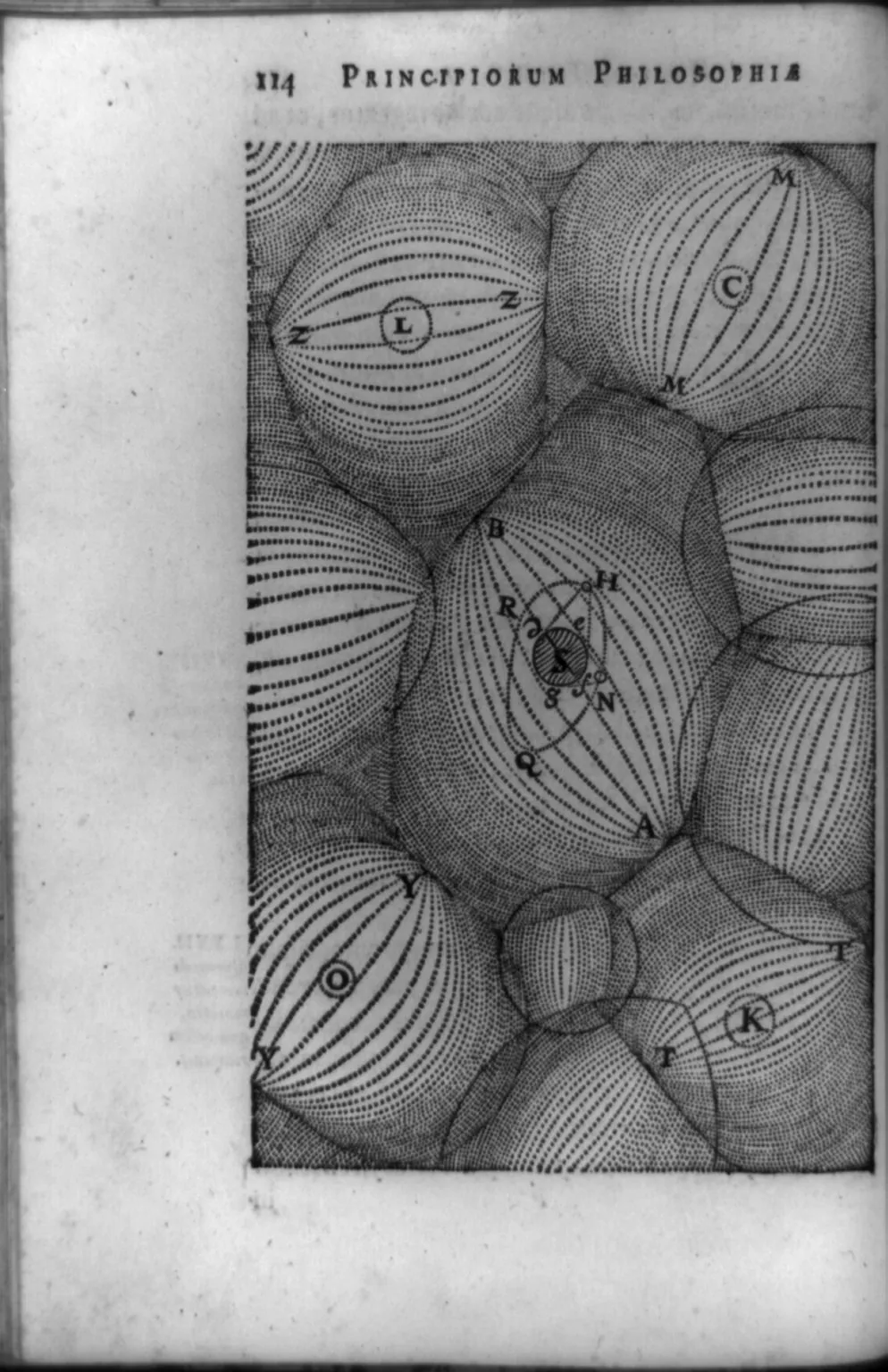
The mechanical philosophy held that every property and change of bodies comes down to the size, shape, arrangement and motion of particles of matter, and that bodies act on one another only by contact. In The Assayer (1623) Galileo had already confined tastes, smells and colours to the perceiver, leaving bodies only shape, size, place and motion. Descartes gave it its most systematic form: the Discourse on Method (1637) treated animals as automata, and the Principles of Philosophy (1644) identified matter with extension, denied the vacuum and carried the planets round the Sun in vortices. Gassendi revived Epicurean atomism in a form acceptable to Christians, and Hobbes opened Leviathan (1651) by asking what the heart is but a spring, and the nerves but so many strings. Boyle introduced the label "Mechanical Hypothesis or Philosophy" in 1661 and looked for experimental support for corpuscles with the air pump and in the laboratory. The clock was the favourite image. Nicole Oresme had compared the heavens to a clock in the fourteenth century, though only the heavens; seventeenth-century writers applied the image to the whole world and to the God who designed it. The "rare Clock" Boyle invoked in 1686 was the astronomical clock of Strasbourg cathedral, completed in 1574 under the mathematician Conrad Dasypodius. In 1715–16 Leibniz, writing against Newton's spokesman Samuel Clarke, mocked a God who "wants to wind up his watch from time to time".
Connections
Causes3
- AristotleinspiresMechanism began by discarding Aristotle's formal and final causes
- Galileo GalileiinspiresGalileo held that philosophy is written in the great book of the universe, in the language of mathematics
- The Mechanical ClockinspiresThe metaphor of the world as a clock
Consequences1
- Universal GravitationenablesNewton worked within the mechanical philosophy and strained it with action at a distance
Sources
- Marie Boas, The Establishment of the Mechanical Philosophy (Osiris 10) (1952)
- E. J. Dijksterhuis, trans. C. Dikshoorn, The Mechanization of the World Picture (1961)
- Robert Boyle, ed. Edward B. Davis and Michael Hunter, A Free Enquiry into the Vulgarly Received Notion of Nature (1996)
- Daniel Garber and Sophie Roux (eds.), The Mechanization of Natural Philosophy (2013)
Open questionspartly uncertain
- Who belongs to the "mechanical philosophy" (whether Hobbes, Galileo and Newton should be included) has long been disputed.
- Descartes's comparison of clocks and fruit trees follows the 1647 French edition of the Principles of Philosophy, Part IV, article 203.
- Oresme's clock metaphor applied only to the heavens and should not be regarded as a direct source of the mechanical philosophy.
- How much the clock metaphor actually contributed to the Scientific Revolution is disputed.
Why it matters
"Mechanical" first referred to man-made devices. The pseudo-Aristotelian Mechanical Problems described mechanics as the art that wins where nature resists, letting a small force move a great weight, and kept art and nature apart. Descartes erased the line: all the rules of mechanics belong to physics, he wrote, and a clock telling the hours by its wheels is no less natural than a tree bearing fruit. Mechanism, the metaphysical claim that nature is nothing but matter in motion, should still be kept apart from mechanics, a mathematical science of force and motion. In the seventeenth century the two reinforced each other; Newton's gravity pulled them apart. Gravity worked but could not be reduced to pushes and collisions; Leibniz called it an occult quality. Roger Cotes replied in the 1713 Principia that either gravity is a primary quality of all bodies or extension, mobility and impenetrability are not; Newton's General Scholium excluded mechanical hypotheses, with all others, from experimental philosophy.