The deep changes in the method, institutions, and world-picture of European natural knowledge across the sixteenth and seventeenth centuries, conventionally dated from Copernicus's De revolutionibus and Vesalius's De humani corporis fabrica (both 1543) to Newton's Principia (1687). Its markers include the mathematization of nature, controlled experiment, the spread of instruments, and the founding of societies and journals. But "revolution" is a retrospective label: whether the period is a rupture or a continuity, and whether it was a single event at all, remain live questions in the discipline.
There was no such thing as the Scientific Revolution, and this is a book about it.
—— Steven Shapin, The Scientific Revolution (1996), opening sentence
History
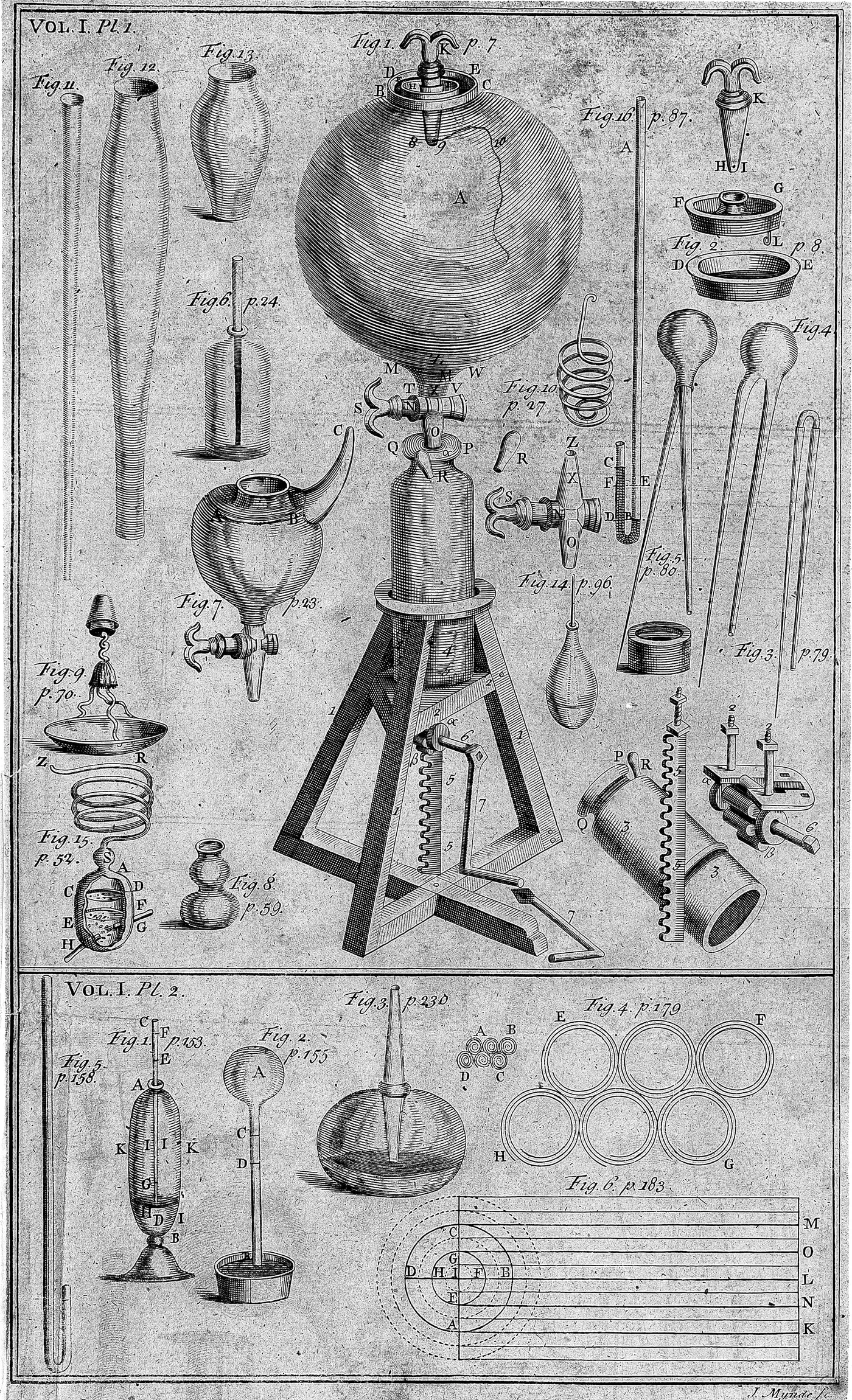
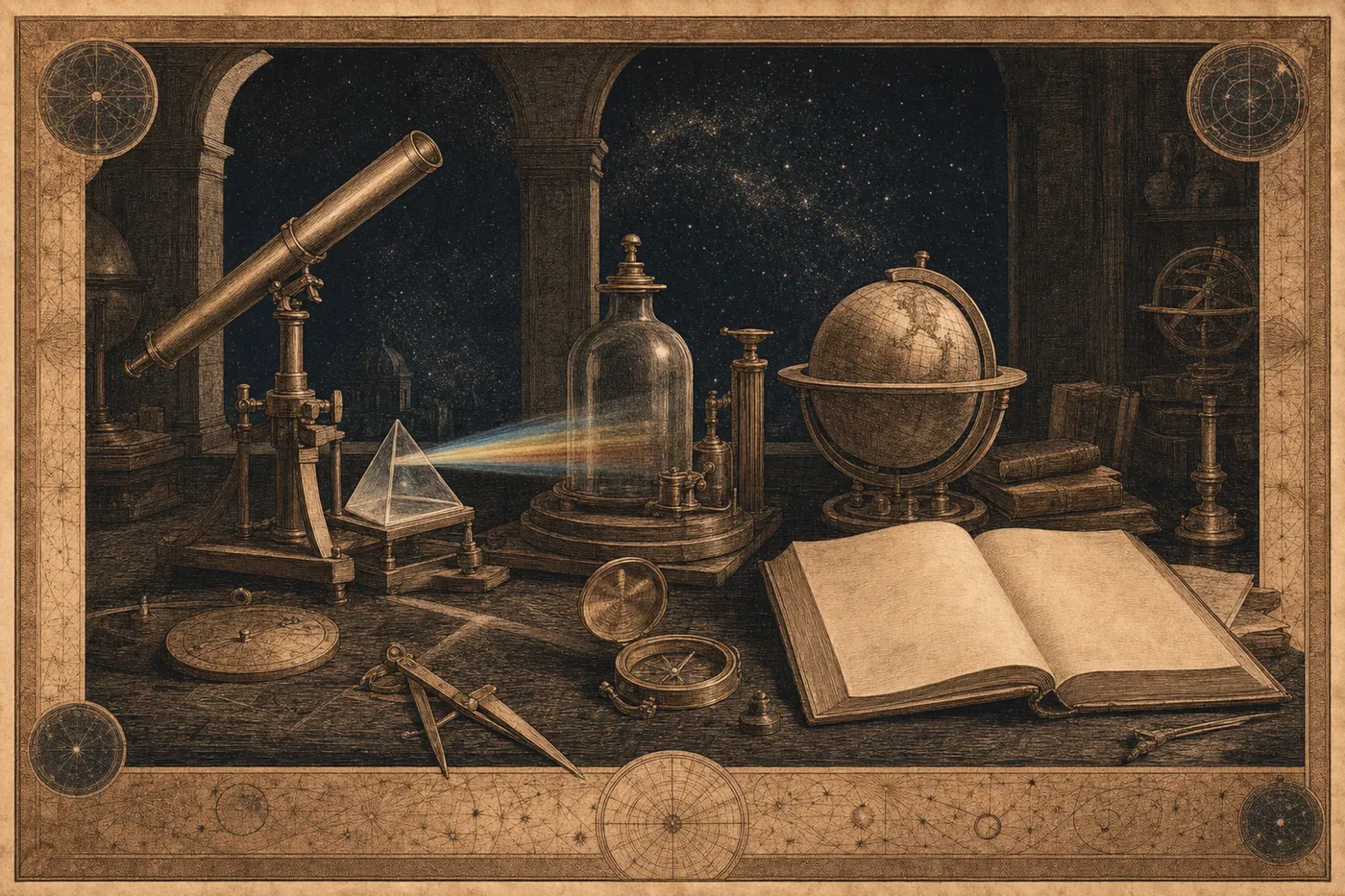
In 1543 Copernicus's De revolutionibus placed the sun at the centre and Vesalius's Fabrica corrected Galen from his own dissections; over the following century and a half, change advanced on several fronts at once. In astronomy, Tycho's precise observations, Kepler's elliptical orbits, and Galileo's telescopic findings (the lunar surface, the moons of Jupiter, the phases of Venus) progressively dismantled the physical basis of the old cosmos. In method, Bacon urged the interrogation of nature by experiment, Descartes the explanation of everything by mathematics and mechanism, while Boyle and Hooke turned instruments such as the air pump into machines for producing "matters of fact." In institutions, the Lincei in Rome, the Cimento in Florence, the Royal Society in London (1660), and the Académie in Paris (1666) followed one another, and the Philosophical Transactions (1665) created the germ of peer review and of establishing priority. In 1687 Newton brought celestial and terrestrial motion under one mathematics with universal gravitation and three laws, which is taken as the completion of a phase. All the while the older knowledge remained present: Newton left more manuscript on alchemy and theology than on physics.
Connections
Causes6
- The Printing Revolutionenables · disputedThe standardization and wide dissemination brought by print helped drive the Scientific Revolution (the degree is debated)
- The Scientific Methodenables · disputedMethod drove the Scientific Revolution (whether as its core or its product is a matter of interpretation)
- Heliocentrisminspires · disputedThe Copernican revolution was the emblematic opening of the Scientific Revolution (whether opening or component is a matter of interpretation)
- The Mechanical Clockenables · disputedOn Landes's view the public hour and the clockwork cosmos aided the new science; critics note that China had more complex timekeeping without that outcome
- The TelescopeinformsInstruments carried observation beyond the naked eye
- Universal GravitationderivesThe Newtonian synthesis closed the Scientific Revolution
Echoes1
- The Reformationechoes · disputedTwo early-modern upheavals of thought catalyzed by print; no causal link between them should be assumed
Sources
- Steven Shapin, The Scientific Revolution
- David Wootton, The Invention of Science: A New History of the Scientific Revolution
- Scientific Revolution
Open questionspartly uncertain
- "The Scientific Revolution" is a 20th-century historiographical construct (Koyré, Butterfield and others), and people at the time did not use the term.
- The debate between continuity (from Duhem onwards, stressing the inheritance of medieval scholastic natural philosophy) and rupture is unresolved.
- How great a role printing played in it (the Eisenstein thesis) is disputed.
- How earlier work in the Islamic world, India and China relates to it is a major question in current historiography, and it should not be settled by calling the revolution a purely European creation.
Why it matters
One of the most valuable things about this period is the discipline's continuing quarrel over the word "revolution." Shapin's famous opening is not a quip but a methodological declaration: a revolution is something posterity cuts out of a continuous process, names, and invests with meaning. The people involved called themselves natural philosophers and understood their work as restoring the ancients rather than overthrowing them. Continuity theorists point out that scholastic discussion of motion, infinity, and experiment had gone a long way; rupture theorists reply that the combination of instruments, mathematization, and corporate institutions did produce a mode of knowledge-making that had not existed. The printing revolution, the Reformation, heliocentrism, and the new scientific method are all bound up with this change; the connections are real, and what is still argued is how much weight each should carry.