In 1608 a Dutch spectacle-maker, Hans Lipperhey, sought a patent for a tube that made distant things look near. A year later Galileo turned one on the sky, and astronomy stopped relying on the naked eye alone.
Sidereal Messenger, unfolding great and very wonderful sights ... observed by Galileo Galilei with the help of a spyglass lately devised by him, about the face of the Moon, countless fixed stars, the Milky Way, nebulous stars, but especially about four planets flying around the star of Jupiter.
—— Galileo, Sidereus Nuncius, title page (Venice, 1610), trans. Albert Van Helden
History
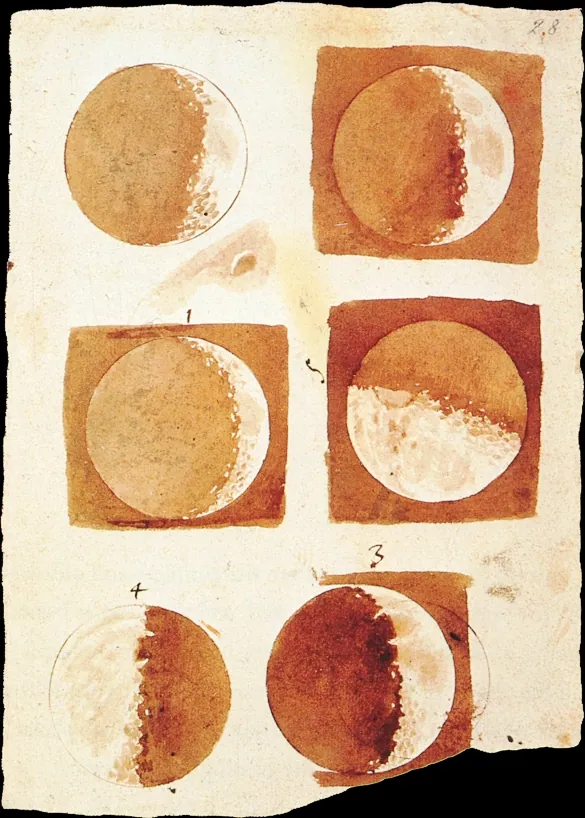
The first telescopes were nothing more than a tube with a convex lens at one end and a concave lens at the other. Lenses themselves were old news: convex spectacles appeared in Italy in the late thirteenth century, and by the sixteenth the spectacle workshops of the Netherlands and Italy could grind them routinely. On 2 October 1608 Hans Lipperhey, a spectacle-maker of Middelburg, asked the States General for a patent; within weeks Jacob Metius of Alkmaar claimed the same device. The patent was refused on the grounds that several people already knew the trick, though Lipperhey was paid to build binocular versions. News spread across Europe within months. In 1609 Galileo, in Padua, heard the report, ground his own lenses, pushed the magnification from three to about twenty, and that winter turned the instrument on the Moon. His Sidereus Nuncius (March 1610) described lunar mountains and craters, a Milky Way dense with stars and four moons circling Jupiter; by the end of the year he had seen the phases of Venus. Kepler's Dioptrice (1611) supplied a theory of lenses and a new design with two convex lenses, and in the same year the Accademia dei Lincei gave the instrument its name, telescopium. In 1668 Newton replaced the objective lens with a concave mirror, avoiding the colour fringes that plagued lenses.
Connections
Causes3
- Optics (Ibn al-Haytham)enablesThe perspectivist tradition built on its Latin translation prepared the understanding of lenses
- Galileo GalileicontributedBuilt his own in 1609 and was the first to turn it systematically on the sky
- Johannes KeplercontributedHis Dioptrice (1611) gave the optical theory and the Keplerian design
Consequences2
- HeliocentrisminformsTelescopic observations brought new evidence into the dispute
- The Scientific RevolutioninformsInstruments carried observation beyond the naked eye
Sources
- Albert Van Helden, The Invention of the Telescope (Transactions of the American Philosophical Society 67.4) (1977)
- Galileo Galilei, trans. Albert Van Helden, Sidereus Nuncius, or The Sidereal Messenger (translation and commentary) (1989)
- Albert Van Helden, Sven Dupré, Rob van Gent, Huib Zuidervaart (eds.), The Origins of the Telescope (2010)
Open questionswell attested
- Lipperhey, Metius and Janssen all have claims to the invention, which remain disputed.
- The magnifications of Galileo's various telescopes are later estimates.
Why it matters
The telescope's weight in history lies in what it did to the meaning of "seeing". Earlier disputes in astronomy were argued over the same sky that everyone could see; after 1610 the strongest evidence could be had only through an instrument, and the instrument itself needed defending. Some of Galileo's opponents refused to look through it; others looked and suspected that the lunar "mountains" were artefacts of the glass, a suspicion not wholly unreasonable given the distortions of early lenses. How an instrument becomes a credible witness became a standing question of modern science, faced in turn by the microscope, the spectroscope and the radio telescope. Nor did the telescope prove heliocentrism on its own: the phases of Venus fit Tycho's compromise system just as well. What it did was make the old cosmos steadily harder to defend.