The astronomical doctrine placing the Sun, not the Earth, at the center of the cosmos or solar system. The ancient Greek Aristarchus (c. 270 BCE) proposed it and was ignored; Copernicus systematically revived it in De revolutionibus (1543); Kepler set elliptical orbits, Galileo furnished telescopic evidence and angered the Church (tried in 1633), and Newton's mechanics gave it a physical foundation. Copernicus's mathematical models drew heavily on Islamic astronomy (the Maragha school). It is the emblematic opening of the Scientific Revolution.
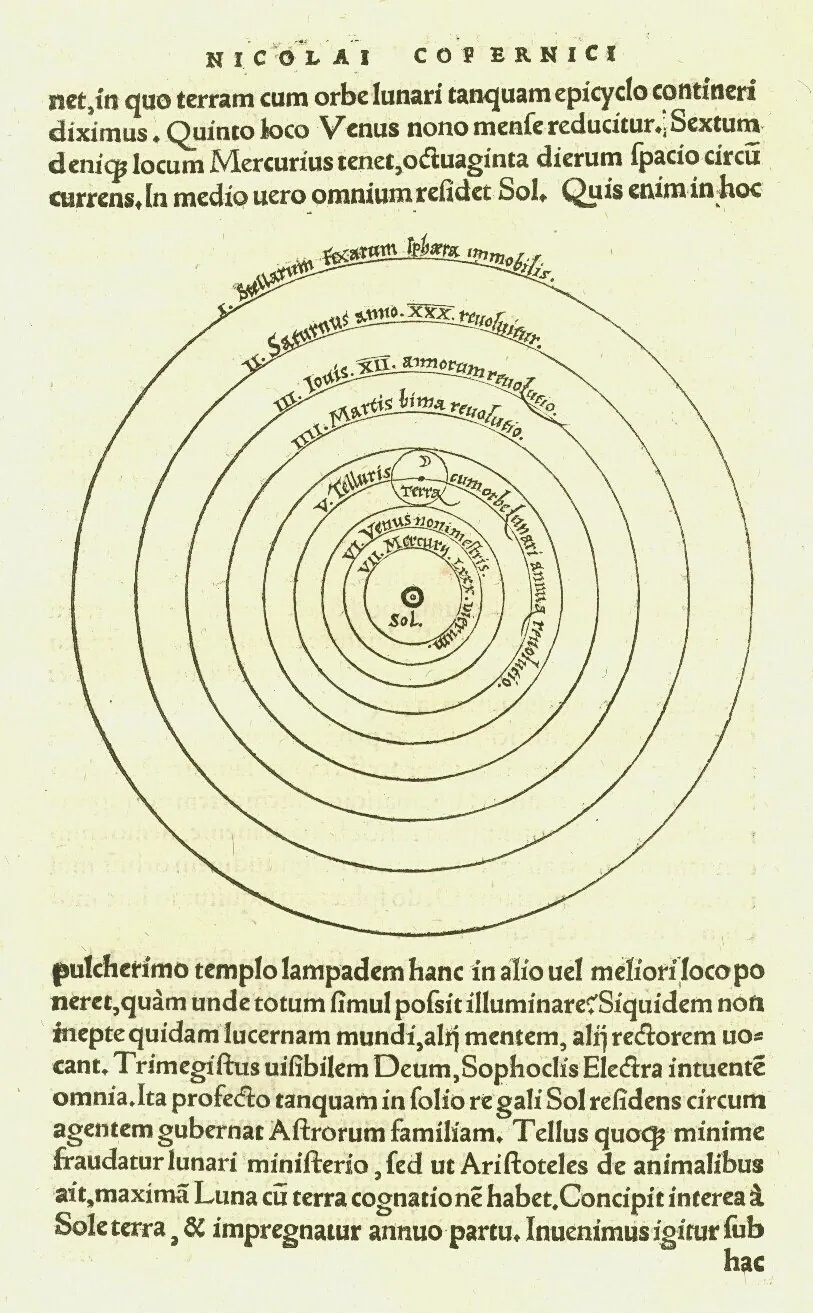
In the middle of all sits the Sun enthroned… as if upon a royal throne, ruling the family of planets that wheel around him.
—— Copernicus, De revolutionibus, Book I (1543)
History
The conjecture of a central Sun did not begin with Copernicus. Around 270 BCE the Greek Aristarchus proposed that the Earth circles and spins about the Sun, but before the authority of the Aristotelian-Ptolemaic geocentric system and the common sense of "if the Earth moved, why do we not feel it," the idea lay buried for a thousand years. In 1543 the Polish canon Copernicus, in De revolutionibus, published on his deathbed, systematically rebuilt the heliocentric model to explain such phenomena as planetary retrogradation. Recent scholarship finds that several of Copernicus's mathematical tools (such as the "Tusi couple") match closely the models of the Islamic Maragha-school astronomers (al-Tusi, Ibn al-Shatir), so that his doctrine in fact inherited the advances of Arab astronomy. Thereafter Kepler, from Tycho's precise observations, set elliptical orbits; Galileo, with the telescope, saw the phases of Venus and the moons of Jupiter, furnishing evidence for heliocentrism—and for it was tried by the Roman Inquisition in 1633 and forced to recant. Only with Newton's universal gravitation did the heliocentric system win a solid physical footing.
Connections
Causes6
- The House of Wisdominforms · disputedIslamic astronomy (the Maragha-school models) fed Copernicus (the degree is debated)
- The Printing Revolutionenables · disputedPrinting let astronomical tables and the new theory spread widely, one of the conditions of its reception
- The Ptolemaic SystemenablesCopernicus used Ptolemy's mathematical craft to move the centre of the cosmos
- Nicolaus CopernicuscontributedOn the Revolutions of the Heavenly Spheres (1543)
- Galileo GalileicontributedOffered the phases of Venus and the moons of Jupiter as evidence
- The TelescopeinformsTelescopic observations brought new evidence into the dispute
Consequences3
- The Scientific Revolutioninspires · disputedThe Copernican revolution was the emblematic opening of the Scientific Revolution (whether opening or component is a matter of interpretation)
- Johannes KeplerinspiresKepler was among the first astronomers to defend heliocentrism in print
- Galileo GalileiinspiresGalileo's defence of heliocentrism ended in his trial
Sources
- Arthur Koestler, The Sleepwalkers
- Thomas S. Kuhn, The Copernican Revolution
- Heliocentrism
Open questionswell attested
- It is agreed that Aristarchus first proposed heliocentrism and that Copernicus revived it in 1543.
- That Copernicus drew on the Maragha school (the Tusi couple, Ibn al-Shatir's models) is a view of recent scholarship, and the details of the transmission are disputed.
- That Galileo said "And yet it moves" is a later legend.
Why it matters
What most repays thought in heliocentrism is the fate of Aristarchus: a correct idea proposed eighteen centuries too early, ignored for want of the evidence (the telescope), the mechanics (inertia), and the mathematics (the ellipse) to support it. This echoes the fate of movable type—being "first" in technology or in idea is never the same as being "first" to win in history; whether an idea takes root depends on whether the whole network of conditions to receive it was ready when it arrived. Heliocentrism is also a fine case against Whig history: Copernicus himself was quite conservative, still wedded to perfect circular motion and still using epicycles, a "reluctant revolutionary"; and some of the mathematical tools of this "revolution" came from Islamic astronomy. To enshrine heliocentrism as the myth of "European reason suddenly opening its eyes" wrongs Aristarchus and erases Maragha alike.