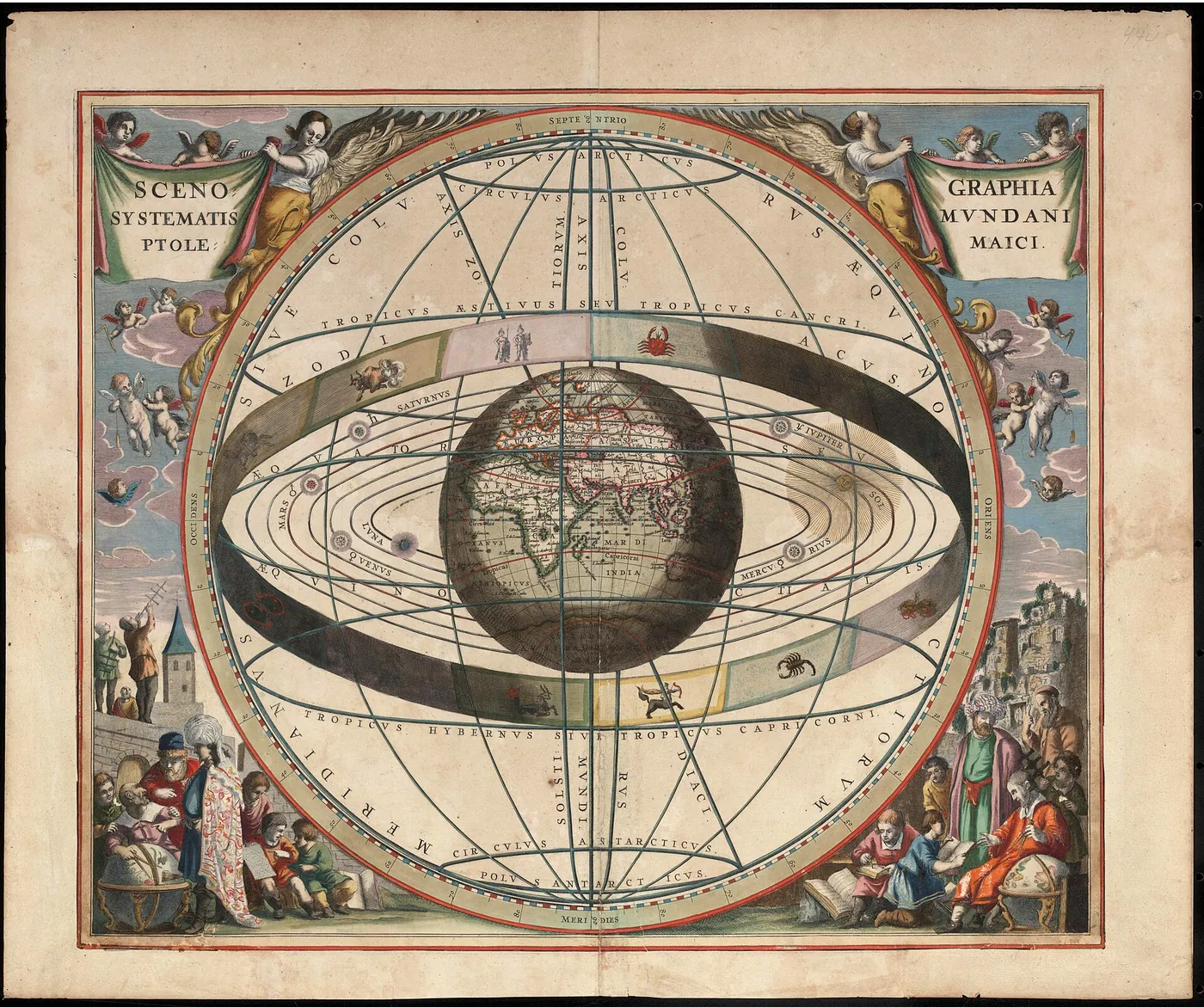
The geocentric model codified in Ptolemy's Almagest, which predicted the positions of sun, moon and planets by combining circles: deferents, epicycles, eccentrics and the equant. It served astronomers for some fourteen centuries.
... when they come to model heaven / And calculate the stars, how they will wield / The mighty frame, how build, unbuild, contrive / To save appearances, how gird the sphere / With centric and eccentric scribbled o'er, / Cycle and epicycle, orb in orb
—— John Milton, Paradise Lost VIII.79–84 (2nd ed., 1674; spelling modernized), the angel Raphael to Adam
History
The Ptolemaic system is the set of geometrical models in the Almagest (c. 150 CE) that keep the Earth at rest in the centre and represent the apparent motions of the sun, moon and five planets as combinations of uniform circular motions. Most of its parts were older. Epicycles (a planet riding a small circle whose centre travels round a larger one, the deferent) and eccentric circles had been studied by Apollonius around 200 BCE, and Hipparchus built them into theories of the sun and moon, fitting parameters with the help of Babylonian eclipse records; Ptolemy's tables count years from the Babylonian era of Nabonassar (747 BCE). Ptolemy added the equant, a point off the centre of the deferent about which the epicycle's centre moves at a constant angular rate. It greatly improved planetary predictions and broke the philosophical rule that uniform motion should be about a circle's own centre. Aristotle's nested spheres supplied the physical background; the declared aim was to "save the phenomena". In Baghdad al-Hajjaj translated the Almagest into Arabic in 827–828, and Ishaq ibn Hunayn made a new version later in the century, revised by Thabit ibn Qurra. The Greek megiste, "greatest", became Arabic al-majisti and Latin Almagestum; Gerard of Cremona translated it from Arabic at Toledo in 1175.
Connections
Causes4
- Babylonian AstronomyenablesPtolemy used Babylonian eclipse records and dated from the era of Nabonassar (747 BCE)
- AristotleenablesThe geocentric spheres and the sublunary/celestial divide supplied its physical framework
- Euclid's ElementsenablesGeometry made it possible to “save the phenomena”
- Claudius PtolemycontributedThe Almagest (c. 150 CE)
Consequences3
- The House of WisdominspiresThe Almagest was repeatedly translated in Baghdad; its very name comes from Arabic
- Ibn al-HaythaminspiresIbn al-Haytham wrote Doubts concerning Ptolemy
- HeliocentrismenablesCopernicus used Ptolemy's mathematical craft to move the centre of the cosmos
Sources
- G. J. Toomer, Ptolemy's Almagest (translation and annotation) (1984)
- Otto Neugebauer, A History of Ancient Mathematical Astronomy (1975)
- Paul Kunitzsch, Der Almagest: Die Syntaxis Mathematica des Claudius Ptolemäus in arabisch-lateinischer Überlieferung (1974)
- Pierre Duhem, trans. E. Doland and C. Maschler, To Save the Phenomena: An Essay on the Idea of Physical Theory from Plato to Galileo (1969)
Open questionswell attested
- The dates of the Arabic translations are based on the colophons of surviving manuscripts.
- The attribution of the invention of epicycles and eccentrics relies mainly on Ptolemy's own account.
- The route by which the models of the Maragha school influenced Copernicus is disputed.
Why it matters
It is easy to treat the Ptolemaic system as a museum of error. Without telescopes or dynamics, it predicted planetary positions well enough for naked-eye astronomy and underpinned teaching and table-making from Baghdad to Toledo to Kraków. Its troubles came in two kinds. One was accuracy: errors accumulated and tables had to be revised. The other was philosophical: the equant, and the question whether the circles were real spheres, never fitted Aristotle's physics, and that is exactly where Ibn al-Haytham's Doubts and the Maragha astronomers led by al-Tusi attacked. Copernicus moved the centre but kept epicycles, and one of his motives was to be rid of the equant; only Kepler's ellipses of 1609 ended the system. Whether a model is a calculating device or a picture of how things are was a question the system posed sharply, and philosophers of science have not stopped asking it.