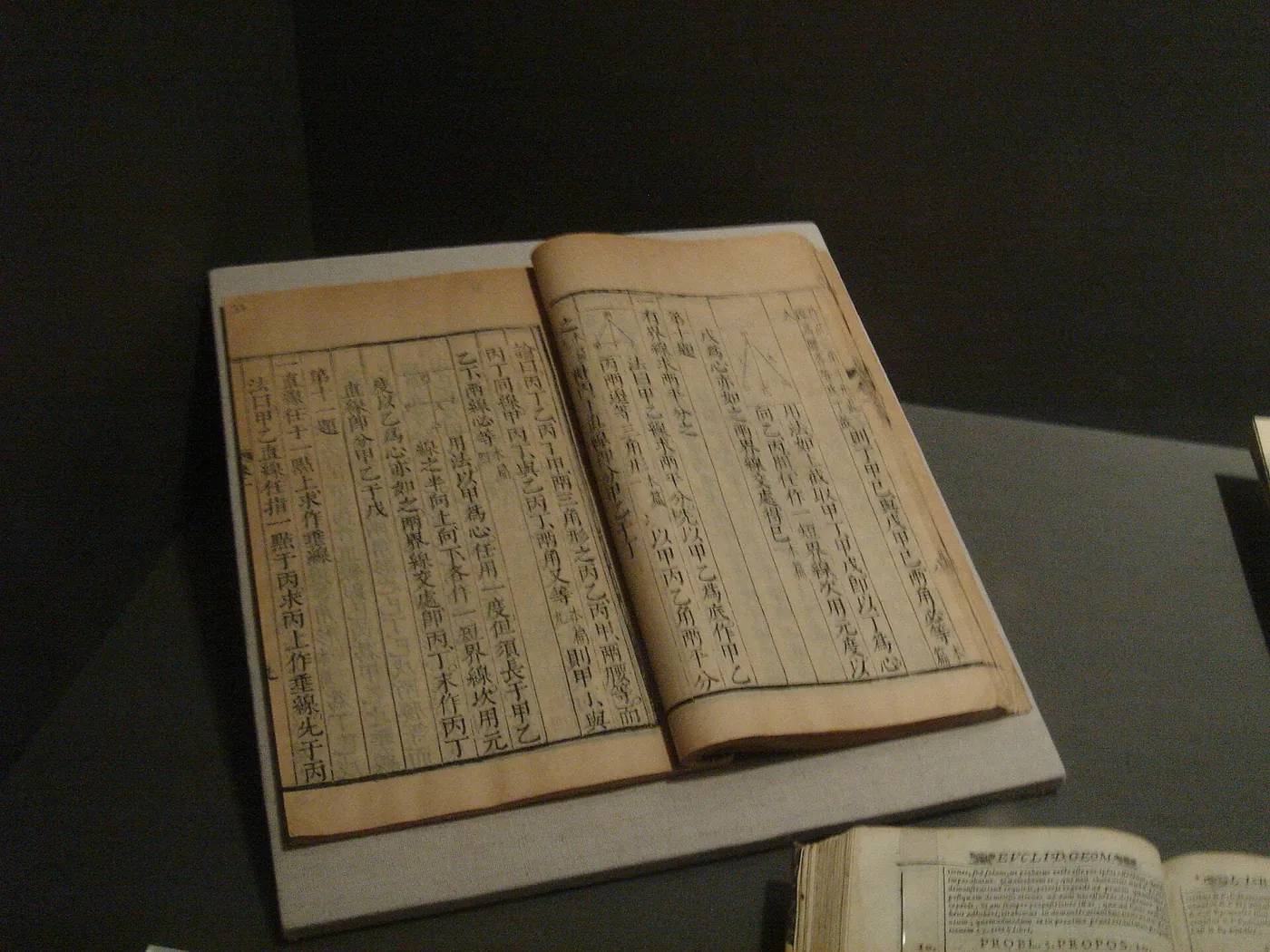
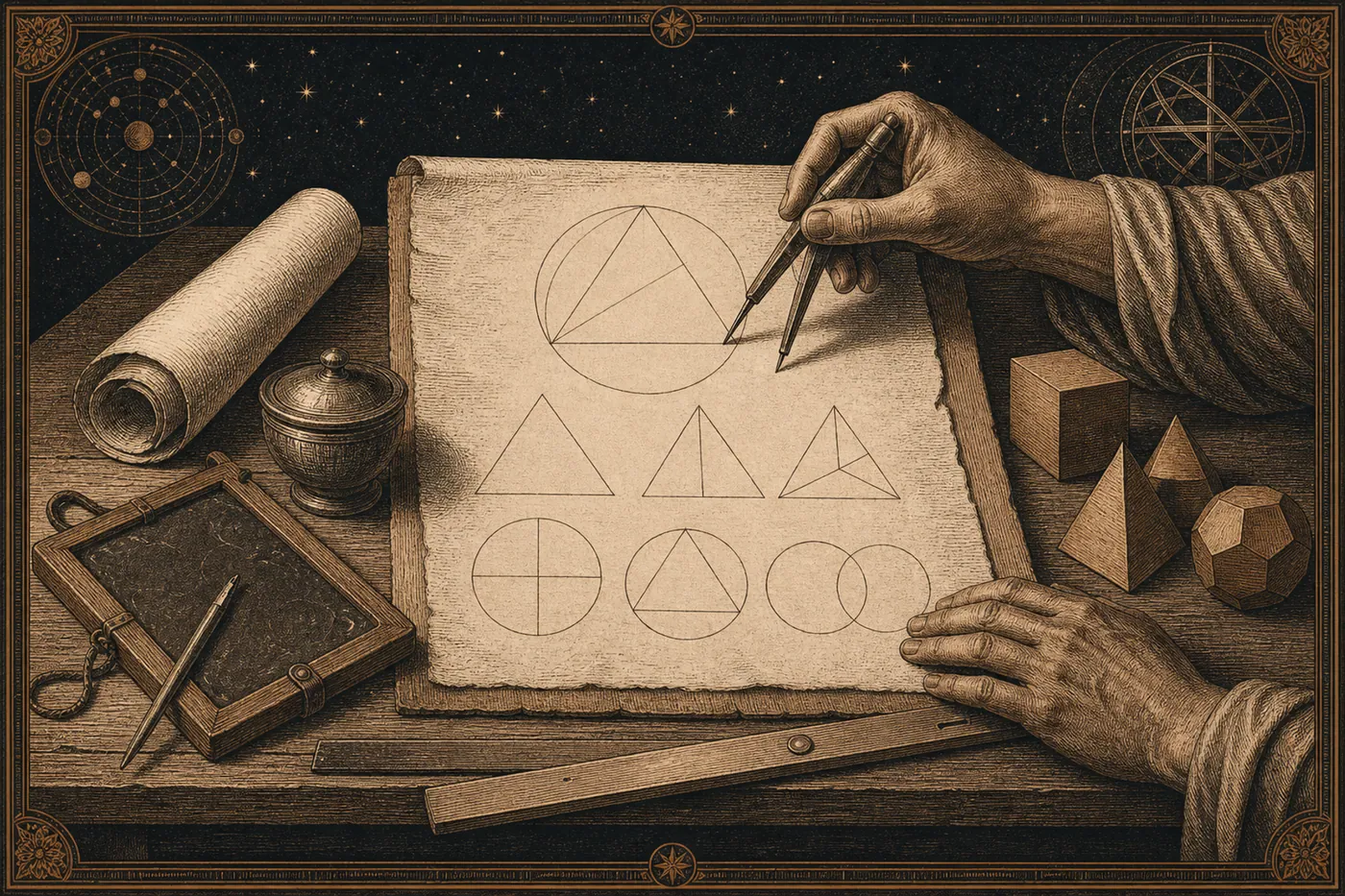
The thirteen books of geometry and number theory compiled by Euclid at Alexandria about 300 BCE. Most of their propositions were already known; their value lies in structure: from twenty-three definitions, five postulates, and five common notions, each of more than four hundred propositions may be proved only from what is already proved. This axiomatic-deductive form became the model of demonstration in the West; it was translated and annotated at Baghdad, returned to Europe in Latin, and in 1607 its first six books were rendered into Chinese by Matteo Ricci and Xu Guangqi, fixing the Chinese terms for point, line, and parallel; the title word jihe, which there meant quantity, later became the Chinese name of the discipline. Around 1830 the construction of non-Euclidean geometries turned two thousand years of self-evidence into one assumption among possible others.
There is no royal road to geometry.
—— Euclid to Ptolemy I, as reported by Proclus, Commentary on Euclid Book I (5th c. CE; a late attribution)
History
About 300 BCE Euclid compiled the thirteen books of the Elements at Ptolemaic Alexandria. Most of the propositions have earlier sources (the theory of proportion from Eudoxus, the classification of irrationals from Theaetetus), and Euclid's achievement was to set them in a chain that cannot be skipped: twenty-three definitions, five postulates ("to draw a straight line from any point to any point"), and five common notions, after which each of some four hundred and sixty propositions may be proved only from what is already proved. The form travelled with the written traditions of the Hellenistic world; from the ninth century it was translated and heavily annotated at Baghdad, where attempts to derive the fifth postulate from the other four ran on for centuries. In the twelfth, Adelard of Bath and Gerard of Cremona rendered it into Latin from the Arabic, and the Elements returned to Europe as the backbone of university teaching. Venice printed the first edition in 1482; for four centuries after, it was the most-printed book after the Bible. In 1607 Ricci and Xu Guangqi translated the first six books at Beijing, fixing the Chinese terms for point, line, surface, parallel, and similar. The title word jihe there meant quantity (the opening assigns all that has measure or number to the jihe category), and its use as the name of the discipline grew later out of that title. Around 1830 Lobachevsky and Bolyai independently constructed geometries that deny the fifth postulate without contradiction.
Connections
Causes1
- EuclidcontributedCompiled the thirteen books of the Elements
Consequences7
- The Scientific Methodenables · disputedThe axiomatic-deductive form is one formal source of the modern scientific method (the degree is contested)
- Optics (Ibn al-Haytham)enablesIbn al-Haytham's Optics treats vision by geometrical demonstration, taking its form from the Greek-Arabic transmission of the Elements
- ArchimedesinspiresArchimedes built his proofs on the system of the Elements
- The Ptolemaic SystemenablesGeometry made it possible to “save the phenomena”
- Universal GravitationenablesThe Principia argues in the form of Euclidean geometry
- Computability (the Turing Machine)inspiresThe axiomatic ideal led, via Hilbert's programme, to the decision problem that Turing answered in the negative
- The House of WisdominspiresAl-Hajjaj translated the Elements into Arabic twice
Sources
- Thomas L. Heath(译注), The Thirteen Books of Euclid's Elements
- 利玛窦、徐光启译(1607), 《几何原本》前六卷
- David H. Fowler, The Mathematics of Plato's Academy
- Euclid's Elements
Open questionswell attested
- Almost nothing is known of Euclid's life, and scholars have debated whether "Euclid" was one person or the name of a compiling tradition.
- "There is no royal road" comes from the much later commentary of Proclus (fifth century) and is hearsay not found in any contemporary record; its source is noted where it is used as the epigraph.
- Most of the propositions derive from predecessors such as Eudoxus and Theaetetus, and Euclid's achievement lay in their arrangement and axiomatization; this is the consensus view.
- In the nineteenth century non-Euclidean geometry showed that the fifth (parallel) postulate could be replaced, so "self-evidence" lost its absolute status, a point crucial to assessing the influence of the Elements.
- Claims such as "the Elements caused the Scientific Revolution" overstate its causal role and are not adopted; the link between the Elements and the Scientific Revolution is disputed.
Why it matters
The reach of the Elements runs well past mathematics. What it demonstrated was not geometrical knowledge but a portable regime of argument: put the premises on the table, and thereafter take nothing more from under it. Newton's Principia is written in geometrical proofs; Spinoza's Ethics is subtitled "demonstrated in geometrical order"; the Declaration of Independence opens by holding truths to be self-evident, which is the voice of an axiom. To credit all of this to Euclid would be over-attribution, since institutions, printing, and a culture of dispute each had their share; but to say it is unrelated will not do either: writing that sets out its premises and then reasons from them is something someone had to write first for others to learn it. The turning point came around 1830. When Lobachevsky showed the fifth postulate could be dispensed with, the most celebrated layer of the Elements, its self-evidence, collapsed, and its most essential layer became firmer for it: the worth of an axiomatic system never lay in the axioms being true, but in putting on open display what has been assumed.