A high-carbon crucible steel made in South India and Sri Lanka from around the third century BCE. Iron, charcoal, and plant matter were sealed in a clay crucible and heated at length to yield ingots of roughly 1.5% carbon. Exported to the Middle East and forged into blades, these showed a watered surface pattern, the mark of what Europeans called Damascus steel. The pattern arises from banded carbide segregation in which trace elements such as vanadium play a decisive part. The technique faded after the eighteenth century; why remains unsettled—loss of access to suitable ores, broken trade, and interrupted craft transmission are all candidates, and “exhausted mines” as a single cause is an untested hypothesis.
The Indians make mirrors of steel, and swords also; their steel, polished, shows a pattern like the ripples of running water.
—— Summarized from medieval Arabic metallurgical literature (e.g. al-Bīrūnī's book on minerals)
History
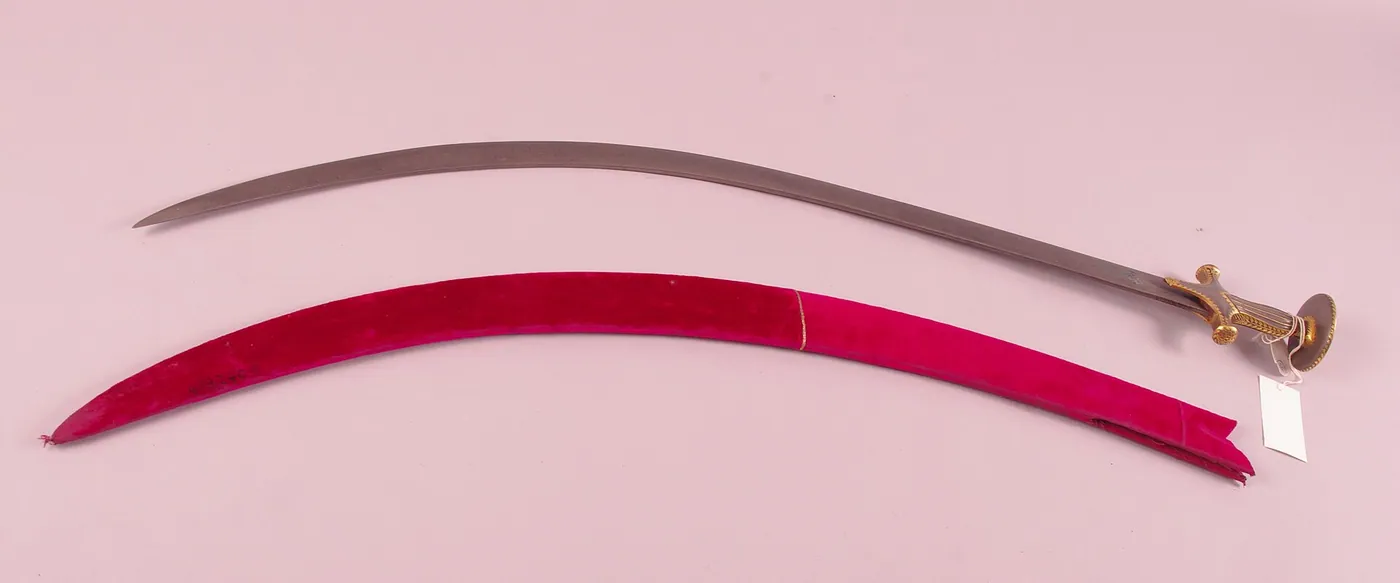
Wootz was made by the crucible route: wrought iron or ore, with charcoal and the leaves of particular plants, was sealed in a clay crucible and heated long enough for the iron to take up carbon and melt, cooling into a cake-shaped ingot. Sites in South India such as Kodumanal show the technique mature by the last centuries BCE. Ingots traveled by land and sea to Persia and the Arab world and were forged into blades at centres including Damascus—whence the European name, taken from the entrepôt rather than the source. Such blades were prized for combining hardness with toughness, and for a surface pattern that is not etched decoration but the outcropping of internal structure. European metallurgists of the eighteenth and nineteenth centuries, Faraday among them, tried repeatedly to reproduce it and failed. In the late twentieth century J. D. Verhoeven, working with the bladesmith Alfred Pendray, showed that the key lay in trace elements in the source ores (vanadium above all), together with a specific cycle of heating and forging: the trace elements promote banded carbide precipitation during slow cooling, and repeated forging aligns the bands into ripples. From this Verhoeven and his colleagues drew a hypothesis still awaiting testing against Indian ore-field data: had the ore in use ceased to carry those trace elements, the pattern would fail to appear even where the craft was unchanged. This is one candidate explanation of the loss, alongside broken trade and interrupted transmission, and not to be taken as settled.
Connections
Causes2
- ForgingenablesThe crucible cake was forged into a blade by long, low-temperature working, in which the pattern also emerges
- CastingenablesWootz was won as a cake from a crucible melt, a liquid-state route; the blade that followed was made by forging
Echoes1
- IronworkingechoesThe crucible route ran alongside the bloomery and cast-iron routes rather than descending from them
Sources
- J. D. Verhoeven, A. H. Pendray & W. E. Dauksch (JOM, 1998), The Key Role of Impurities in Ancient Damascus Steel Blades
- Sharada Srinivasan & Srinivasa Ranganathan, India's Legendary Wootz Steel: An Advanced Material of the Ancient World
- Wootz steel
Open questionspartly uncertain
- "Damascus steel" means blades forged from wootz ingots, which are not the same thing as European pattern-welded steel.
- The explanation of the pattern (banded carbide segregation plus trace vanadium) comes from experimental reconstructions by Verhoeven and others, and the details are still being researched.
- Several explanations for its loss coexist (exhausted ore sources, broken trade links, the dying-out of the chain of craft skills), and none is settled.
- Its starting date has moved earlier with the dating of Kodumanal and other sites in south India, and is still being revised.
Why it matters
Wootz is the most honest case in the category of "lost technologies," because it lays the mechanism of loss open to view: a technique resides not only in the hands of craftsmen but in the chemistry of particular ore bodies, in the trade routes that carry ore to the crucible, and in the unbroken transmission from master to apprentice. Remove any of the three and the recipe fails. Early modern Europe's repeated failures most likely came from iron that lacked that trace of vanadium—an explanation suggested by experimental reconstruction, with ore-field evidence still to come. This also corrects the modern intuition that technology is information: not everything can be written down and carried away. The naming is worth a note as well. Europeans called it Damascus steel, after the place they bought it, erasing the place it was made, a habit of naming by entrepôt that recurs in the history of science (the "Arabic" numerals likewise), and that constitutes, in itself, a record of how knowledge comes to be remembered and forgotten.