The reduction of iron ore to workable metal and its fashioning into tools. Emerging in and around Anatolia in the mid-second millennium BCE, it became general after 1200 BCE as the bronze system collapsed. The West long used the bloomery, producing a spongy mass consolidated by repeated forging; China by the fifth century BCE achieved high-temperature reduction and cast iron directly, later developing decarburizing methods such as puddling and co-fusion—a quite different path. Iron ore is far more widely distributed than tin, and with iron, metal tools reached ordinary farming households for the first time.
As for the good iron about which you wrote to me: good iron is not available in my storehouse in Kizzuwatna. That it is a bad time for producing iron I have written.
—— Letter of the Hittite king Hattusili III to an Assyrian king (c. 1250 BCE)
History
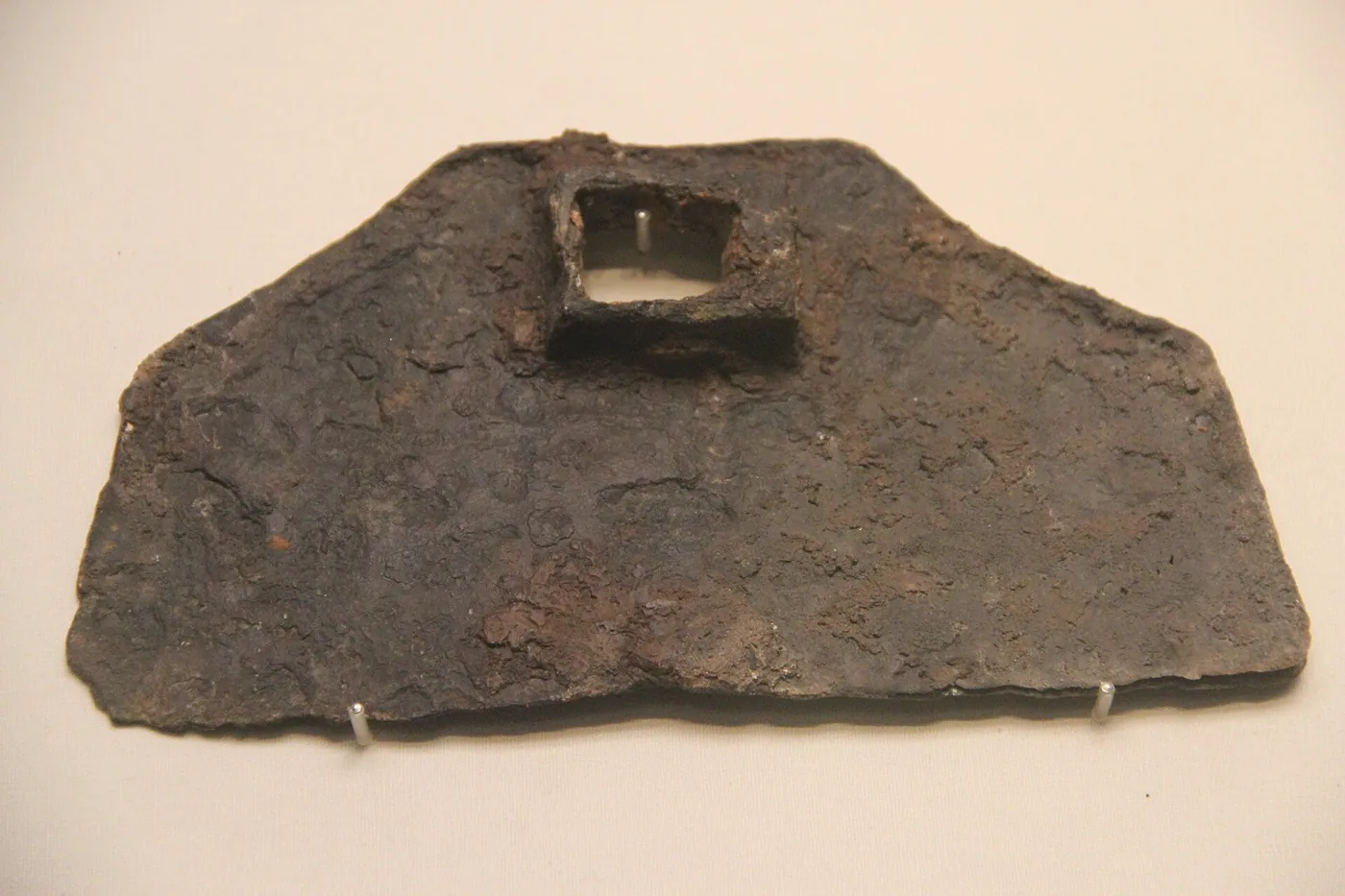
Iron scarcely occurs as a free metal (meteoric iron excepted); it must be won from ore by reduction with carbon at high temperature, and so its metallurgy came after copper's. By the middle of the second millennium BCE Anatolia and the Near East produced iron on a small scale; Hattusili's letter shows it still a scarce and precious commodity, made seasonally and allocated on request. The old story that the Hittites monopolized the technique and that its escape followed their fall has been much weakened in recent decades: more probably the collapse of the bronze system, cutting off tin, forced region after region toward the ore that lay everywhere. The Western path was the bloomery—furnaces too cool to melt iron yielded a slag-riddled sponge that had to be reheated and hammered repeatedly, laborious and low-yielding. China took another road: by the fifth century BCE at the latest, shaft furnaces reduced ore hot enough to tap liquid cast iron and pour it into moulds, so that cast-iron farm tools became common in the Warring States; later methods such as puddling, hundredfold forging, and co-fusion decarburized it into steel. Europe reached the blast furnace only in the late Middle Ages, and only with coke in the eighteenth century did iron enter industrial scale.
Connections
Causes2
- ForgingenablesBloomery iron leaves the furnace as a slag-riddled sponge that only repeated hot hammering turns into wrought iron; forging was thus essential to the West Asian and European iron route
- CastingenablesChinese shaft furnaces ran hot enough to tap and pour liquid iron, a road parallel to the West Asian and European bloomery-and-forge route
Consequences1
- The StirrupenablesMetal forging was the craft precondition of paired metal stirrups
Echoes3
- Meroitic Ironworkingechoes · disputedWhether sub-Saharan ironworking was transmitted or independent remains unsettled
- Bronze MetallurgyechoesNot a linear upgrade: iron spread because tin routes failed and iron ore is ubiquitous
- Wootz SteelechoesThe crucible route ran alongside the bloomery and cast-iron routes rather than descending from them
Sources
- Theodore A. Wertime & James D. Muhly (eds.), The Coming of the Age of Iron
- 李约瑟(Joseph Needham)等, 《中国科学技术史》第五卷第十一分册·钢铁冶金
- Ferrous metallurgy
Open questionspartly uncertain
- The idea of a Hittite monopoly on ironworking is an old view that scholars have largely set aside in recent decades.
- Linking the spread of iron to the collapse of the bronze system is the mainstream explanation, but not the only one.
- Cast-iron production in China in the 5th century BCE is archaeologically confirmed, about 1,800 years earlier than in Europe.
- Whether ironworking in sub-Saharan Africa arose independently is still debated.
Why it matters
Iron's historical weight is often compressed into "harder weapons," when the deeper layer is farm tools. Bronze was too dear for any but nobles and armies; iron ore lies everywhere, and iron ploughs and hoes could reach ordinary households, raising cultivated area and population a step. A technology's social effect often turns not on the ceiling of its performance but on the floor of its cost. The divergence of the Chinese and Western paths is likewise instructive: China commanded cast iron some eighteen centuries before Europe, a fact long absent from Eurocentric textbooks—but one that should not simply be inverted into another tale of superiority. The cast-iron route grew out of particular conditions: shaft-furnace design, phosphorus-rich ores, blast and fuel. It is the result of a set of circumstances, not evidence of national endowment.