Iron production at Meroë (in modern Sudan), capital of the Kingdom of Kush. Great slag heaps ring the site; radiocarbon dating published in Antiquity in 2019 places the ironworking chiefly in the early (Napatan) and late (late and post-Meroitic) phases, with little direct evidence for the classic Meroitic centuries between roughly 300 BCE and 300 CE. In 1912 the British scholar A. H. Sayce called it "the Birmingham of ancient Africa"—a phrase that traveled far, though recent excavation indicates the scale was overstated and iron less central to Kushite society than supposed. Meroë matters not as a defence that "Africa too had industry," but as an upper-Nile state with its own dynasty, its own script, and its own metallurgical tradition.
Meroë, the Birmingham of ancient Africa.
—— A. H. Sayce, 1912; later excavation has corrected the exaggeration
History
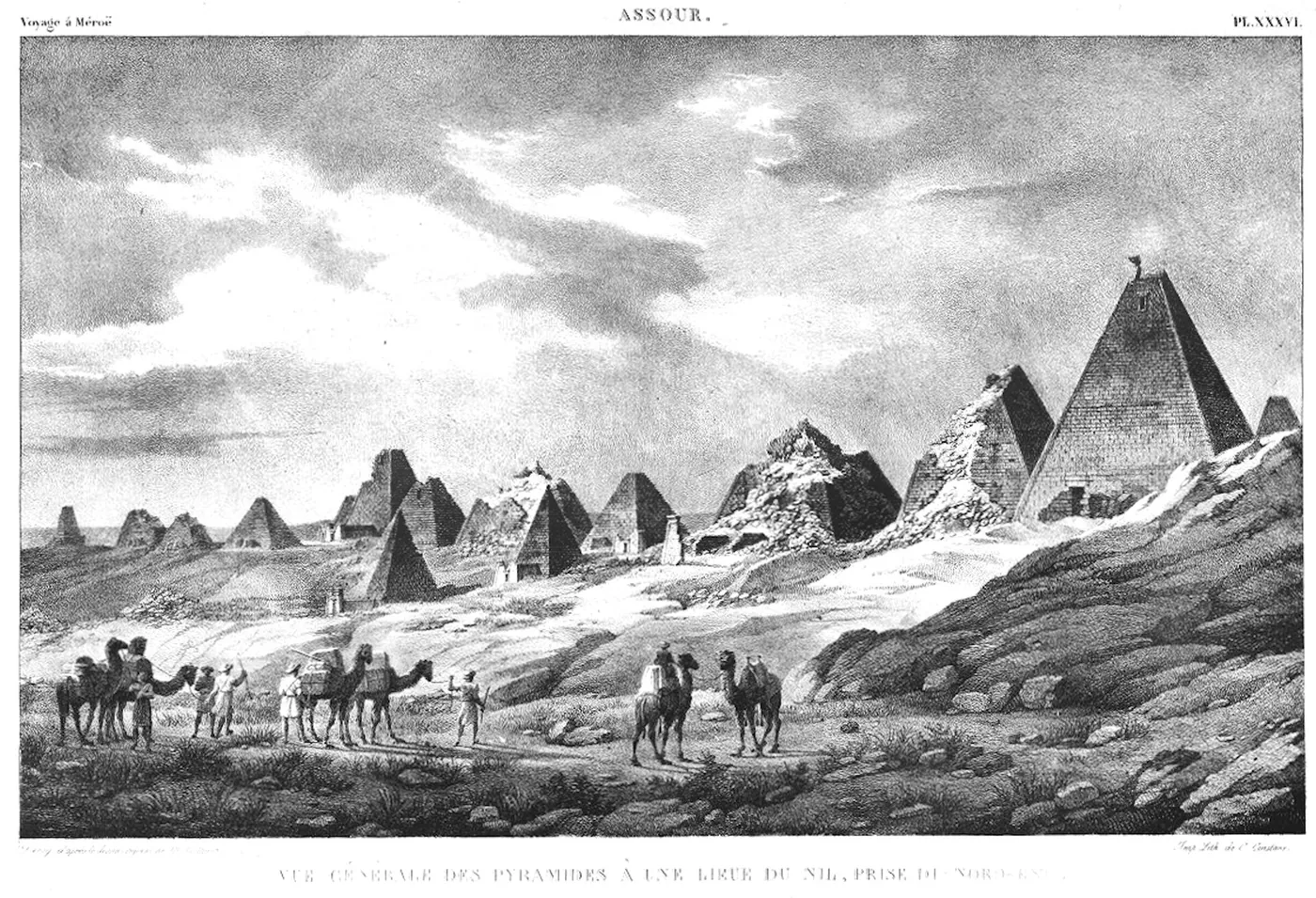
Kush was an ancient state of the upper Nile that ruled Egypt in the eighth century BCE as its Twenty-fifth Dynasty. After about 300 BCE its political centre moved south to Meroë, which lasted more than six centuries. Slag heaps spread around the site, where bloomery furnaces, tuyères, and iron objects have all been excavated; radiocarbon work published in 2019 (Carey, Stremke & Humphris, in Antiquity) shows the slag accumulating chiefly in the early (Napatan) and the late (late and post-Meroitic) phases, with little direct evidence of ironworking in the classic Meroitic centuries when the royal city was at its height—the old picture of continuous, substantial production has been taken apart by the dating. In 1912 Sayce called the place "the Birmingham of ancient Africa," and the phrase was quoted for the next hundred years, both as evidence of African technical achievement and as a weapon against the claim that Africa had no history. Systematic excavation in recent decades gives a more careful picture: the heaps are large but accumulated over centuries, so annual output falls far short of the industrial metaphor, and the proportion of iron in graves and settlements shows it did not displace stone, bone, and copper in daily use. Meanwhile Meroë's other achievements stand confirmed: its own Meroitic script (today pronounceable but largely untranslatable), hundreds of steep-sided pyramids, and trade reaching Rome and the Indian Ocean world.
Connections
Echoes1
- Ironworkingechoes · disputedWhether sub-Saharan ironworking was transmitted or independent remains unsettled
Sources
- Derek A. Welsby, The Kingdom of Kush: The Napatan and Meroitic Empires
- Carey, Stremke & Humphris (Antiquity, 2019), Ironworking remains in the royal city of Meroe: new insights on the Nile Corridor and the Kingdom of Kush
- Meroe: The Capital of Kush (UNESCO World Heritage, Island of Meroe)
- Kingdom of Kush
Open questionspartly uncertain
- "The Birmingham of ancient Africa" is a rhetorical phrase from 1912, and modern excavation shows that the output and social importance of ironworking at Meroë were exaggerated.
- A radiocarbon study published in Antiquity in 2019 (Carey, Stremke and Humphris) places ironworking mainly at the two ends of the sequence, in the Napatan and the Late/Post-Meroitic periods, with little evidence from the Classic Meroitic period; the chronology is still being revised.
- The technological source of Meroitic ironworking (introduced from Egypt or the Near East, or developed locally) is unresolved.
- The question of whether ironworking south of the Sahara arose independently, which turns on early dates from Termit in Niger and elsewhere, remains open because those dates are disputed.
- Meroitic script can so far only be transliterated, and most of it still cannot be understood.
Why it matters
Half the lesson here concerns Meroë and half the metaphor. Naming an ancient African capital after a city of the Industrial Revolution was meant as praise, but its effect was to concede the measuring stick: as though African achievement counted only when converted into European units. The sounder course is to let Meroë stand as itself—it had its own dynasty, script, funerary system, and metallurgy, none of which require a European counterpart as guarantor. Sayce's phrase and its later correction belong together in the telling, because the self-correcting work of historiography is itself part of historical knowledge. Conceal it, and the reader is left choosing between two simplifications.