Mesopotamian scholars watched the sky to read omens for their kings. The Astronomical Diaries of Babylon ran for some six centuries from 652 BCE, and by the Seleucid period scribes could compute eclipses and planetary positions by arithmetic.
If on the 14th day the moon and sun are seen together: reliable speech; the land will become happy.
—— Report of Rašil the Older to the king of Assyria (Esarhaddon or Ashurbanipal), State Archives of Assyria 8, no. 394, trans. Hermann Hunger (1992)
History
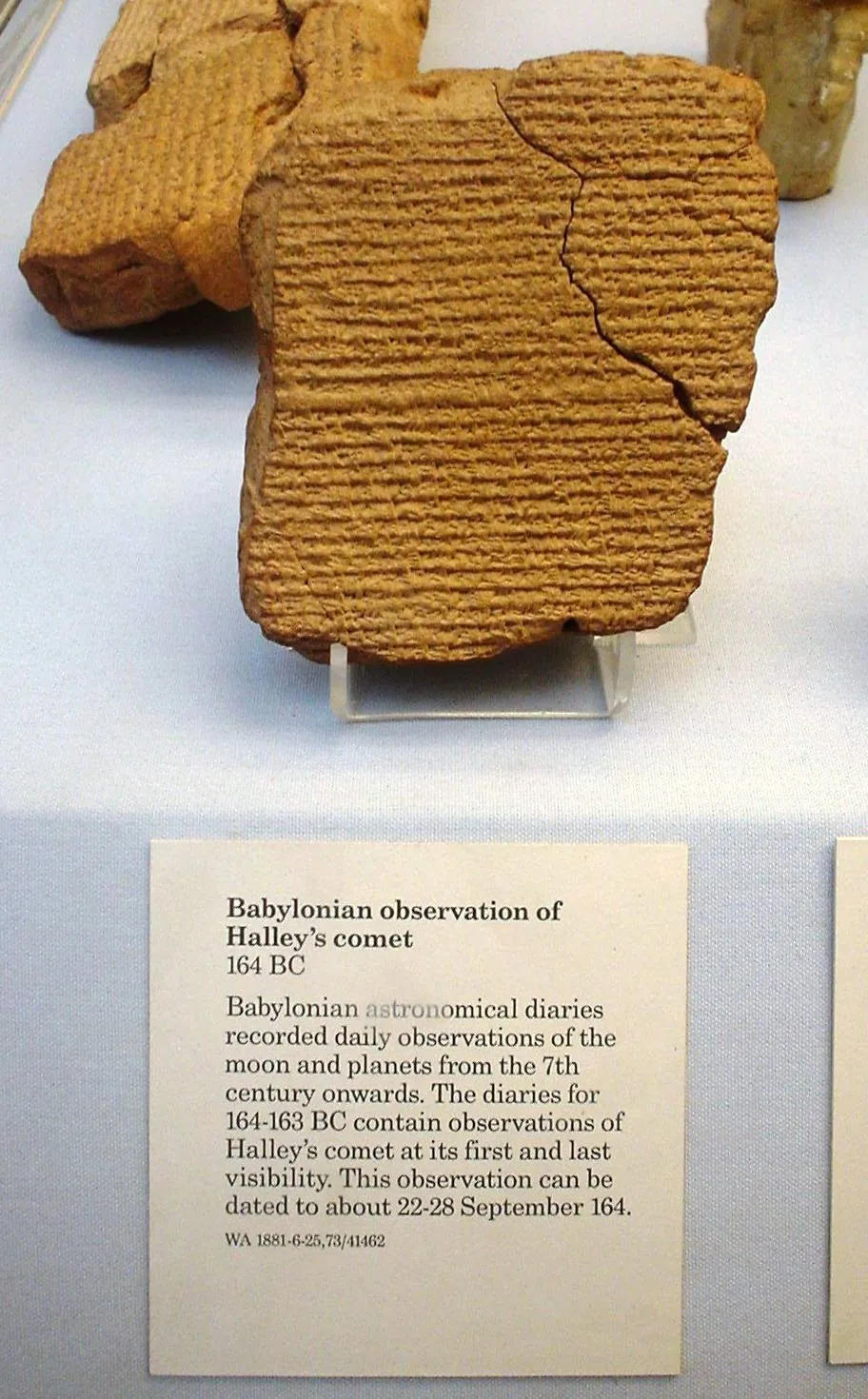
Babylonian astronomy is the tradition of sky records and calculation that Mesopotamian scribes built up on clay, and it began as divination. The omen series Enūma Anu Enlil, some seventy tablets with six or seven thousand entries of the form "if this appears in the sky, that will happen on earth", supplied the scholars of the Assyrian court in the seventh century BCE with the omens they reported to their kings. MUL.APIN, compiled around 1000 BCE, lists 66 stars and constellations together with rules for intercalation. From 652 BCE scribes in Babylon kept nightly Astronomical Diaries, the latest surviving from 61 BCE; besides the positions of the moon and planets they noted the weather, the level of the Euphrates, the prices of barley, dates and four other goods, and the news of the city. No later than the sixth century BCE they were arranging possible lunar eclipses in a cycle of 223 synodic months, about 18 years, later called the Saros. A zodiac of twelve equal signs of 30 degrees appeared around 400 BCE. In the Seleucid period, ephemerides from Babylon and Uruk computed the positions of the moon and planets with arithmetic sequences alone, without geometric models. Hipparchus and Claudius Ptolemy both drew on Babylonian eclipse records and parameters, and the Almagest counts its years from the accession of Nabonassar, 26 February 747 BCE.
Connections
Causes1
- CuneiformenablesCenturies of sky records survived because they were written on clay
Consequences2
- The Antikythera MechanismenablesBabylonian cycles such as the Saros are engraved on its back dials
- The Ptolemaic SystemenablesPtolemy used Babylonian eclipse records and dated from the era of Nabonassar (747 BCE)
Echoes1
- Zero and Place-ValueechoesBabylonian sexagesimal place value echoes the Indian decimal place-value system
Sources
- Abraham J. Sachs & Hermann Hunger, Astronomical Diaries and Related Texts from Babylonia, vol. I: Diaries from 652 B.C. to 262 B.C. (1988)
- Hermann Hunger, Astrological Reports to Assyrian Kings (State Archives of Assyria 8) (1992)
- Hermann Hunger & David Pingree, Astral Sciences in Mesopotamia (1999)
Open questionswell attested
- The date of compilation of Enūma Anu Enlil is uncertain; it is generally thought to have reached its standard form in the late second millennium BCE.
- Most scholars date MUL.APIN to around 1000 BCE.
- When lunar eclipses began to be arranged in 18-year cycles can only be inferred as no later than the sixth century BCE.
- The name "Saros" is a seventeenth-century misapplication by Halley of a term taken from a Byzantine lexicon.
- It cannot be determined whether the report quoted was addressed to Esarhaddon or to Ashurbanipal.
Why it matters
Babylonian astronomy shows how predictive science could grow out of divination. An omen is useful only if one knows when it will appear; an eclipse computed in advance gave the court time to prepare its countermeasures, which in Assyria could include seating a substitute king on the throne to absorb the evil. That demand turned nightly observation and long record-keeping into an institution, and centuries of data let scribes find periods and then methods of calculation that no longer depended on watching every night. The methods were purely arithmetical. They could say when the moon would be visible without any geometric picture of how it moved through space, and it was Greek astronomers who later set Babylonian parameters inside geometric models, the marriage that underlies the Ptolemaic system. Sexagesimal place value travelled with them, which is why a circle still has 360 degrees and an hour 60 minutes.