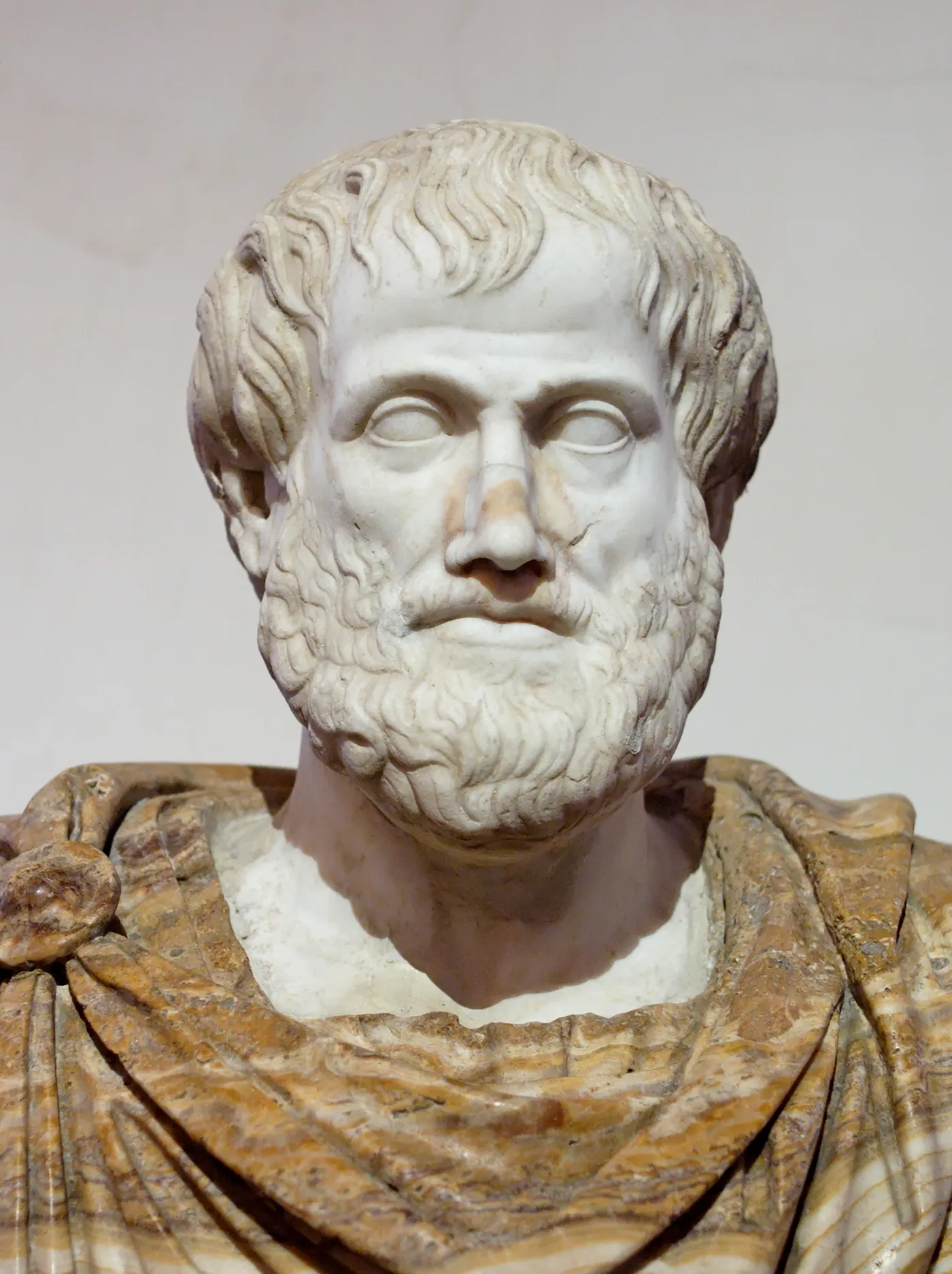
Greek philosopher (384–322 BCE), pupil of Plato, tutor of the young Alexander and founder of the Lyceum. His logic, physics, cosmology and biology dominated learning in Europe and the Islamic world for nearly two thousand years.
For if every instrument could accomplish its own work, obeying or anticipating the will of others, like the statues of Daedalus, or the tripods of Hephaestus ... if, in like manner, the shuttle would weave and the plectrum touch the lyre without a hand to guide them, chief workmen would not want servants, nor masters slaves.
—— Aristotle, Politics I.4, 1253b33–1254a1, trans. Benjamin Jowett (1885)
History
Aristotle was born in 384 BCE at Stagira in the Macedonian sphere, the son of a court physician. At seventeen he entered Plato's Academy in Athens and stayed some twenty years; after Plato's death in 347 he spent several years at Assos and on Lesbos, where he and Theophrastus studied animals. In 343 Philip II engaged him to teach the thirteen-year-old Alexander at the sanctuary of the Nymphs at Mieza and, Plutarch says, rebuilt Stagira, which Philip himself had destroyed, as part of the fee. In 335 Aristotle returned to Athens and opened his school in the Lyceum, whose members became known as Peripatetics. When Alexander died in 323 and anti-Macedonian feeling rose, he withdrew to Chalcis and died there the next year. His works range over logic, physics, astronomy, biology, ethics, politics and poetics. The Physics explains change through four causes, material, formal, efficient and final; On the Heavens argues for an Earth at the centre of the cosmos and heavens made of aether; the biological works record dissections and observations, among them a dogfish whose embryos are joined to the mother by a placenta-like structure, confirmed only by Johannes Müller in 1842. Strabo calls him the first man known to have collected books, one who "taught the kings in Egypt how to arrange a library". His library passed through many hands before Andronicus of Rhodes edited the surviving writings, mostly lecture notes, in the first century BCE.
Connections
Consequences6
- Alexander the GreatinspiresTaught the young Alexander at Mieza from about 343 BCE
- The Library of AlexandriainspiresStrabo calls him the first collector of books and the teacher of the Egyptian kings in arranging a library
- The Ptolemaic SystemenablesThe geocentric spheres and the sublunary/celestial divide supplied its physical framework
- al-Ma'muninspires · disputedIbn al-Nadim records al-Ma'mun's dream of Aristotle, later told as the origin legend of the translations
- Francis BaconinspiresThe Novum Organum was named against Aristotle's Organon
- The Mechanical PhilosophyinspiresMechanism began by discarding Aristotle's formal and final causes
Sources
- Aristotle, Politics (trans. Benjamin Jowett) (1885)
- Strabo, Geography, vol. VI: Books 13-14 (Loeb Classical Library, trans. H. L. Jones) (1929)
- Jonathan Barnes (ed.), The Cambridge Companion to Aristotle (1995)
- Armand Marie Leroi, The Lagoon: How Aristotle Invented Science (2014)
Open questionswell attested
- The years in which the teaching at Mieza began and ended are approximate; it is generally thought to have lasted two or three years.
- Strabo's statement that he "taught the kings of Egypt" can only mean indirect influence through his school, since Aristotle had died before the Library of Alexandria was founded.
- The story that Stagira was rebuilt as a reward comes from Plutarch.
- Most of the surviving works are lecture notes, and how they were written and edited is unclear.
- Al-Ma'mun's dream of Aristotle is a legend.
Why it matters
Aristotle matters to the history of technological thought because he understood nature through the craftsman's work. His four causes are illustrated from the workshop: the bronze of a statue, its shape, the sculptor, the purpose for which it is made. Art, he held, imitates nature, and nature itself works like a purposeful maker. Carried by Arabic translators and Latin schoolmen, the framework made him simply "the Philosopher" to Thomas Aquinas, and Ibn al-Nadim recorded the legend that the caliph al-Ma'mun saw Aristotle in a dream. In the seventeenth century Francis Bacon named his Novum Organum against the Organon, and the mechanical philosophers threw out formal and final causes; many claims of modern science were first made in argument with him. The passage on self-moving tools is a counterfactual, followed at once by an argument that some people are slaves by nature. More than two thousand years later Marx quoted it in Capital when he turned to machinery.