Al-Ma'mun (786–833), seventh Abbasid caliph (r. 813–833), sponsored translations of Greek science, astronomical observations at Baghdad and Damascus and a survey of the meridian, and used state power to impose the doctrine of the created Qur'an.
Then I asked, 'What is good?' He replied, 'What is good in the mind.' I said again, 'Then what is next?' He answered, 'What is good in the law.' I said, 'Then what next?' He replied, 'What is good with the public.' I said, 'Then what more?' He answered, 'More? There is no more.'
—— Ibn al-Nadim, al-Fihrist, ch. 7 (987), al-Ma'mun's dream of Aristotle; trans. Bayard Dodge (1970), vol. 2, p. 583
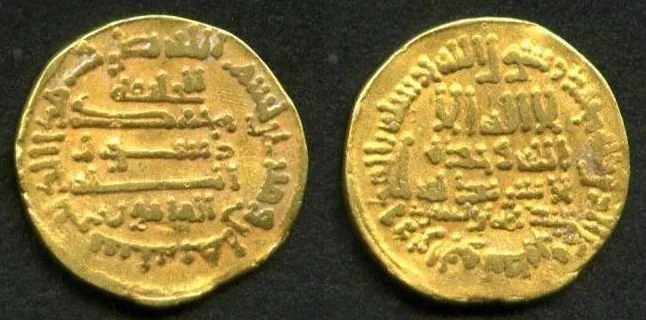
History
A son of Harun al-Rashid, al-Ma'mun was born in Baghdad in 786. After his father's death he fought his half-brother al-Amin for the caliphate; the civil war ran from 811 to 813, Baghdad endured a long siege, and al-Amin was killed. Al-Ma'mun stayed at Merv in Khurasan until 819 before entering Baghdad. Under him the translation of Greek science reached its height: al-Hajjaj revised his Euclid for the caliph and in 827–828 translated the Almagest, and al-Khwarizmi dedicated his book on al-jabr to him. In 828–829 Yahya ibn Abi Mansur and others observed the sun and moon in the Shammasiyya quarter of Baghdad to check Ptolemy's parameters; observations continued near Damascus in 831–833, and the results went into the "Verified Tables" (al-Zij al-Mumtahan). According to al-Biruni, the caliph read in Greek books that a degree measured 500 stades but found no one who knew how long a stade was, so he sent two parties onto the plain of Sinjar, west of Mosul, to pace north and south until the noon sun's altitude had changed by one degree; they reported 56 2/3 Arabic miles (another account says 56). In 833 he ordered judges and scholars of hadith to affirm that the Qur'an was created, the inquisition known as the Mihna; Ahmad ibn Hanbal refused. That August he died near Tarsus while campaigning against Byzantium.
Connections
Causes1
- Aristotleinspires · disputedIbn al-Nadim records al-Ma'mun's dream of Aristotle, later told as the origin legend of the translations
Consequences2
- The House of WisdompatronizedThe House of Wisdom flourished under his patronage
- al-KhwārizmīpatronizedThe Compendious Book on Calculation by Completion and Balancing is dedicated to al-Ma'mun
Echoes2
- Ptolemy II PhiladelphusechoesTwo rulers, two cities of learning: royal patronage in Alexandria and in Baghdad
- EratosthenesechoesTwo measurements of the earth: shadows at Alexandria, survey lines on the plain of Sinjar
Sources
- Dimitri Gutas, Greek Thought, Arabic Culture: The Graeco-Arabic Translation Movement in Baghdad and Early ʿAbbāsid Society (2nd–4th/8th–10th centuries) (1998)
- Bayard Dodge (ed. and trans.), The Fihrist of al-Nadīm: A Tenth-Century Survey of Muslim Culture (1970)
- Jamil Ali (trans.), The Determination of the Coordinates of Cities: al-Bīrūnī's Taḥdīd al-Amākin (1967)
- Aydın Sayılı, The Observatory in Islam and Its Place in the General History of the Observatory (1960)
Open questionspartly uncertain
- Two figures are recorded for the result of the Sinjar measurement: 56 and 56 2/3 Arabic miles.
- The length of the Arabic mile is uncertain (from about 1.9 km to over 2 km), which makes the accuracy of the measurement hard to calculate.
- Al-Ma'mun's dream of Aristotle is a legend.
- The nature and scale of the "House of Wisdom" are disputed.
- Opinions differ on whether al-Ma'mun himself can be counted as a Mu'tazilite scholar.
Why it matters
Al-Ma'mun is often cast as the enlightened ruler who launched Arabic science single-handed. Dimitri Gutas has shown that the translation movement began under al-Mansur in the mid-eighth century, lasted more than two centuries and was paid for by princes, officials, physicians and merchants for administrative, astrological, medical and ideological reasons; the "House of Wisdom" was chiefly a library, and the dream of Aristotle can be read as propaganda for the dynasty. None of this erases al-Ma'mun's part. He made observation and measurement collective, state-organized and checkable work; the very title "Verified Tables" announces a habit of testing inherited numbers, and the observatories of the later Islamic world descend from it, much as Ptolemaic patronage had once concentrated learning in Alexandria. The Mihna showed the same power turned the other way: an inquisition in the name of rational theology, abandoned under al-Mutawakkil.