The branch of mathematics that treats unknown quantities by symbols and rules of operation. Its name comes from al-jabr ("restoration," i.e. transposing terms) in al-Khwarizmi's Compendium on Calculation by Restoration and Balancing, of about 820. The book reduces quadratics to six standard forms, gives general procedures, and proves them geometrically—the first systematic treatment of equation-solving as a subject in its own right. Latin translations carried it into Europe in the twelfth century, whence both "algebra" and "algorithm" (from the author's name).
I have composed this work on calculation by restoration and balancing, confining it to what is easiest and most useful in arithmetic, such as men constantly require in cases of inheritance, legacies, partition, lawsuits, and trade.
—— al-Khwarizmi, preface to the Kitāb al-jabr wa'l-muqābala (c. 820)
History
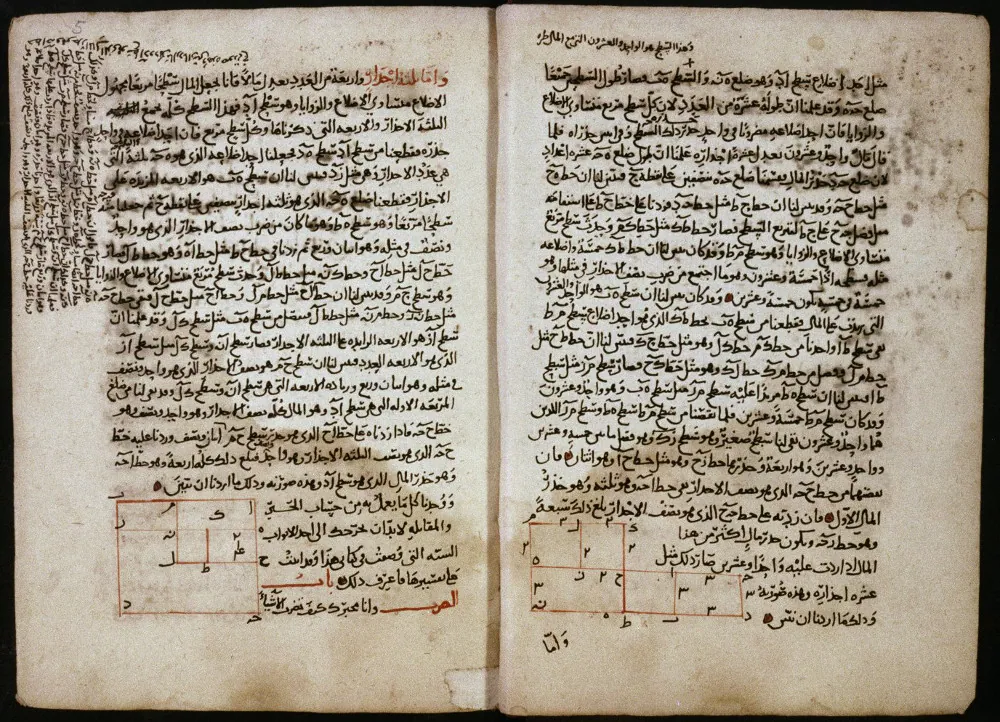
Al-Khwarizmi served at the House of Wisdom in Baghdad and wrote the Compendium on Calculation by Restoration and Balancing around 820. The two operations in its title are the method: al-jabr, "restoration," moves a negative term to the other side to make it positive; al-muqābala, "balancing," cancels like terms on both sides. He reduced linear and quadratic equations to six standard forms (six rather than one because negative numbers were not admitted), gave for each a mechanically executable procedure, and then proved each by areas of squares and rectangles, algebra and geometry standing surety for one another. The book contains not a single symbol: the unknown is "the thing" (shayʼ), its square is "property" (māl), and equations and solutions alike are written out in words—hence "rhetorical algebra." It entered Europe with his other work, on calculating with the Indian numerals, through twelfth-century Latin translation: the first gave Europe the word algebra, while the author's name, Latinized as algorismi, became algorithm. As for the sources of algebraic thought, there is more than one: Diophantus' Arithmetica handles particular solutions of indeterminate equations, and Brahmagupta (628) already used negative numbers systematically and solved quadratics. Al-Khwarizmi's contribution was to organize scattered techniques into a teachable, usable, demonstrated discipline.
Connections
Causes3
- Zero and Place-ValueenablesPlace-value and zero provided the notational basis for symbolic algebra
- al-KhwārizmīcontributedThe Kitab al-jabr founded algebra and gave the word "algebra"
- The House of WisdomenablesAlgebra was founded within its scholarly circle
Sources
- Frederic Rosen (trans., 1831), The Algebra of Mohammed ben Musa
- J. L. Berggren, Episodes in the Mathematics of Medieval Islam
- Algebra
Open questionswell attested
- Al-Khwarizmi's algebra is "rhetorical algebra": the book uses no symbols, and equations and methods of solution are all set out in words.
- The earlier work of Diophantus and Brahmagupta differs in kind (the former sought particular solutions, while the latter already used negative numbers and solved quadratic equations), so the question "who was the father of algebra?" is itself dubious.
- Symbolic algebra took shape only in the sixteenth and seventeenth centuries, with Viète and Descartes.
Why it matters
"Who invented algebra" is a badly posed question. Diophantus had equations without general procedures; Brahmagupta had procedures without a system; al-Khwarizmi made it a discipline. These are three different kinds of work, not three legs of a relay. The formation of algebra was itself cross-civilizational, with Indian and Greek contributions, and filing it under any single civilization requires cutting the foot to fit the shoe. A second point is often passed over. Al-Khwarizmi says plainly in his preface that he wrote for inheritance, partition, and trade; the fractional shares of Islamic inheritance law are intricate, and it was this everyday, legal, commercial demand that forced an abstract discipline into being.