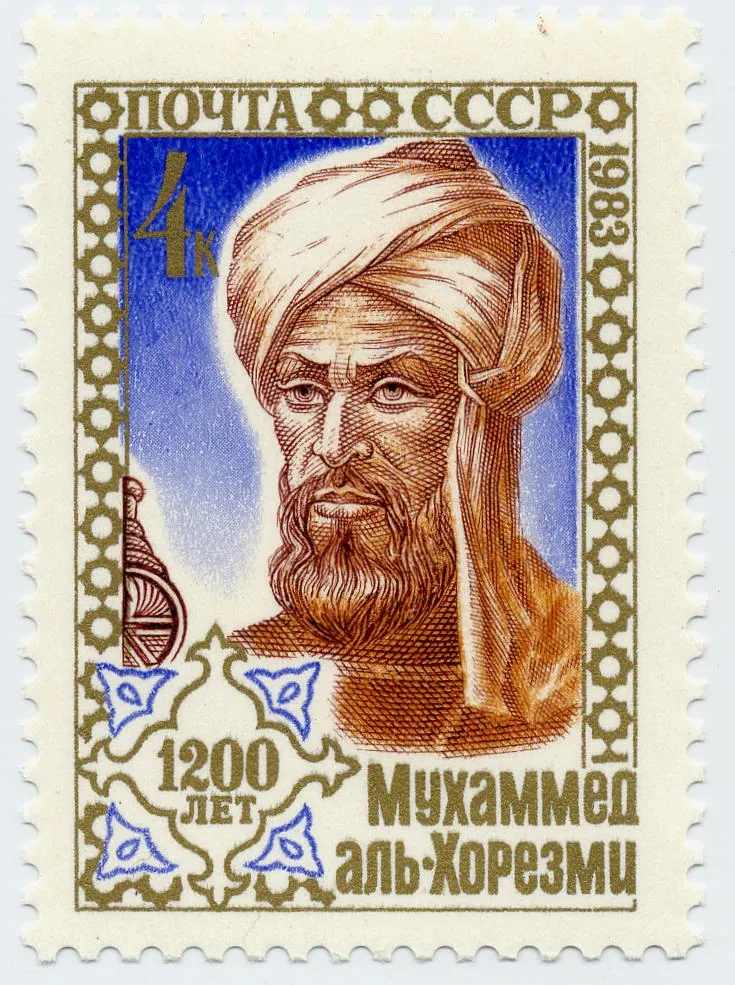
A scholar of Persian origin in the Abbasid scholarly circle of Baghdad (c. 780–c. 850). His Al-jabr wa'l-muqābala founded algebra as a discipline (the word "algebra" comes from al-jabr); his work on Indian reckoning transmitted the decimal numerals to the Arab world (the Latinized form of his name, Algoritmi, became "algorithm"). He also worked in geography and astronomy. His historical role lay chiefly in synthesis and transmission.
I have composed… what is easiest and most useful in arithmetic, such as men constantly require in cases of inheritance, legacies, partition, lawsuits, and trade.
—— al-Khwārizmī, preface to the Algebra (c. 820; trans. Rosen)
History
Al-Khwārizmī was born around 780 and worked in the scholarly circle of Abbasid Baghdad (later often called the House of Wisdom), across mathematics, astronomy, and geography. Around 820 he presented to the caliph al-Ma'mun a Book of Restoration and Balancing (Kitāb al-jabr wa'l-muqābala): the al-jabr in its title ("restoration," the moving of terms to restore an equation) is the root of the word "algebra." The book treated the solution of linear and quadratic equations, stated in words rather than symbols, yet established algebra as a discipline in its own right. He also wrote On the Hindu Art of Reckoning, introducing the decimal numerals with zero to the Arab world; the Latin version opens Dixit Algoritmi ("al-Khwārizmī said"), and Algoritmi became our "algorithm." He compiled astronomical tables, took part in geodesy, and mapped the known world.
Connections
Causes1
- al-Ma'munpatronizedThe Compendious Book on Calculation by Completion and Balancing is dedicated to al-Ma'mun
Consequences3
- Hindu–Arabic NumeralscontributedHis treatise on Indian reckoning carried the numerals westward (the word "algorithm" comes from his name)
- The House of WisdomcontributedAl-Khwarizmi was a core scholar of the House of Wisdom
- AlgebracontributedThe Kitab al-jabr founded algebra and gave the word "algebra"
Echoes1
- Computability (the Turing Machine)echoesThe word “algorithm” comes from al-Khwarizmi's name
Sources
- Frederic Rosen (trans.), The Algebra of Mohammed ben Musa
- J. L. Berggren, Episodes in the Mathematics of Medieval Islam
- Muhammad ibn Musa al-Khwarizmi
Open questionspartly uncertain
- His dates of birth and death, c. 780–850, are estimates.
- Whether he came from Khwarazm (in present-day Uzbekistan) or was a native of Baghdad is debated.
- It is well established that the words "algebra" and "algorithm" derive from the title of his book and from his name respectively.
Why it matters
Al-Khwārizmī did not "invent algebra alone" (Diophantus in Greece, Brahmagupta in India, and Babylonian problem-texts all contributed), nor did he invent the Indian numerals. His place in history lies in synthesis and relay: folding Indian digits, Greek geometry, and Babylonian arithmetic into Arabic works and passing them east and west. His much-quoted preface reveals another layer: he says plainly that this advanced mathematics serves inheritance, partition, lawsuits, and trade—mathematics rooted in the marketplace and the estate dispute, not the ivory tower. That "algebra" and "algorithm" are spoken daily still is a living fossil of transmission left in language, of a piece with the misnomer "Arabic numerals": what a name remembers is usually the road knowledge travelled.