The idea of zero as both a placeholder and a number in its own right, together with place-value notation. Brahmagupta (628 CE) first gave arithmetic rules for zero and negatives; the Bakhshali manuscript, the Maya Long Count, and the Babylonian placeholder each developed some notion of "zero" independently. It is the conceptual bedrock of Hindu–Arabic numerals, algebra, and modern computation.
A negative minus zero is negative, a positive [minus zero] positive; zero [minus zero] is zero… A positive divided by a positive or a negative divided by a negative is positive; a zero divided by a zero is zero; a positive divided by a negative is negative…
—— Brahmagupta, Brahmasphutasiddhanta (628), rules for zero
History
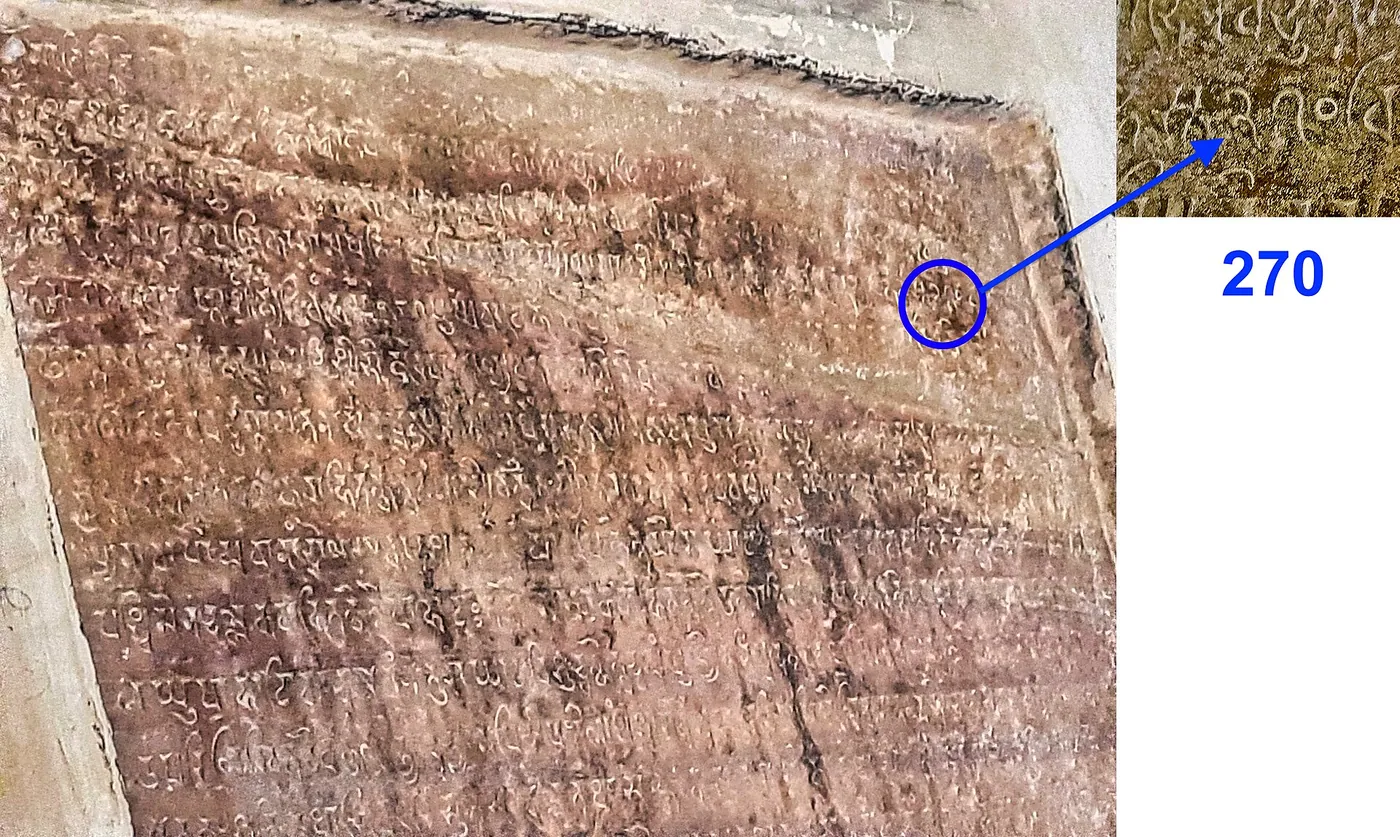
The elegance of place-value is that one sign means different magnitudes according to the place it occupies (in base ten, 2 is two in the units column, two hundred in the hundreds). But for place-value to work, a sign is needed to mark that a place is empty: zero. Zero as a placeholder was already nascent in Babylonian base-sixty, and the Mesoamerican Maya used it independently in their Long Count. To raise zero into a number, one that can be added, subtracted, multiplied, and stand as the result of a calculation, was carried furthest by Indian mathematics: around the 7th century Brahmagupta, in the Brahmasphutasiddhanta (628), first set out systematic rules for zero and negative numbers (though even he stumbled on "zero divided by zero"). This "zero plus place-value" passed west through the Arab world to become the core of the Hindu–Arabic numerals.
Connections
Consequences3
- Hindu–Arabic NumeralsenablesZero and place-value are the operative core that makes the numerals calculable
- AlgebraenablesPlace-value and zero provided the notational basis for symbolic algebra
- The Electronic ComputerenablesPlace-value notation underlies all mechanical and electronic calculation
Echoes3
- The Maya Calendar (Long Count)echoes · disputedThe Maya Long Count independently developed a positional zero, another cross-civilizational "something from nothing"
- Quipuechoes · disputedPlace value and an empty-position zero were realized independently in the Andean quipu, with no historical connection to the Old World
- Babylonian AstronomyechoesBabylonian sexagesimal place value echoes the Indian decimal place-value system
Sources
- Georges Ifrah, The Universal History of Numbers
- Robert Kaplan, The Nothing That Is: A Natural History of Zero
- 0 (number) — history
Open questionspartly uncertain
- It is established that Brahmagupta gave rules for calculating with zero in 628.
- Place-value placeholders appeared earlier (in Babylonian and some Maya material), but the mainstream view is that zero as a number was most fully developed in India.
- The dating of the Bakhshali manuscript, which uses a dot for zero, is disputed.
Why it matters
Zero is a philosophical puzzle disguised as a mathematical sign: to compute with "nothing" as if it were "something" took a conceptual leap—the hard part was never drawing the circle but daring to let emptiness enter arithmetic. This step was taken independently in different civilizations (Babylon, the Maya, India), to differing depths, and is a fine specimen of cross-civilizational parallelism: Mesoamerican priests, recording time, invented their own zero, unknown to and unknowing of the mathematicians of India. It reminds us that humanity's key ideas often have several sources, and need not, and should not, be conscripted into a single "west-to-east" or "east-to-west" line. Zero holds up the whole Hindu–Arabic numeral system and lays the ground for later algebra.