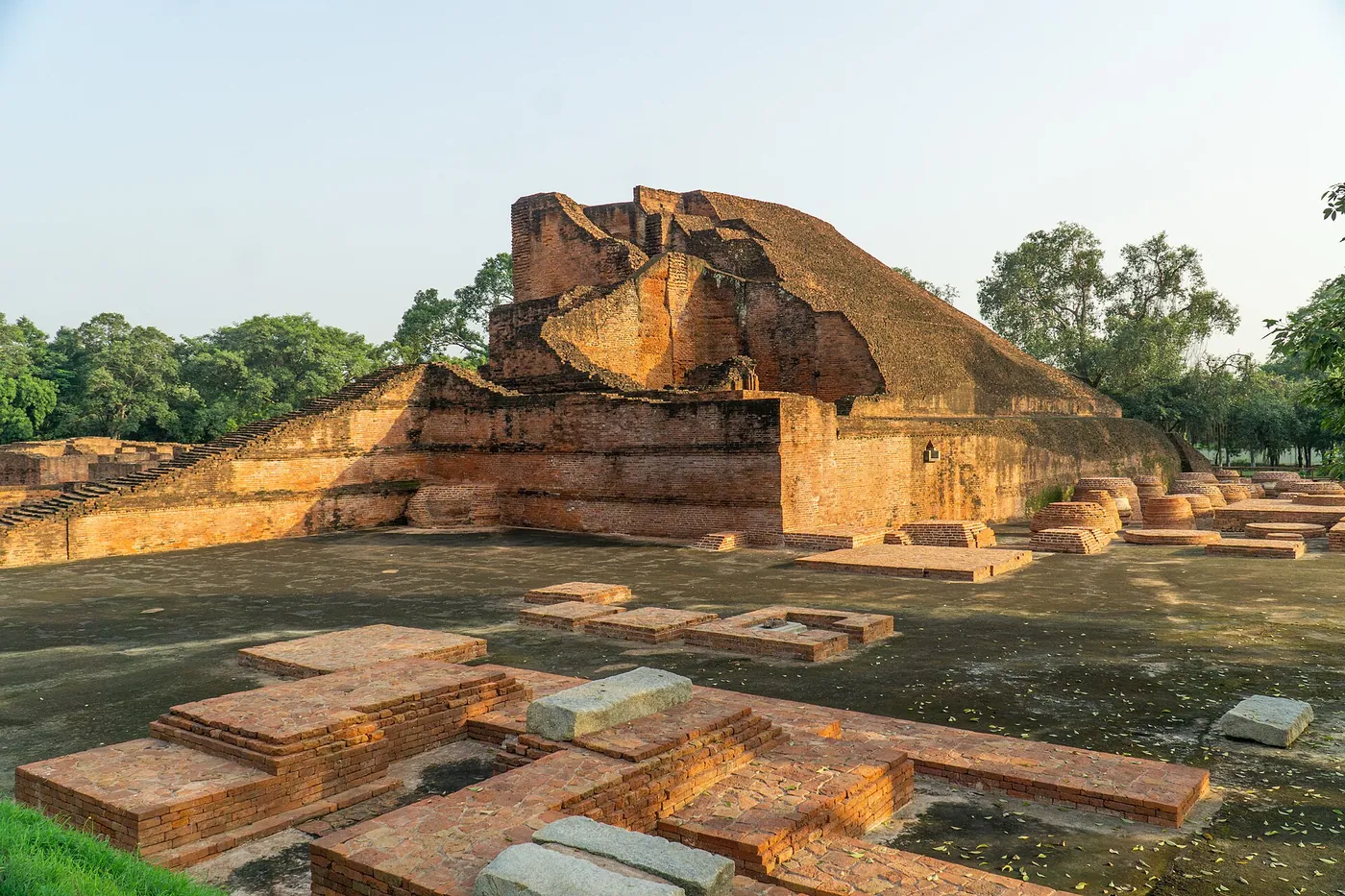
A great Buddhist monastic university in Bihar, India, endowed by the Gupta dynasty around the 5th century. At its height (7th century) it held several thousand monks and a curriculum spanning Buddhist doctrine, logic, grammar, medicine, and metaphysics. Xuanzang and Yijing studied here. Around 1193 it fell to the Turko-Afghan commander Bakhtiyar Khalji, its libraries burned. It is a seat of learning that echoes the Library of Alexandria across civilizations—and a road that ended.
Its monks numbered several thousand, all men of great talent and learning… of all the monasteries of India, this was the most magnificent.
—— Xuanzang, Records of the Western Regions, ch. 9 (on Nalanda)
History
Nalanda lay in the Magadha region of Bihar, endowed by the Gupta dynasty around the 5th century and enlarged by successive reigns into the largest and most famous Buddhist monastic university in South Asia. At its height (c. 7th century) it housed several thousand resident monks and many visiting scholars; its curriculum went far beyond Buddhist doctrine to logic, grammar, medicine, fine arts, and metaphysics—a comprehensive institution of higher learning. The Tang monk Xuanzang studied here for years, as did Yijing, and their accounts are precious first-hand sources for Nalanda today. It held great library halls. Around 1193 Nalanda fell to the Turko-Afghan commander Bakhtiyar Khalji; its monks scattered and its texts burned, and an institution that had run for over seven centuries was extinguished.
Connections
Echoes2
- The House of WisdomechoesNalanda and the House of Wisdom, centres of learning in different civilizations, invite comparison
- The Library of AlexandriaechoesThe Library of Alexandria and Nalanda, great centres of learning in different civilizations, invite comparison
Sources
- 玄奘《大唐西域记》
- (various), The History and Culture of Nalanda
- Nalanda mahavihara
Open questionspartly uncertain
- The mainstream view attributes its founding to the Gupta ruler Kumaragupta I (5th century).
- The size of its libraries and the story that they burned for months come from later accounts, and the figures cannot be verified.
- Its destruction by Bakhtiyar Khalji in 1193 is the traditional account, and the details are disputed.
Why it matters
Nalanda and the Library of Alexandria, thousands of kilometres apart and out of all contact, each independently pushed "gathering scholars and the world's texts under one patronage" to the limit of antiquity. Such cross-civilizational pairing is what anti-Whig history values: it reminds us that "university" and "library" are neither Europe's monopoly nor of single origin. Nalanda is, moreover, a road that ended: unlike Bologna or Paris, it did not carry its flame into the modern age but stopped short in a single conflagration. History is not fated toward the present; a school that ran for seven centuries can vanish leaving no heir. Nalanda's splendour and its sudden end belong to one history.