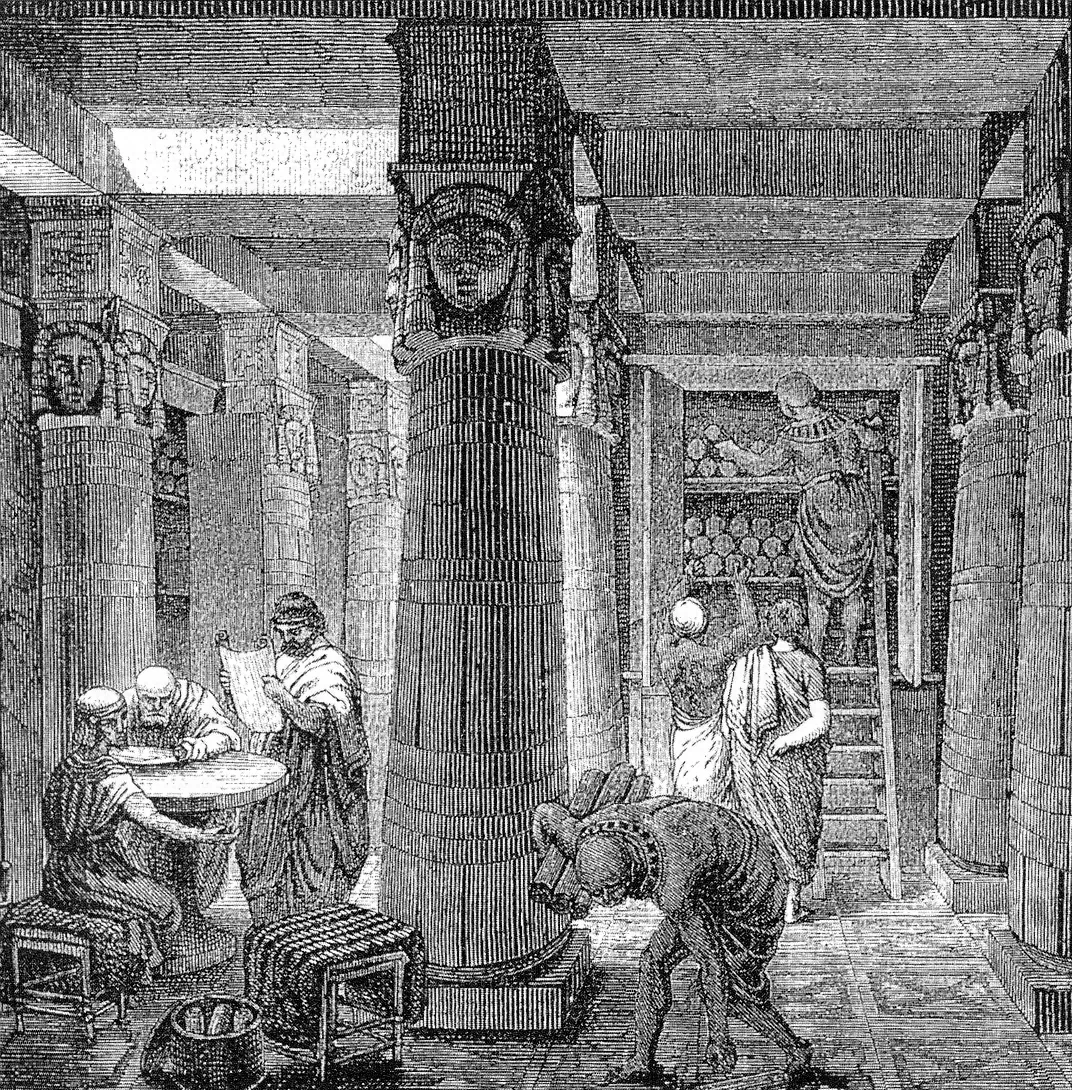
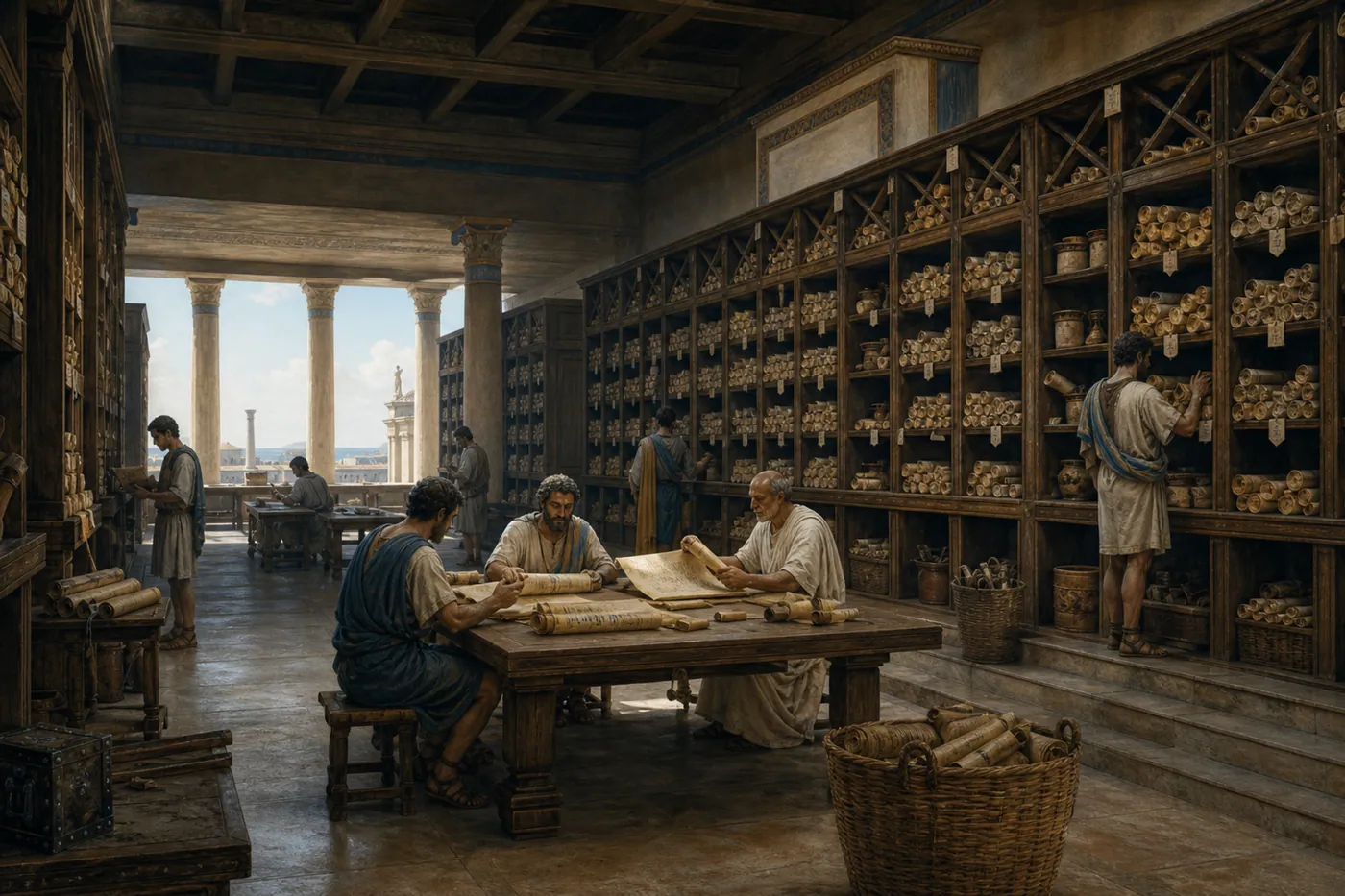
In the early 3rd century BCE the Ptolemies attached a Library to the Mouseion at Alexandria, gathering the manuscripts of the Greek-speaking world with near-state resources and supporting over a hundred scholars. Its "destruction" was no single blaze but a gradual decline across centuries (events of 145 BCE, 48 BCE, 272 and 391 CE); the popular myth of one catastrophic fire has been discarded by historians.
Demetrius of Phalerum, the president of the king's library, received vast sums of money, for the purpose of collecting together, as far as he possibly could, all the books in the world.
—— Letter of Aristeas §9 (pseudepigraphic, c. 2nd c. BCE)
History
The Library of Alexandria was founded in the early 3rd century BCE under the Ptolemies as part of the Mouseion (the "institution of the Muses," root of the word museum). The idea may have begun with Ptolemy I Soter, reportedly on the advice of Demetrius of Phalerum; the physical institution was built and expanded mainly under Ptolemy II Philadelphus. It gathered the manuscripts of the Greek-speaking world on a near-state scale; according to Galen, Ptolemy III Euergetes ordered that books aboard ships in the harbor be seized and copied, the originals kept and the copies returned to their owners. Its holdings cannot be verified—ancient sources speak of 200,000 or even 500,000 scrolls, modern estimates range from 40,000 to 400,000. It supported over a hundred scholars with food, lodging, and tax exemption; Euclid, Eratosthenes, and Aristarchus of Samothrace (a head librarian) worked here, and the science of cataloguing (Callimachus's Pinakes) was founded here.
Connections
Causes6
- Ptolemy I SoterpatronizedThe Library's conception and royal patronage began with Ptolemy I
- Demetrius of Phalerumcontributed · disputedAccording to the late Letter of Aristeas he advised on collecting books; his role is doubtful
- PapyrusenablesThe Library's scrolls were papyrus; Egyptian papyrus was its material precondition
- AristotleinspiresStrabo calls him the first collector of books and the teacher of the Egyptian kings in arranging a library
- Alexander the GreatenablesHe founded Alexandria in 331 BCE, the city that would house the Library
- Ptolemy II PhiladelphuspatronizedThe Library was largely built out and expanded under him
Consequences3
- Cataloguing (the Pinakes)enablesGave rise to the science of cataloguing
- EratosthenesinspiresHe became its head librarian; its holdings were his data for measuring and mapping the earth
- Claudius PtolemyinspiresPtolemy worked in Alexandria, heir to centuries of astronomy gathered there
Echoes3
- NalandaechoesThe Library of Alexandria and Nalanda, great centres of learning in different civilizations, invite comparison
- The House of WisdomechoesThe Library of Alexandria and the House of Wisdom, centres for gathering and translating knowledge in different eras, invite comparison
- The Timbuktu ManuscriptsechoesThe Library of Alexandria and the Timbuktu manuscripts, gatherings of knowledge in different civilizations, invite comparison
Sources
- Roy MacLeod (ed.), The Library of Alexandria
- Diana Delia, From Romance to Rhetoric (American Historical Review, 1992)
- Letter of Aristeas
Open questionspartly uncertain
- Accounts differ on whether Ptolemy I or Ptolemy II founded the Library; the mainstream view is that it was conceived under Ptolemy I and completed under Ptolemy II.
- The actual role of Demetrius of Phalerum is doubtful.
- The size of the collection cannot be established, with figures ranging from 40,000 to 400,000 scrolls.
- It is agreed that the Library's destruction was gradual and had several causes, and the idea of a single fire has been abandoned.
- The passage about Demetrius collecting "all the books in the world" comes from the pseudepigraphic Letter of Aristeas.
Why it matters
Of its "destruction," the most popular tale is one great fire, set by Caesar, by Christians, or by Muslims, depending on whom the teller wishes to blame. But the scholarly consensus is far less dramatic: the Library withered slowly across centuries. Ptolemy VIII's expulsion of scholars in 145 BCE, Caesar's fire reaching the dockside stores in 48 BCE, Aurelian's razing of the palace quarter in 272 CE, the destruction of the daughter library at the Serapeum in 391 CE—each blow was real, yet none was "the" fire. To lay the loss on a single act of barbarism both satisfies the fantasy of a golden age destroyed by savages and excuses us from asking about institutional decay. As a wonder, its costs deserve a level gaze too: this "temple of human knowledge" filled part of its shelves by royal confiscation (Galen's story of Ptolemy III seizing and copying the books on ships in harbor is one example); the ambition to gather the universal was also an ambition to requisition.