Second king of Ptolemaic Egypt (309–246 BCE; sole ruler from about 283). Under him the Library of Alexandria was greatly enlarged and the Pharos completed around 280 BCE, and tradition credits him with commissioning the Greek translation of the Torah.
Many there be that batten in populous Egypt, well-propped pedants who quarrel without end in the Muses' bird-cage.
—— Timon of Phlius (3rd century BCE), quoted in Athenaeus, Deipnosophists 1.22d, trans. C. B. Gulick (Loeb, 1927)
History
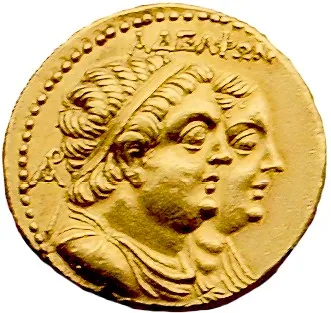
Ptolemy II, son of Ptolemy I Soter and Berenice I, was born on Kos in 309 BCE, made co-ruler around 285 and ruled alone from about 283 until his death in 246. He married first Arsinoe I, daughter of Lysimachus of Thrace, and then his full sister Arsinoe II; Philadelphus means "sibling-loving", and the couple were worshipped in their lifetime as the Sibling Gods. In the usual reconstruction the Library of Alexandria was conceived under Ptolemy I and built out under his son, when Callimachus compiled its catalogue, the Pinakes; the Pharos was completed around 280. The Letter of Aristeas, probably written in the second century BCE, says he brought 72 translators from Jerusalem who rendered the Law of Moses into Greek on the island of Pharos in 72 days. The details are legend, but the Pentateuch was indeed translated in third-century Alexandria. Callixenus of Rhodes described his Grand Procession through the capital, with a giraffe, a rhinoceros, a white bear and cages of parrots and peacocks. He also cleared the old canal from the Nile to the Red Sea, drained marshland in the Fayum to settle soldiers, and appeared on temple reliefs in the guise of a pharaoh.
Connections
Causes1
- Ptolemy I SoterinspiresMade him co-ruler around 285 BCE, continuing the royal patronage of learning
Consequences3
- The Library of AlexandriapatronizedThe Library was largely built out and expanded under him
- The Pharos of AlexandriapatronizedThe lighthouse was completed around 280 BCE
- Cataloguing (the Pinakes)patronizedCallimachus compiled the Pinakes in his reign
Echoes1
- al-Ma'munechoesTwo rulers, two cities of learning: royal patronage in Alexandria and in Baghdad
Sources
- R. H. Charles (ed.), The Letter of Aristeas, in The Apocrypha and Pseudepigrapha of the Old Testament, vol. II (1913)
- Athenaeus, The Deipnosophists, vols. I-II (Loeb Classical Library, trans. C. B. Gulick) (1927)
- Günther Hölbl, A History of the Ptolemaic Empire (2001)
- Paul McKechnie & Philippe Guillaume (eds.), Ptolemy II Philadelphus and his World (2008)
Open questionspartly uncertain
- The start of his co-regency and of his sole reign are reckoned differently, for instance as 285/284 or 283/282 BCE.
- Dates proposed for his marriage to Arsinoe II range from 279 to 273 BCE.
- How the founding of the Library was shared between Ptolemy I and Ptolemy II is only the prevailing inference.
- The story of the origin of the Septuagint comes from the later Letter of Aristeas.
- Galen attributes the story of books being seized from ships in port to be copied to Ptolemy III, not Ptolemy II.
- The date of the Grand Procession is uncertain, but it is usually placed in the 270s BCE.
Why it matters
Ptolemy II is often paired with al-Ma'mun of Baghdad: both made the gathering of books, the commissioning of translations and the keeping of scholars part of kingship. In Alexandria scholarship and spectacle followed one logic. The Library gathered the world's books, the procession paraded the world's beasts and treasure, the lighthouse announced the kingdom's wealth to every passing ship, and together they claimed that the dynasty held the known world. The patronage was real; for a century geometry, astronomy and philology received resources no Greek city could supply. But the scholars lived at the king's pleasure. Timon already called the Mouseion a bird-cage, and when Ptolemy VIII expelled the scholars in 145 BCE, Alexandrian learning scattered across the Mediterranean.