The lighthouse on the eastern tip of Pharos island at Alexandria, completed around 280 BCE and probably over 100 metres tall. It guided ships into harbour by day and by night for some sixteen centuries until earthquakes ruined it in the fourteenth century.
When the building was done, he inscribed on the actual masonry his own name, but covered this up with plaster, on which he then added the name of the reigning king. He knew that, as happened later, letters and plaster would fall off together, and reveal the words: SOSTRATUS SON OF DEXIPHANES OF CNIDUS ON BEHALF OF ALL MARINERS TO THE SAVIOUR GODS.
—— Lucian, How to Write History 62 (2nd century CE), trans. H. W. and F. G. Fowler (1905)
History
Pharos was a long island off Alexandria, joined to the mainland by a causeway seven stades long, and the tower stood on a rock at its eastern end. Ancient sources disagree on its date: Eusebius places it early in the reign of Ptolemy II, the Suda earlier, and most modern scholars think it was begun late in the reign of Ptolemy I and finished around 280 BCE. Strabo says it was dedicated for the safety of sailors by Sostratus of Cnidus, "a friend of the kings"; Pliny calls Sostratus the architect and gives the cost as 800 talents. Whether he designed the tower or paid for it is still debated. Posidippus, a contemporary poet, wrote that sailors could see the great fire on its summit all night long. Twelfth-century visitors such as al-Idrisi and al-Balawi describe three storeys, square, octagonal and cylindrical, from which modern estimates of more than 100 metres are derived. An earthquake in 956 brought down the top; the great earthquakes of 1303 and 1323 left it largely in ruins, and when Ibn Battuta returned in 1349 he could no longer enter it. In 1477 the Mamluk sultan Qaitbay built a fort on the site. Since 1994 Jean-Yves Empereur's French team has mapped thousands of blocks on the floor of the Eastern Harbour.
Connections
Causes2
- Ptolemy I Soterpatronized · disputedBy one account the lighthouse was begun late in his reign
- Ptolemy II PhiladelphuspatronizedThe lighthouse was completed around 280 BCE
Echoes1
- The Pyramids of GizaechoesTwo of the Seven Wonders of the ancient world, both in Egypt
Sources
- Strabo, Geography, vol. VIII: Book 17 (Loeb Classical Library, trans. H. L. Jones) (1932)
- Lucian, How to Write History, in The Works of Lucian of Samosata, vol. II (trans. H. W. and F. G. Fowler) (1905)
- Jean-Yves Empereur, Alexandria Rediscovered (1998)
- Judith McKenzie, The Architecture of Alexandria and Egypt, c. 300 B.C. to A.D. 700 (2007)
Open questionspartly uncertain
- Ancient sources disagree on when the tower was begun and completed.
- Whether Sostratus was the architect or the donor who dedicated the tower is disputed.
- Lucian's story of the name carved beneath the plaster is an anecdote.
- Its height is an estimate based on medieval descriptions.
- The claim that a mirror at the top could spot enemy ships or set them on fire is a medieval legend.
- Ancient lists of the "Seven Wonders" exist in many versions, and the lighthouse appears in only a few of them.
Why it matters
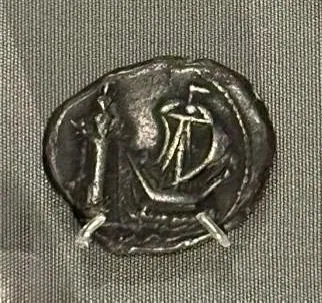
The tower answered a problem of terrain. The Nile delta coast is low, with no headland to steer by, and the harbour approaches are strewn with reefs; Strabo gives exactly this as the reason it was built. It combined height, masonry and a night fire into a public utility for the grain exports and Mediterranean trade of Ptolemaic Egypt, and it was also royal display. The "Saviour Gods" of its dedication could mean Ptolemy I and his queen, or the Dioscuri, protectors of sailors. The familiar list of Seven Wonders was fixed only in the sixteenth century; the list of Antipater of Sidon in the second century BCE gave its place to the walls of Babylon. Its influence outlasted the lists. Roman-era coins of Alexandria show it again and again, and French phare and Italian and Spanish faro all come from the island's name.