A general of Alexander (c. 367–283 BCE) who, after Alexander's death, took Egypt and in 305 BCE declared himself king, founding the Ptolemaic dynasty. He laid the foundation of the Mouseion and Library at Alexandria, reportedly on the advice of Demetrius of Phalerum, gathering the world's books with near-state resources. He also wrote a history of Alexander's campaigns that became one of Arrian's chief sources. The Library's "cause" was this system of royal patronage, not the man alone.
Since he was a king, mendacity would have been more disgraceful for him than for anyone else—so I hold his account the more trustworthy.
—— Arrian, Anabasis of Alexander, preface (on Ptolemy as a source)
History
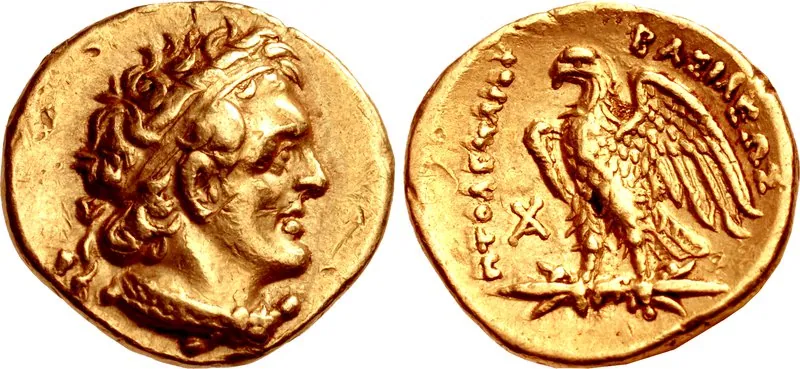
Ptolemy son of Lagos was among Alexander's most trusted generals. When Alexander died suddenly in 323 BCE and the empire split among his commanders, Ptolemy took Egypt and in 305 declared himself king, styled "Soter" (Saviour), founding a dynasty that ruled Egypt for nearly three centuries. In his new capital of Alexandria he built the Mouseion (a research institution supporting scholars) and its Library; by later sources such as the Letter of Aristeas, perhaps on the advice of Demetrius of Phalerum. Under his successors collecting became almost a state enterprise: according to Galen, under Ptolemy III books found aboard ships in the harbour were seized and copied, the originals kept and the copies returned. Ptolemy himself wrote history, an eyewitness account of Alexander's campaigns; though lost, it survives in part through Arrian's citations—and Arrian, on the ground that "a king would scorn to lie," ranked it among his most reliable sources.
Connections
Causes1
- Alexander the GreatinspiresPtolemy was his bodyguard and general, and took Egypt when the empire was divided
Consequences4
- The Library of AlexandriapatronizedThe Library's conception and royal patronage began with Ptolemy I
- Ptolemy II PhiladelphusinspiresMade him co-ruler around 285 BCE, continuing the royal patronage of learning
- Euclidpatronized · disputedAccording to Proclus, Euclid flourished in Alexandria under Ptolemy I
- The Pharos of Alexandriapatronized · disputedBy one account the lighthouse was begun late in his reign
Sources
- Arrian, Anabasis of Alexander
- Roy MacLeod (ed.), The Library of Alexandria
- Ptolemy I Soter
Open questionspartly uncertain
- The mainstream view is that the Library was conceived under Ptolemy I and largely completed under Ptolemy II.
- The claim that Demetrius of Phalerum proposed the scheme is doubtful.
- His birth year of about 367 BCE is an estimate with a margin of uncertainty.
Why it matters
Ptolemy I stood to the Library as patron to beneficiary. The Library was not "his invention" but something he sustained with royal power and treasury—the real "cause" was the patronage system that folded scholarship into state expenditure, the man merely its initiator and figurehead. This also shows the double face of the Library: the ambition to gather the world's books was also the ambition to requisition them (under Ptolemy III, Galen reports, books found on ships in the harbour were seized and copied). The universal ideal of knowledge and the imperial appetite for possession were, in this Library, two sides of one coin.